
At its core, commercial real estate investing means acquiring income-producing or business-use properties — office buildings, retail centers, warehouses, multifamily complexes — with the goal of generating rental income, appreciation, or both. The mechanics differ significantly from buying a home, and understanding those differences is the starting point for anyone serious about this asset class.
This guide covers the property types, benefits and risks, a step-by-step process for getting started, capital requirements, and the financial metrics you'll need to evaluate any deal.
TLDR: Key Takeaways
- CRE includes office, retail, industrial, multifamily, and specialty properties — each with a distinct risk/return profile
- Higher income potential and longer leases make CRE attractive, but it demands more capital and expertise than residential investing
- Entry points range from a few hundred dollars (public REITs) to $25,000–$100,000+ (private syndications) to $400,000+ (direct ownership)
- Individual warehouse unit ownership offers a lower-cost entry point, often financeable through SBA loans or conventional mortgages
- Defining your goals upfront and vetting every deal with thorough due diligence are what separate profitable CRE investments from costly mistakes
What Is Commercial Real Estate Investing?
CRE investing means acquiring properties used for business or income-generating purposes, where profit comes from tenant rents, property appreciation, or a combination of both. The key distinction from homeownership: you're buying for income and wealth-building, not personal use.
Two differences from residential real estate matter most to beginners:
- Tenants are businesses, not individuals. Income is tied to business performance rather than household budgets, which changes the risk profile considerably.
- Leases are much longer — typically 3–20 years compared to the standard 12-month residential lease. This provides better income predictability, but also creates more complexity when a lease expires or a tenant vacates.
Active vs. Passive Participation
CRE offers two fundamentally different ways to participate:
- Active investing — you own, manage, or directly oversee the property. Higher control, higher workload.
- Passive investing — you allocate capital to a sponsor, fund, or REIT that handles all operations. Most first-time investors find this significantly more manageable.
For most beginners, passive investing is the practical starting point — it limits operational burden while you build familiarity with how CRE deals actually work.
Types of Commercial Real Estate
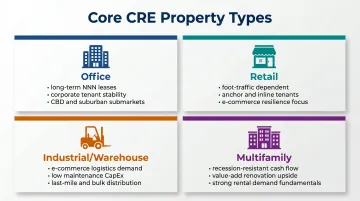
The Four Core Property Types
| Property Type | Investment Characteristics |
|---|---|
| Office | Longer leases; significant tenant improvement costs; remote work trends affecting demand |
| Retail | Anchor tenants (like grocery stores) stabilize income; e-commerce pressure on weaker centers |
| Industrial/Warehouse | Simple build-outs, lower ongoing capital expenditure, strong demand from logistics and e-commerce |
| Multifamily (5+ units) | Steady demand — housing is a basic need; CBRE's H2 2025 Cap Rate Survey ranks multifamily #1 for expected 10-year investment performance |
Specialty categories — self-storage, hospitality, mixed-use, data centers — also attract investors, but typically require specialized market knowledge before entering.
Why Industrial Stands Out for New Investors
Industrial and warehouse properties have become a standout sector for a straightforward reason: they're simpler to operate. Lower tenant improvement costs and strong tenant demand driven by supply chain and e-commerce growth make the math cleaner for first-time investors.
U.S. industrial vacancy held at 7.5% in Q1 2026 with absorption expected to push rates lower as new construction slows — a positive supply/demand signal for existing owners.
That dynamic creates an opening for small business owners who want more than just market exposure. Owning a warehouse unit delivers two things at once: a functional workspace and a real estate asset building equity.
Personal Warehouse® develops customizable warehouse units across multiple U.S. states — including an active project in Bozeman, MT — with ownership structures supported by SBA 504 and 7(a) financing, making entry far more accessible than purchasing an entire commercial building outright.
Property Class: A, B, and C
Understanding property class helps you quickly assess risk/return before diving into full due diligence:
- Class A — Newer, prime locations, highest rents, stable income, lower yields. Best for risk-averse investors.
- Class B — Solid fundamentals, some deferred maintenance, value-add potential. Often the sweet spot for active investors.
- Class C — Older or secondary locations, lowest prices, highest management intensity. Higher risk, potentially higher return.
Classifications are relative to each local market — a Class A property in a secondary city may look like Class B in a primary market.
Benefits and Risks of Investing in Commercial Real Estate
Key Benefits
Higher income potential. Commercial rents typically exceed residential rents per square foot, and multi-tenant buildings multiply income streams across a single investment.
Longer lease terms. Income stability is built in: commercial leases typically run 3–10+ years with rent escalations that residential investing rarely matches.
Portfolio diversification. REITs have shown an imperfect correlation of 0.56 with the S&P 500 over a 20-year period, meaning CRE tends to move at least partially independent of equity markets.
Tax advantages. IRS Publication 946 confirms that nonresidential real property depreciates over 39 years using the straight-line method under MACRS — a substantial deduction that improves after-tax returns. Investors can also defer capital gains through 1031 exchanges: replacement property must be identified within 45 days and the exchange completed within 180 days.
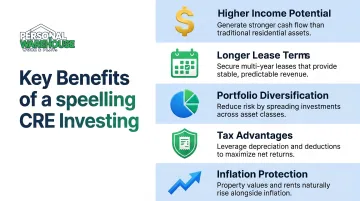
Inflation protection. Commercial leases often include rent escalation clauses, and property values historically track or outpace inflation over time.
Each of these benefits comes with a corresponding risk — and understanding both sides is what separates informed investors from overexposed ones.
Primary Risks
- Market volatility — economic downturns increase vacancy and suppress rents. U.S. office vacancy sat at 18.6% in Q1 2026, a direct consequence of pandemic-era demand shifts.
- Tenant risk — business failures, lease defaults, or long vacancy periods can dramatically cut income.
- Financing complexity — commercial loans typically require 20–30% down payments, stricter underwriting, and shorter loan terms than residential mortgages.
- Illiquidity — most private CRE deals are locked in for 3–10 years. There's no quick-sale option when market conditions turn.
- High upfront costs — beyond the down payment, budget for closing costs, reserves, tenant improvements, and ongoing maintenance.
Mitigating these risks starts with a disciplined approach:
- Conduct thorough due diligence before committing capital
- Work with professional property management
- Diversify across property types or geographies
- Choose experienced co-sponsors if investing passively
How to Get Started: A Step-by-Step Guide
Step 1: Define Your Investment Goals
Before looking at a single property, get clear on four things:
- Return objective — income now, capital growth later, or a blend of both?
- Risk tolerance — stable stabilized assets, or value-add projects with more upside and more risk?
- Time horizon — CRE typically requires a 3–10+ year commitment
- Involvement level — active management or passive capital allocation?
These answers filter every decision that follows.
Step 2: Learn the Fundamentals
Three areas of knowledge matter most before your first deal:
- Lease structures — a gross lease means the landlord covers most property expenses; a triple-net (NNN) lease shifts taxes, insurance, and maintenance to the tenant. NNN leases are common in industrial and retail and typically mean lower landlord management burden.
- How lenders underwrite CRE — they assess the property's income potential, not just your credit score. Understanding debt service coverage ratio (DSCR) matters.
- Core financial metrics — NOI, cap rate, cash-on-cash return, and IRR (detailed in the final section).
Industry publications, local commercial real estate associations (NAIOP, CCIM), and networking with experienced investors are solid starting points.
Step 3: Secure Financing
Main commercial financing options:
| Loan Type | Best For | Key Terms |
|---|---|---|
| Conventional commercial mortgage | Stabilized acquisitions | 20–30% down, 15–30 year amortization |
| SBA 7(a) | Owner-occupied businesses; flexible uses including equipment and working capital | Up to $5M; 25-year real estate terms |
| SBA 504 | Owner-occupied; fixed-rate financing with low down payment | Up to $5.5M; as low as 10% down; 10/20/25-year terms |
| Bridge loan | Value-add acquisitions | Short-term (6–36 months), higher rates |
For passive investors, "financing" simply means deciding how much capital to allocate to a REIT, syndication, or crowdfunding platform.
One distinction worth understanding: recourse loans allow lenders to pursue your personal assets on default; non-recourse loans limit lender recovery to the property itself. Non-recourse typically requires lower LTV ratios and carries slightly higher rates.
Step 4: Build Your Professional Team
Commercial deals are more complex than residential transactions. A reliable team includes:
- Commercial real estate broker — market research, deal sourcing, negotiation
- Real estate attorney — contract review, regulatory navigation
- CPA or accountant — tax strategy, financial reporting, depreciation modeling
- Property manager — day-to-day operations, tenant relations, maintenance
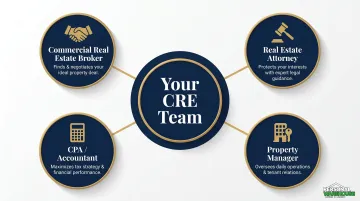
Passive investors can skip building this team individually — a vetted sponsor or operator covers all of these roles on your behalf.
Step 5: Find and Vet Properties
Where to search:
- LoopNet and CREXi — largest online marketplaces for listed CRE
- Broker networks — the best off-market deals rarely hit public platforms
- Crowdfunding platforms (CrowdStreet, RealtyMogul) — for passive opportunities
Due diligence checklist:
- Physical inspection of the property
- Review of existing leases and rent rolls
- Local market analysis (vacancy rates, rent trends, new supply pipeline)
- Environmental and structural assessments
- Seller's financial statements (at least two to three years)
Skipping due diligence is the single most common mistake first-time CRE investors make — and the one most likely to turn a promising deal into a costly problem.
Step 6: Analyze the Deal and Make an Offer
Run your financial models before submitting anything — confirm the deal meets your return targets using the metrics covered in the final section of this guide.
Offers typically begin with a Letter of Intent (LOI) outlining broad terms, followed by a Purchase and Sale Agreement with detailed legal language. Commercial contracts contain far more variables than residential agreements — have your attorney review everything before signing.
How Much Capital Do You Need?
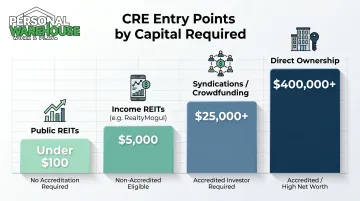
Entry costs vary dramatically depending on the investment vehicle:
| Vehicle | Minimum Investment | Accreditation Required? |
|---|---|---|
| Public REITs (via brokerage) | Under $100 (one share) | No |
| RealtyMogul Income REIT | $5,000 | No |
| CrowdStreet (individual deals) | $25,000+ | Yes (accredited investors) |
| Direct property acquisition | 20–30% down + reserves | N/A |
For direct ownership, a $1.5M commercial property could require $400,000–$500,000 in equity when you factor in down payment, closing costs, and initial reserves.
Beginners with limited capital shouldn't stretch into direct ownership before building foundational knowledge. Starting with a public REIT or a small syndication lets you learn the asset class with lower stakes and no management burden.
There's also a middle path between REITs and full building ownership: individual commercial warehouse or flex-space units, like those offered by Personal Warehouse, can be purchased using SBA 504 or 7(a) financing. These loan programs typically carry lower down payment requirements than a conventional commercial mortgage, giving small business owners a realistic path into CRE ownership without taking on an entire building.
How to Evaluate a CRE Deal
Key Financial Metrics
Every beginner needs to know these four before analyzing any deal:
Net Operating Income (NOI) Total rental income minus operating expenses (excluding debt service). The foundation of commercial property valuation. Example: $200,000 gross rent − $60,000 operating expenses = $140,000 NOI
Cap Rate NOI divided by purchase price. Used to compare relative yields across deals. Example: $140,000 NOI ÷ $2,000,000 purchase price = 7.0% cap rate
Cash-on-Cash Return Annual pre-tax cash flow divided by total equity invested. Shows what your capital earns each year. Example: $50,000 annual cash flow ÷ $500,000 equity = 10% cash-on-cash return
Internal Rate of Return (IRR) The annualized return over the full investment period, accounting for the timing of all cash flows including the eventual sale. Because it factors in when cash flows occur — not just how much — IRR lets you compare deals with different hold periods on equal footing. Example: A 5-year hold returning $800,000 on a $500,000 equity investment might show a 9.8% IRR, depending on the timing of distributions.
Once you understand what the numbers mean, the next step is matching them to a strategy that fits your risk tolerance.
Investment Strategies by Risk Profile
| Strategy | Risk Level | Target Return | Who It's For |
|---|---|---|---|
| Core | Low | 7–10% | Stabilized, fully leased assets; income-focused investors |
| Core-Plus | Moderate | 9–12% | Quality assets with minor improvement opportunities |
| Value-Add | Medium-High | 12–18% | Properties needing renovation or lease-up |
| Opportunistic | High | 18%+ | Ground-up development, distressed assets |
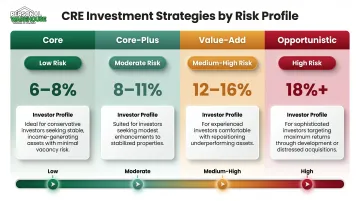
First-time investors are generally better served starting with core or core-plus strategies before moving up the risk spectrum.
For passive investors, vet any sponsor's track record across multiple market cycles — not just the most recent bull run. Ask specifically how their deals performed during 2008–2009 or 2020 — periods that separated disciplined operators from those who relied on rising markets to paper over weak underwriting.
Frequently Asked Questions
How much money do you need to invest in commercial real estate?
Entry points range widely. Public REITs are accessible for under $100; private syndications like CrowdStreet require $25,000 minimum for accredited investors; direct property ownership typically demands $400,000–$600,000+ in equity depending on asset size and market.
What type of commercial real estate is most profitable?
Industrial and multifamily are consistently cited as top performers — industrial from e-commerce demand, multifamily from persistent housing needs. That said, profitability depends heavily on market conditions, property class, location, and execution quality.
Is it worth it to invest in commercial real estate?
With the right education, due diligence, and a strategy matched to your risk tolerance, CRE can deliver higher income, long-term appreciation, and real portfolio diversification. It's not a passive play — preparation drives results.
How do you analyze a commercial real estate market?
Study local employment growth, population trends, vacancy and absorption rates, new supply in the pipeline, and comparable rents. Tools like CoStar, LoopNet, and local broker reports are your primary data sources.
What does a commercial real estate investment broker do?
A CRE broker researches the market for suitable properties, analyzes deal economics, negotiates purchase terms, and taps their network to find both on-market and off-market opportunities. On the buy side, they work on your behalf.
Is there a site like Zillow for commercial property?
LoopNet and CREXi are the closest equivalents — searchable listings with asking prices, lease rates, and property details. CoStar is the institutional-grade platform used by brokers and investors for in-depth market analytics and is subscription-based.