If you've ever wondered how a business can own a building without owning the land beneath it, you're already asking the right question.
This article covers everything you need to know: what a ground lease is, how it works mechanically, the two main types, who benefits (and how), real-world examples ranging from Macy's to warehouse ownership, and what happens when the lease eventually ends.
TL;DR
- A ground lease splits land and building ownership: the landlord retains the land while the tenant owns any improvements built on it
- Terms typically run 50 to 99 years, structured similarly to triple-net (NNN) leases
- Two types exist: subordinated (tenant-friendly financing, higher risk for landlord) and unsubordinated (landlord retains full priority, harder tenant financing)
- Tenants access prime locations without buying land; landlords generate long-term income without selling assets
- At expiration, improvements typically revert to the landlord, so early renewal planning is critical
What Is a Ground Lease?
A ground lease is a long-term agreement in which a tenant leases land only — not any structure on it — for an extended period, typically 50 to 99 years. During that time, the tenant has the right to construct, own, and operate improvements on that land.
As Holland & Knight's December 2025 analysis explains, this creates "a legal separation between the ownership of the land, known as the fee interest, and the ownership of the improvements, known as the leasehold interest."
The Ownership Split
This distinction matters enormously — legally and financially:
- The landlord (lessor) retains fee ownership of the land throughout the entire lease term and beyond
- The tenant (lessee) owns any buildings or improvements they construct during the lease period
- When the lease ends, ownership of those improvements typically transfers back to the landlord
That ownership split shapes how ground leases are structured — and why tenants take on nearly all property-related costs in return for the right to build and control what sits on the land.
The NNN Structure
Ground leases are generally structured as true triple-net (NNN) leases. That means the tenant takes on responsibility for virtually all property-related costs — not just rent. These typically include:
- Property taxes
- Insurance premiums
- Maintenance and repairs
- All operating costs
The landlord collects rent and retains land ownership — nothing more. For tenants, this means carrying more financial responsibility upfront, but it also grants substantial control over how the property is used, developed, and managed throughout the lease term.
How a Ground Lease Works
The Basic Mechanics
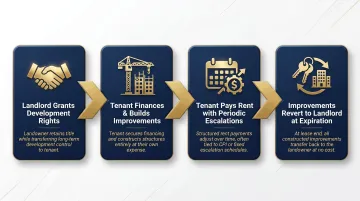
A ground lease follows a consistent sequence:
- The landlord grants development rights — the tenant receives the right to build on and use the land
- The tenant finances and constructs improvements at their own expense
- Rent is paid throughout the lease term — often with periodic escalations
- At expiration, ownership of all improvements reverts to the landlord (unless otherwise negotiated)
Rent Escalation Clauses
Because ground leases span decades, most include provisions for periodic rent increases. Two structures are common:
| Type | How It Works | Benefit |
|---|---|---|
| Fixed percentage | Set increase annually (often ~3%) | Predictability for both parties |
| CPI-indexed | Tied to Consumer Price Index changes | Tracks real-world inflation |
Some leases combine both approaches with a cap on maximum annual increases, balancing landlord income growth against tenant budgeting predictability.
Leasehold Financing
Since the tenant doesn't own the land, a traditional mortgage isn't available. Instead, tenants can seek a leasehold mortgage — a loan secured by their ground lease interest rather than the land itself.
For a ground lease to be financeable, lenders typically require:
- Lease term exceeding the loan term by at least 10–20 years (often 25–30 years minimum remaining)
- Lender cure periods that extend beyond the tenant's own cure period
- Written notice of default sent directly to the lender
- Right to a new lease if the ground lease terminates, allowing the lender to step in
Personal Warehouse, for example, works with preferred lenders experienced with SBA 504 and 7(a) loans for their owner-occupied warehouse units on 99-year ground leases — giving small business owners and buyers a practical path into commercial real estate ownership.
Assignment Rights
Leasehold financing terms often intersect with how interests can be transferred. Most ground leases allow tenants to transfer their leasehold interest to another party — and that transfer can be structured two different ways:
- Assignment transfers the tenant's entire interest — creating a direct relationship between the new tenant and landlord
- Sublease grants an interest less than the tenant's full interest — the original tenant remains on the hook
Even after a full assignment, the original tenant may retain some residual liability depending on lease language. Before reselling a unit or business, confirm with legal counsel whether the lease includes a landlord consent requirement or a formal release clause.
Types of Ground Leases: Subordinated vs. Unsubordinated
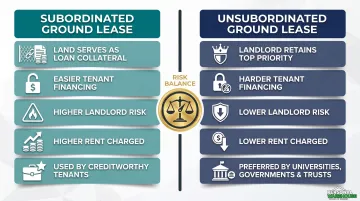
Whether a ground lease is subordinated or unsubordinated determines who bears the most risk — and directly affects rent levels, financing access, and what happens if the tenant defaults.
Subordinated Ground Leases
In a subordinated lease, the landlord agrees to allow their ownership interest in the land to serve as additional collateral for the tenant's construction or improvement loan. If the tenant defaults, the lender can pursue the land itself.
- Tenants find it significantly easier to secure financing
- Landlords take on greater risk of losing the land to foreclosure
- Landlords typically charge higher rent to compensate for that risk
Unsubordinated Ground Leases
In an unsubordinated lease, the landlord retains top priority. Lenders cannot foreclose on the land if the tenant defaults — only the leasehold interest (the improvements) serves as collateral.
- Landlords are fully protected from foreclosure risk
- Tenants face more difficulty securing financing (lenders have less collateral)
- Landlords typically charge lower rent because their risk is minimal
When Each Type Is Used
- Subordinated leases are more common when tenants are creditworthy and lenders need additional collateral to approve the loan
- Unsubordinated leases are preferred by government agencies, universities, and family trusts — entities often legally restricted from putting their land at risk
- Developer-structured leases (such as those used for warehouse condos and similar ownership models) typically follow unsubordinated structures to protect the underlying land asset while still enabling unit financing
The University of Texas System, Battery Park City Authority (a New York State public benefit corporation), and various family trusts all operate as ground lease landlords using unsubordinated structures. Each retains fee ownership of the land while enabling development above it.
Advantages and Disadvantages of a Ground Lease
Advantages for Tenants
Access without the capital burden. The biggest benefit is access to high-value or prime-location land without the cost of purchasing it outright. No down payment on land is required — that capital stays available for construction, operations, or expansion.
Tax benefits worth knowing:
- Ground lease rent may be deductible as an ordinary and necessary business expense under IRC Section 162
- Tenants can depreciate the cost of improvements they construct — commercial property carries a 39-year MACRS recovery period under IRS Publication 946
Advantages for Landlords
Landlords retain land ownership indefinitely while generating a steady, growing income stream. Key advantages include:
- Earn rising rental income through escalation clauses — no development funding required
- Avoid triggering a capital gains event by leasing rather than selling the land
- Retain the asset at lease end, including any improvements the tenant constructed
Disadvantages to Consider
For tenants:
- Risk of losing the building and all improvements at lease expiration if renewal isn't negotiated
- Negotiating leverage shifts strongly toward the landlord as the expiration date approaches
- Leasehold interests with fewer than 20 years remaining can become difficult to sell or finance
For landlords:
- Poorly drafted leases can result in loss of control over property use and development quality for 50–99 years
- Inadequate rent escalation terms may fail to keep pace with actual land value growth
- Disputes over maintenance responsibilities and compliance can be costly to resolve
Real-World Examples of Ground Leases
Ground leases aren't limited to Manhattan towers. They appear across retail, industrial, and storage sectors.
Major Retailers
McDonald's explicitly identifies ground leases as its primary real estate strategy, carrying $15,506M in buildings on leased land and $12,488M in operating lease liabilities. That structure fuels its franchise-landlord business model, which generates over $10B annually in rent revenue.
Macy's uses the structure more selectively: 83 of its 680 stores operate on ground leases (77 Macy's branded, 6 Bloomingdale's), with total operating lease liabilities of $3,279M per its most recent 10-K. Starbucks takes a comparable approach, using 20-year primary terms to secure prime retail locations without tying up capital in land.
Warehouse, Storage, and Industrial Real Estate
Ground leases work well in industrial real estate because they lower entry costs by eliminating upfront land acquisition. Warehouse operators, storage facilities, distribution centers, and truck parking operations all use this structure for exactly that reason.
Personal Warehouse applies this model to make warehouse ownership accessible to individual buyers. Under a 99-year ground lease structure, buyers own their unit outright (Personal Warehouse®, Professional Work Suite, RV and boat storage, or specialty space) without purchasing the underlying land, keeping acquisition costs significantly lower than fee-simple ownership.
The target buyers span several groups:
- Small business owners needing dedicated workspace for fabrication, distribution, or creative work
- Collectors and hobbyists protecting classic cars, antiques, or recreational equipment
- RV and boat owners who want owned, secure storage rather than indefinite rental payments
- Real estate investors looking for commercial assets that are easy to lease and built to appreciate
Current projects are under construction in Belgrade, MT (near Bozeman), with additional markets across Montana, North Carolina, Georgia, Texas, and other states.
Government, University, and Trust Landlords
These entities are the most common unsubordinated ground lease landlords:
- University of Texas System : uses ground leases as an institution of "perpetual duration," retaining land for future repurposing
- Battery Park City Authority : a NY State public benefit corporation that retains fee ownership while leasing to developers, funding public parks and affordable housing with the proceeds
- U.S. Army : actively exploring ground leases for data center development at Fort Hood, Fort Bliss, and other installations
- Family trusts : frequently act as ground lease landlords to generate income without triggering a land sale
What Happens When a Ground Lease Expires?
The default outcome is straightforward and consequential: at expiration, the land and all improvements — every building the tenant constructed — revert to the landlord at no additional cost, free and clear of all liens. In some cases, leases require tenants to demolish improvements before the term ends rather than transferring them.
This is the central risk of ground lease tenancy — a valuable asset built over decades becomes the landlord's property the moment the term ends.
Don't Wait to Address Renewal
McLane Middleton's analysis recommends tenants begin negotiating renewals when 30 to 40 years remain on the lease. The reasoning is practical: a leasehold interest with fewer than 20 years remaining often becomes difficult to sell or finance — lenders won't touch it, and buyers won't want it.
Waiting until the final decade puts tenants in the weakest position — the landlord already knows the building will revert shortly anyway. To protect your investment:
- Start renewal negotiations 30–40 years before expiration, not 10
- Explore buyout options early, when the landlord still has incentive to negotiate
- Ensure leasehold financing remains viable by maintaining a long remaining term
Frequently Asked Questions
What's the difference between a lease and a ground lease?
A standard lease typically covers both land and an existing building — the landlord owns the structure and the tenant simply uses it. A ground lease covers land only; the tenant constructs and owns any buildings on that land during the lease period.
Who owns the land in a ground lease?
The landlord (lessor) retains ownership of the land throughout the entire lease term and beyond. Even though the tenant owns the buildings or improvements they build, the land itself never changes hands.
Is a ground lease considered real property?
The land is the landlord's real property (fee interest). The tenant holds a leasehold interest — a legally recognized property interest that can be mortgaged, assigned, or insured, but is distinct from fee ownership of real property.
What are the different types of ground leases?
The two main types are subordinated (the landlord allows their land interest to serve as loan collateral, enabling easier tenant financing but at higher risk) and unsubordinated (the landlord retains top priority, protecting the land from foreclosure but making tenant financing harder to secure).
Why would anyone do a ground lease?
Landlords generate long-term income without selling their land. Tenants access prime locations they couldn't otherwise afford to buy outright — a trade-off that works for both sides across retail, industrial, and storage real estate.
Is a ground lease a good investment?
For landlords, ground leases provide stable long-term income and eventual ownership of improved property. Tenants gain access to high-value locations without purchasing land. The main risks — rent escalations and end-of-term reversion — are manageable with thorough legal review before signing.