Neither path is universally right. The decision hinges on where the business sits in its lifecycle, how stable its revenue is, and how much capital it can commit without gutting operating reserves. This guide breaks down how each option actually works, what it costs, and which situations favor one over the other.
TL;DR
- Leasing preserves cash upfront and allows easier relocation, but builds no equity and exposes you to rent increases at renewal
- Buying builds long-term equity and stabilizes costs, though it demands a large down payment and stronger financial qualifications
- Leasing suits early-stage, fast-growing, or location-flexible businesses; buying fits established businesses with stable revenue and predictable space needs
- Ownership models like warehouse condominiums and ground leases offer a middle path: equity benefits with lower upfront costs than a traditional purchase
Buying vs. Leasing: Quick Comparison
| Factor | Leasing | Buying |
|---|---|---|
| Upfront Cost | Security deposit only | 10–35% down payment |
| Monthly Payments | Typically higher relative to property value | Fixed mortgage; builds equity |
| Equity | None | Builds with every payment |
| Flexibility | Easy exit at lease end | Selling takes 5–10 months |
| Modifications | Requires landlord approval | Full owner discretion |
| Tax Benefits | Rent deductible as business expense | Depreciation, mortgage interest, cost segregation |
On the financing side, SBA 504 loans require as little as 10% down for established businesses (15% for businesses under two years old), while conventional commercial mortgages typically require 20–35% down with LTV ratios of 65–80. For a small business with limited capital, that difference can determine whether buying is a realistic option right now — or something to plan toward.
The financing picture is only part of the equation — tax treatment adds another layer to consider. Tenants deduct rent as a business expense in the year paid, per IRS guidelines. Owners access a different set of advantages: the IRS allows nonresidential real property to be depreciated over 39 years under MACRS, and cost segregation studies can reclassify certain building components into 5-, 7-, or 15-year asset categories — accelerating deductions significantly.
How Leasing Commercial Real Estate Works
A commercial lease grants temporary occupancy rights for an agreed term — typically three to five years for most property types, with industrial and warehouse leases often running longer. At expiration, you renew, renegotiate, or move on.
The Three Lease Structures You'll Encounter
The structure of the lease determines who pays for what beyond base rent:
- Full-service (gross) lease — You pay one fixed monthly amount; the landlord covers property taxes, insurance, utilities, and maintenance. Higher payment, but simpler to budget
- Triple net (NNN) lease — You pay base rent plus property taxes, insurance, and maintenance costs. Lower base payment, but your total monthly cost varies and can climb
- Modified gross lease — You pay base rent plus a fixed contribution toward operating expenses. Gives cost predictability without absorbing full operating risk
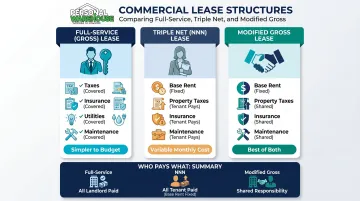
For most small businesses, a modified gross lease strikes the most workable balance — you know your monthly spend without those costs being folded into rent increases at renewal.
Pros and Cons of Leasing
Advantages:
- Low barrier to entry — security deposit versus a six-figure down payment
- Relocate when the lease expires without the complexity of selling a property
- The landlord handles some or all maintenance, depending on your lease type
Drawbacks:
- Zero equity accumulation — every dollar paid is gone
- Rent escalations at renewal can disrupt financial planning
- Any meaningful customization requires written landlord approval, which may come with restoration obligations at lease end
Before signing, understand the qualification bar. Commercial landlords commonly require personal or business credit scores of 700 or higher, according to Legal Templates' commercial tenant screening guidance. Newer businesses with limited credit history may face higher deposit requirements or personal guarantee requests to offset perceived risk.
How Buying Commercial Real Estate Works
Purchasing commercial property follows a familiar arc: agree on price and terms, move through escrow, and take title. Most small business buyers finance the purchase rather than paying cash.
Financing Options Worth Knowing
SBA 504 Loans are the most favorable option for owner-occupants. The structure splits the financing: a third-party lender covers 50%, an SBA-backed Certified Development Company covers up to 40%, and the borrower contributes a minimum 10% down payment. Loan terms run 10, 20, or 25 years at fixed rates. The business must occupy at least 51% of an existing building. Full details at SBA.gov.
SBA 7(a) Loans are more flexible in use — they can cover real estate, equipment, and working capital — with terms up to 25 years for real estate and a maximum loan amount of $5 million.
Conventional commercial mortgages typically demand 20–35% down with amortization periods up to 25 years. The higher capital requirement makes these harder for businesses without substantial reserves.
Alternative ownership models lower the barrier further. Personal Warehouse's warehouse condominium units, for example, use a 99-year ground lease structure: buyers own the physical unit while leasing the underlying land, which removes land acquisition cost from the equation. Financing is available through preferred lenders with terms comparable to residential loans, and units qualify for SBA 504 and 7(a) financing.
For trades businesses, light manufacturers, or distributors who need owned space but can't absorb the capital required for a traditional commercial purchase, this model is worth a close look.
Tax Benefits of Ownership
- Depreciation: Deduct the building's cost over 39 years using straight-line MACRS
- Cost segregation: Reclassify certain components (electrical, plumbing, fixtures) into shorter depreciation periods to accelerate deductions
- Mortgage interest: Fully deductible as a business expense
- Section 179: Qualifying improvements (HVAC, roofing, security systems) placed in service after 2017 may be immediately expensed
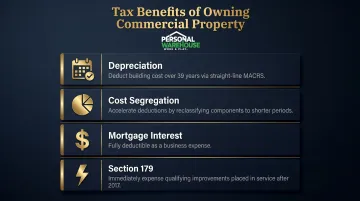
Consult a CPA to model how these interact with your specific tax situation — the combined effect can be substantial, particularly in the early years of ownership.
The Real Drawback of Buying
Ownership locks up capital in an illiquid asset. According to Lornell Real Estate, selling a commercial property typically takes 5 to 10 months from listing to closing, covering preparation, active marketing, and due diligence. Exiting a lease, by contrast, requires only waiting for the term to expire. For businesses that may need to pivot quickly, that gap in flexibility carries real cost.
Which Option Fits Your Business?
Four questions cut through most of the noise:
- Can you cover a 10–20% down payment without draining operating reserves?
- Has the business operated profitably for at least two years? (Lenders prefer this threshold; SBA 504 charges a higher rate for businesses under two years old)
- Will your space needs stay roughly stable for the next 7–10 years?
- Does your operation require significant customization — specialized electrical, dedicated loading areas, or a layout unique to your trade?
Your answers will point you in a clear direction. Here's how to read them.
Lean Toward Leasing If:
- The business is under two years old or still refining its model
- Cash reserves are thin and capital is better deployed in operations, inventory, or hiring
- Rapid growth may require a larger or different space within three to five years
- The operation doesn't require meaningful property modification
Lean Toward Buying If:
- The business has at least two years of stable, documented revenue
- Down payment capital is available without compromising operations
- The space requires heavy customization — fabrication setups, specialized HVAC, reinforced flooring, or trade-specific layouts
- Building personal wealth alongside the business is a priority
The Hybrid Middle Ground
Lease-to-own agreements, ground leases, and warehouse condominium ownership programs sit between these two poles. They're especially relevant for contractors, distributors, storage-dependent businesses, and light manufacturers who want equity without the full capital commitment of a traditional commercial purchase.
Personal Warehouse units, for example, give buyers options that standard leases rarely permit without landlord negotiation:
- Add mezzanines that expand usable square footage by up to 30%
- Customize HVAC to match operational requirements
- Install private restrooms
- Configure the layout to trade-specific specs
Real-World Scenarios
Scenario A: Leasing Preserves Options for a Growing Business
A service business in its second year leases 1,800 square feet in a light industrial park on a three-year modified gross lease. The preserved capital goes into equipment and staffing rather than a down payment. When the lease expires, the business — now generating twice its original revenue — relocates to a larger space across town without the months-long process of selling a building.
Hughes Marino, a national commercial real estate advisory firm, describes this as a common pattern for high-growth businesses: sign a shorter lease, negotiate expansion rights, and keep relocation options open until space needs stabilize.
Scenario B: Buying Creates a Second Asset
The Small Business Anti-Displacement Network documented several Philadelphia businesses that transitioned from leasing to ownership. Ibrahim G., owner of I&F Grocery, secured a Commercial Real Estate Acquisition Loan through the Women's Opportunities Resource Center and purchased his corner store outright. B&A Dubai Fashion and The African Small Pot completed similar acquisitions.
Across all three cases, ownership delivered the same core outcomes:
- Eliminated rent escalation risk in a market where commercial rents were climbing
- Created equity that could be leveraged for future capital needs
- Provided long-term stability that leasing couldn't guarantee
Both scenarios point to the same conclusion: where you are in your business lifecycle matters far more than any general argument for buying or leasing.
Conclusion
Leasing is the right starting point for most small businesses — lower barriers, more flexibility, and less capital at risk when the future is uncertain. Buying becomes the smarter move once the business has stable revenue, clear space requirements, and the capital to execute without straining operations.
Neither decision is permanent. Many businesses lease first, build financial strength, and buy when they're ready. When that moment arrives, financing options like SBA 504 loans have made ownership more accessible than many small business owners expect. Revisiting the decision as the business matures isn't indecision — it's sound financial management, and the timing matters as much as the choice itself.
Frequently Asked Questions
Is it better to lease or buy commercial real estate for a small business?
Neither is universally better. Leasing suits businesses that prioritize flexibility and lower upfront costs, while buying makes more sense for established businesses seeking long-term equity and cost stability. The right answer depends on the business's age, cash reserves, and space requirements.
Can I buy a house for business purposes?
In limited cases — home offices or home-based businesses — yes, though zoning laws and lender restrictions often limit commercial activity in residential properties; businesses needing public-facing or specialized space are better served by purpose-built commercial or mixed-use properties.
Is an LLC good for real estate?
Holding commercial property inside an LLC is a common approach for liability protection and tax flexibility. The right structure varies by ownership goals and tax situation, so consult a CPA or real estate attorney before deciding.
What type of commercial lease is best for a small business?
A modified gross lease typically offers the best balance: predictable costs without absorbing full operating expense risk. The best fit still depends on the specific property, location, and what the landlord will negotiate.
What credit score do I need to buy commercial real estate?
Most commercial lenders look for a personal credit score of 650–680 or higher. SBA program lenders apply similar thresholds, though stronger overall applications can sometimes qualify at the lower end of that range.
Can I rent out commercial real estate I own as a small business?
Yes — owner-occupied commercial property can often be partially leased to other tenants, generating rental income that helps offset the mortgage. This is one of the more practical wealth-building advantages that ownership holds over leasing.