
The challenge most investors face isn't picking an asset class — it's picking the right geography. A well-located industrial property in a supply-constrained secondary market will outperform a similar asset in an oversupplied gateway city almost every time. Geographic misalignment remains one of the most common reasons CRE portfolios underperform.
This guide covers the markets worth watching in 2026, the criteria that separate strong markets from mediocre ones, and why the ownership model itself is evolving in ways that create new entry points for smaller investors.
TL;DR
- Industrial and flex space nationally posted 14% year-over-year leasing growth in Q1 2026, while office vacancy peaked near 19%
- Dallas-Fort Worth, Atlanta, Charlotte, Bozeman (MT), and Denver are among the strongest-performing markets heading into 2026
- The best markets share four traits: population growth, job diversification, low vacancy, and constrained new supply
- Ownable flex and warehouse units are outperforming traditional leasing in supply-limited secondary markets, where available inventory stays tight
- Tariffs, construction costs, and rate uncertainty create headwinds, though markets where demand structurally outpaces supply have absorbed these pressures more effectively
Why 2026 Is a Pivotal Year for CRE Investment
Capital markets are thawing. Private-label CMBS issuance grew 21% in 2025 to $125.6 billion, signaling a meaningful recovery in lender confidence after two years of constrained deal flow. The Federal Reserve cut rates by 25 basis points to approximately 4.00–4.25% in September 2025 — the first cut of the year — and lending standards that tightened sharply in 2023–2024 have begun to ease.
Recovery isn't uniform, though. Performance varies sharply by asset class — and which sector you target in 2026 matters as much as where you invest:
| Asset Class | National Vacancy (2025–2026) | Trend |
|---|---|---|
| Industrial | 6.7% (Q1 2026) | Stabilizing with strong leasing |
| Multifamily | ~9.0% (Q3 2025) | Declining gradually |
| Office | ~19% (2025 peak) | Elevated; selective recovery |
According to CBRE's Q1 2026 industrial figures, leasing activity jumped 14% year-over-year to 249.8 million sq. ft., with net absorption rebounding to 43.1 million sq. ft. Office, by contrast, is still working through oversupply and hybrid-work demand destruction.
Macro Risks That Make Market Selection Critical
Three headwinds deserve attention in 2026:
- Tariffs on construction materials — A 25% tariff on imported steel and aluminum took full effect in March 2025, with roughly half of structural steel used in U.S. construction imported. This raises replacement costs and slows new supply pipelines
- Labor constraints — Construction labor availability remains tight in most high-growth metros, extending project timelines
- Rate uncertainty — Despite the September 2025 cut, rates remain elevated relative to the 2020–2022 era, keeping cap rate compression gradual
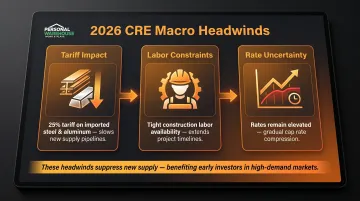
These headwinds actually work in favor of investors who move early. Higher construction costs and longer timelines suppress new supply — which props up rental income and property values in markets where demand is already running ahead of available space.
Best Places to Invest in Commercial Real Estate in 2026
Markets below were selected based on population growth, employment diversification, vacancy rate trends, infrastructure investment, and the ratio of new supply to absorption — not historical reputation alone.
Dallas-Fort Worth, TX
DFW is the country's premier industrial and logistics market by almost any measure. The metroplex added 123,557 residents between mid-2024 and mid-2025 — roughly 339 people per day — bringing total MSA population to 8.47 million. It ranked #1 among U.S. metros for corporate relocations from 2018–2024, and attracted 11 interstate headquarters moves in 2025 alone, including KFC U.S. and Sally Beauty Holdings.
The industrial market reflects this demand directly:
| Metric | Current Figure | Source |
|---|---|---|
| Population Growth | +123,557 residents (2024–2025) | U.S. Census Bureau |
| Top CRE Asset | Industrial/Warehouse, Flex | Q2 2025 avg. lease: varies by submarket |
| Industrial Vacancy | 8.9%–9.1% (Q4 2025 – Q1 2026) | Partners RE / CBRE |
| Cap Rate | ~6.4% average | Partners RE Q2 2025 |
| Q1 2026 Leasing | 18.0M sq. ft. (+37.4% YoY) | CBRE Q1 2026 |
Key demand drivers include last-mile delivery (DHL signed 699,246 sq. ft. in 2025), warehouse/distribution absorption of 5.5M sq. ft. in a single quarter, and flex space commanding premium rents at $13.60/sq. ft. Construction is moderating — the pipeline dropped from 24.2M sq. ft. in mid-2025 to 16.5M sq. ft. in Q1 2026 — which should support rent stability.
Atlanta, GA
Atlanta's investment case rests on infrastructure that cannot be replicated: Hartsfield-Jackson Airport, the world's busiest by passenger traffic at over 104 million annually, creates a logistics backbone that anchors e-commerce fulfillment and cold storage demand across the Southeast.
The metro population reached approximately 6.27 million in 2025 (+1.28% YoY), with corporate expansions from Mercedes-Benz, TriNet, and AIG adding high-quality employment in the first half of 2025.
| Metric | Current Figure | Source |
|---|---|---|
| Population (2025) | ~6.27 million (+1.28% YoY) | Macrotrends |
| Top CRE Asset | Industrial logistics, workforce multifamily | — |
| Industrial Vacancy | 9.0% (Q4 2025, -20 bps QoQ) | Partners RE |
| Flex Asking Rent | $13.47/sq. ft. | Partners RE Q4 2025 |
| Multifamily Cap Rate | 4.5%–5.5% | CBRE / Lee & Associates |
Industrial vacancy dropped 20 basis points quarter-over-quarter in Q4 2025, with 3.1 million sq. ft. of net absorption — a recovery from negative absorption earlier that year. The I-85 North corridor (Gwinnett County) is the most active submarket for both industrial leasing and multifamily absorption, making suburban Atlanta particularly worth attention for investors who can move quickly.

Charlotte, NC
Charlotte is one of the fastest-growing Sun Belt metros, and its CRE absorption numbers have started to match that reputation. The Charlotte-Concord-Gastonia MSA ranked 7th nationally for population growth between 2020 and 2025, adding over 278,700 residents — a 10.5% increase — to reach approximately 2.9 million people.
From mid-2024 to mid-2025 alone, the metro added 54,100 people, the 5th-highest numeric increase in the country.
| Metric | Current Figure | Source |
|---|---|---|
| Population Growth | +54,100 (2024–2025), 5th nationally | Charlotte Observer / Census |
| Top CRE Asset | Flex/industrial, grocery-anchored retail | — |
| Key Industries | Financial services, manufacturing, healthcare | — |
| CRE Trend | Part of national 14% YoY leasing increase | CBRE Q1 2026 |
Charlotte's sprawling growth pattern — extending through Cabarrus, Union, and Iredell counties — creates strong demand for suburban flex space and neighborhood retail that follows rooftop growth. Financial services and manufacturing anchor the commercial tenant base, while healthcare expansion drives both office and medical flex leasing in suburban corridors.
Note: Charlotte-specific cap rate and vacancy figures were limited at time of writing. CBRE and JLL Charlotte quarterly reports are the best sources for current submarket-level data.
Bozeman, MT
Bozeman is the deliberate outlier on this list. By conventional CRE standards it's a small market, with a city population of roughly 57,894 (2024 Census estimate) growing toward approximately 59,914 by 2026.
That growth represents a 37% increase from 2010, driven by remote worker relocation, an outdoor recreation economy, and small business formation at a pace few secondary markets can match.
| Metric | Current Figure | Source |
|---|---|---|
| City Population (est. 2026) | ~59,914 | Taunyafagan.com/Census |
| Growth Since 2010 | +37% | Taunyafagan demographics |
| Median Home Value | $821,750 (+24% annually) | Taunyafagan.com |
| Top CRE Asset | Flex warehouse, personal/business storage | — |
| Key Demand Driver | Remote workers, small business, lifestyle buyers | — |
What makes Bozeman especially compelling for investors is the combination of demand growth and supply constraint. Land availability and zoning limitations mean institutional developers are largely absent, creating a window for smaller investors and owner-users to enter at ground level.
Personal Warehouse has a project under construction at 105 Copper Ranch Road in Belgrade (Bozeman metro), accepting reservations now with delivery targeted for 2026. The development includes Personal Warehouses, Professional Work Suites, and Self-Storage spaces — all available for ownership rather than lease.
Buyers can finance units through SBA 504 and 7(a) loans via preferred lenders, with terms comparable to residential financing. The 99-year ground lease structure keeps entry costs lower than fee-simple land purchase while preserving full ownership benefits and resale flexibility.
In a market this supply-constrained, buyers who move before institutional capital arrives capture both better pricing and stronger long-term appreciation. Bozeman was ranked the top-performing small metro in the U.S. for economic strength for five consecutive years (2018–2022) — a track record that points to durable, not cyclical, demand.

Denver, CO
Denver's industrial and flex market is bifurcated. The CBD faces ongoing headwinds from hybrid work, but suburban and airport-adjacent submarkets are absorbing space at a healthy pace — and that's where investors should focus.
Direct asking rents hit $9.61/sq. ft. in Q1 2025 (+3.2% YoY), with warehouse cap rates at 6.48% and flex industrial at 6.97% as of mid-2025. The airport submarket alone captured 60% of total Q1 2025 leasing volume.
| Metric | Current Figure | Source |
|---|---|---|
| Top CRE Asset | Flex industrial, suburban commercial | — |
| Direct Asking Rent | $9.61/sq. ft. (+3.2% YoY) | CBRE / Mile High CRE |
| Warehouse Cap Rate | 6.48% | IRR Mid-Year 2025 |
| Flex Industrial Cap Rate | 6.97% | IRR Mid-Year 2025 |
| Q1 2025 Net Absorption | 531,000 sq. ft. (+9.9% YoY) | CBRE |
Large build-to-suit deals (Target: 529,000 sq. ft., Discount Tire: 339,000 sq. ft.) indicate that major tenants are committing to Denver's logistics infrastructure long-term. The tech and energy sectors continue driving employment, supporting demand for flex office and light industrial adjacent to the urban core.
Q1 2026 absorption moderated to 416,000 sq. ft., down from Q4 2025. That decline is largely seasonal: 77.7% of 2025 completions were preleased or build-to-suit, which means the underlying tenant demand remains intact heading into the second half of 2026.
Key Criteria for Choosing a CRE Investment Market in 2026
The most common mistake: choosing a market based on its reputation from 2018 or 2021. In a post-rate-shock environment, fundamentals shift faster than market narratives.
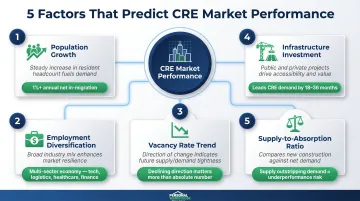
Five Factors That Actually Predict Performance
Evaluate any market candidate against these criteria before committing capital:
- Population growth trajectory — Net in-migration (not just births) signals real demand for housing, retail, and commercial services. Look for metros adding 1%+ annually with domestic migration as the primary driver
- Employment diversification — Single-sector markets are fragile. Markets with tech, logistics, healthcare, and finance all represented weather downturns better than those dependent on one employer or industry
- Vacancy rate trend — Direction matters more than the absolute number. A market at 9% vacancy declining 20 bps per quarter is more attractive than one at 7% that's been rising for six months
- Infrastructure investment — Airport expansions, highway construction, and port upgrades attract tenants. These investments are public record and often lead commercial real estate demand by 18–36 months
- Supply-to-absorption ratio — How much is being built relative to how much is being leased? Supply outstripping demand is how 2021's hottest markets became 2024's underperformers
Ownership vs. Leasing as an Investment Model
Those five criteria point toward one underappreciated conclusion for 2026: in supply-constrained secondary markets, outright ownership of flex or warehouse space is gaining traction as a wealth-building alternative to traditional REIT investment or leasing-based income.
Bozeman is a clear example. Owning a flex or warehouse unit in a market like this offers:
- Owned assets appreciate while lease costs typically increase — a built-in inflation hedge
- Multiple exit strategies: hold for appreciation, lease to tenants for income, or sell as the market matures
- SBA 504 and 7(a) loans make commercial ownership accessible for small business owners at near-residential financing terms
Personal Warehouse units are engineered for long-term value: 100/150-amp 3-phase electrical service, commercial-grade insulated overhead doors, superior insulation with optional HVAC, and mezzanine options that expand usable space by up to 30%.
The 99-year ground lease structure keeps land costs off the purchase price while maintaining full ownership rights — a structure that compares favorably to fee-simple commercial purchases in markets where land alone can price out smaller buyers.
Conclusion
The strongest CRE investments in 2026 share the same profile: markets where structural demand — population growth, job creation, and limited new supply — is outpacing what developers can deliver. That's true whether you're looking at DFW's industrial corridors, Atlanta's logistics submarkets, or Bozeman's emerging flex warehouse market.
Match your market selection to your investment profile. A passive investor might favor the cap rate stability and liquidity of a Dallas or Denver industrial position. An owner-user or smaller investor looking to build equity through direct ownership might find more upside — and better financing terms — in a supply-constrained secondary market like Bozeman.
That ownership-over-leasing thesis is exactly what Personal Warehouse is built around. The company offers warehouse and flex spaces built for ownership across high-growth markets — with a 99-year ground lease structure and SBA-eligible financing through preferred lenders. An active project in Bozeman is now accepting reservations for 2026 delivery. Reach out to learn more: info@personalwarehouse.com or 303-222-0768.
Frequently Asked Questions
Is 2025 a good time to buy commercial real estate?
Conditions are improving for well-positioned buyers. CMBS issuance grew 21% in 2025, lending standards are beginning to ease, and industrial and flex fundamentals remain strong in high-demand markets. Macro uncertainty persists, but supply-constrained markets with genuine demand drivers continue to reward investors who act on fundamentals rather than sentiment.
What is the 2% rule in commercial real estate?
The 2% rule suggests a property's monthly rental income should equal at least 2% of its purchase price. This heuristic is more commonly applied in residential investing — in commercial real estate, NOI, cap rate, and debt service coverage ratio are more reliable benchmarks for evaluating deal quality.
What is the 7% rule in real estate?
The 7% rule is an informal valuation check suggesting that a property's annual value should not exceed roughly 7 times its gross annual rent. It works as a quick screening filter only — market-specific cap rates, vacancy trends, and local comparable sales are far more reliable for CRE underwriting.
Why invest in industrial real estate?
Industrial assets offer long lease terms, low capital expenditure requirements, and strong tenant retention. With national vacancy at 6.7% in Q1 2026 and leasing activity up 14% year-over-year, industrial remains one of the most consistent-performing CRE asset classes — delivering through economic cycles where e-commerce and logistics demand holds firm.
What are the major commercial real estate trends in 2026?
Industrial and flex space are outperforming most other asset classes. Multifamily demand is sustained by persistent housing supply shortages. Office is recovering selectively in high-quality suburban submarkets while CBD assets remain challenged. Alternative asset types — self-storage, data centers, cold storage — are attracting growing investor interest as traditional categories bifurcate further.
What are the best commercial real estate investments in 2026?
Industrial properties, workforce multifamily, and flex/warehouse spaces in supply-constrained secondary markets have been the most consistent performers. The common thread: markets where demand structurally outpaces the ability to add new supply. Your risk tolerance, capital availability, and timeline should drive the final call.