For small business owners, warehouse buyers, and commercial real estate investors, this structure can be genuinely powerful. But it comes with legal nuances that catch people off guard: statutory caps that void certain extensions, rent reset clauses that trigger disputes, and reversion rights that affect what happens to your improvements at the end of the term.
This guide covers what the lease is, why 99 years specifically, how extension options work — and the legal risks most people overlook before signing.
TL;DR
- A 99-year ground lease grants long-term land use without purchasing the land outright
- The 99-year cap is statutory in many states — California's Civil Code §718 voids any rent-reserving lease on city or town lots exceeding 99 years
- Tenants can build, sublease, and mortgage their leasehold interest — but only while lease terms are met
- Poorly drafted extension options can be legally void — especially when cumulative renewal terms push past the 99-year statutory cap
- Review rent reset clauses and reversion rights with an attorney before signing
What Is a 99-Year Ground Lease?
A ground lease creates two distinct property interests from the start:
- The lessor's leased fee interest — the landowner retains ownership of the land throughout the entire term
- The lessee's leasehold interest — the tenant controls the land and any improvements built on it for the full lease duration
The basic deal works like this: the tenant pays ground rent to the landowner, constructs or occupies improvements on the land, and when the lease expires, the land — and typically any buildings on it — reverts to the landowner. This differs from a standard commercial space lease (where a landlord leases you space they already own and control) and from a property purchase (where you acquire fee simple title outright).
In practical terms, you're not buying the land. You're buying the right to use it for a defined period, along with whatever you build on it during that time.
Personal Warehouse uses exactly this structure for its warehouse and storage unit ownership model. The approach gives buyers the benefits of ownership — including the ability to hold, lease out, or resell their space — without requiring the capital outlay of a full fee simple land purchase.
Their 99-year ground lease is structured for long-term security, giving buyers decades of stable control over their space and any improvements they make to it.
Why 99 Years? The Legal and Strategic Logic Behind the Number
The Legal Basis
The 99-year cap is not arbitrary. It's rooted in public policy against perpetual land grants that lock up property indefinitely.
California Civil Code §718 states explicitly: "No lease or grant of any town or city lot, which reserves any rent or service of any kind, and which provides for a leasing or granting period in excess of 99 years, shall be valid." Originally enacted in 1872 with a 20-year limit, the statute was amended to 99 years in 1911. Alabama's Code §35-4-6 mirrors this cap. Kentucky takes a stricter approach — KRS §65.946 caps real property leases at 40 years including renewals.
California courts have held that these limits work alongside the state's Rule Against Perpetuities to prevent property from being "tied up for an undue length of time," ensuring real estate remains freely alienable and open to development.
The Historical Origin
The 99-year figure traces directly to English common law. Legal historian Edwin J. Wittelshofer documented that English legal writer Mathew Bacon identified 99 years as the longest permissible term in 1798 — representing "three lives," or three successive human generations at roughly 33 years each. By the 16th century, the 99-year lease was a recognized standard. Choosing 99 rather than 100 was deliberate: a century-long term risked being construed as a perpetual interest or a de facto ownership transfer, potentially violating the Rule Against Perpetuities.
The Strategic Logic
For tenants, 99 years is long enough to:
- Fully amortize major construction and improvement costs
- Secure leasehold mortgage financing (lenders typically require at least 30 years of remaining term beyond scheduled loan maturity, per Joshua Stein writing in The Practical Real Estate Lawyer)
- Offer subtenants occupancy terms stable enough to support their own business planning
For landowners, the appeal is different: they retain the asset, collect steady income, and recover the land with all improvements at term end — without ever selling.
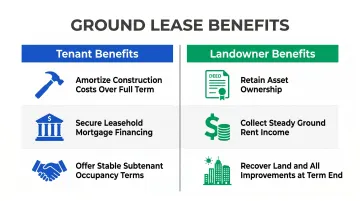
A leasehold interest's value depreciates as the remaining term shortens. A 99-year leasehold at inception commands far greater value than a 20-year remaining term, which typically cannot support mortgage financing at all.
How a 99-Year Ground Lease Works: Rights, Rent, and Responsibilities
Tenants under a standard 99-year ground lease typically hold the right to:
- Construct and own improvements on the land during the lease term
- Sublease space to third parties (subject to lease terms)
- Mortgage the leasehold interest to secure financing
These rights are contingent — they exist only as long as the tenant complies with lease obligations.
Rent and Rent Reset Clauses
Ground rent is set at lease commencement, but long-term leases almost always include rent reset clauses that adjust rent at predetermined intervals. The problem: vague reset language creates enormous financial uncertainty.
The core dispute in rent reset litigation is whether "fair market value" means the land valued as unencumbered (as if freely available for any use) or as subject to the lease and its restrictions. New York courts default to valuing land subject to the lease unless the agreement explicitly states otherwise — which can produce valuations that "vastly differ from the actual economic value of the land to either the landlord or tenant," according to Morrison Cohen LLP's analysis of ground lease rent resets.
Lenders prefer predictable resets — fixed schedules or CPI-indexed increases (commonly capped around 3.5%) — because large fair-market-value-based jumps can threaten the tenant's ability to keep the lease current, which directly threatens the lender's collateral.
Ground rent takes priority over mortgage payments. If the tenant fails to pay rent, the landlord can terminate the lease — extinguishing the leasehold mortgage along with it. Lenders price this risk carefully when underwriting leasehold loans.
What Happens to Improvements at Expiration
Unless the lease specifies otherwise, the land and all improvements revert to the landowner at the end of the term — including any buildings, mezzanines, or other structures the tenant constructed. This is standard reversion doctrine.
Lenders impose strict timing thresholds as a result:
- Leasehold loans must typically be repaid at least 10 years before lease expiration
- Leases with fewer than 20 years remaining fall below the 30-year minimum most lenders require
- Leases in that range are effectively non-financeable in conventional markets
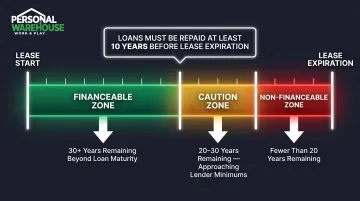
If you're evaluating a property with a ground lease already partially elapsed, run the remaining term against these thresholds before proceeding.
Extension Options: What Happens When the Term Nears Its End
As a ground lease approaches expiration, three general paths exist:
- Negotiate a new lease or extension directly with the landowner
- Exercise a pre-negotiated renewal option written into the original lease
- Allow the lease to expire and relinquish the land and improvements
The Legal Trap in Extension Provisions
Renewal options must be drafted carefully. In states with statutory caps, any tenant-controlled extension that pushes the cumulative term past 99 years is void — not just voidable, but legally unenforceable.
Tufeld Corporation v. Beverly Hills Gateway, L.P. (86 Cal.App.5th 12, 2022) illustrates this risk clearly. The original ground lease ran from 1960 through 2058 (98 years). In 2007, the parties agreed to extend it through 2123 — and the tenant paid $1.5 million for that extension.
Years later, Tufeld's president discovered the extension breached California's 99-year cap and filed for declaratory relief. The court held the excess portion void. Equitable defenses — estoppel, laches, waiver — could not save it. The tenant recovered $484,615 in restitution, representing the pro-rata share of the $1.5 million paid for the voided years.
The Novation Complication
The court also found that a 2003 assignment of the lease constituted a novation — effectively creating a new contract and resetting the 99-year clock from 2003, not 1960. This meant the valid lease term could extend to 2102 rather than expiring in 2058. Any assignment worth reviewing should include an explicit analysis of whether it creates a novation — because the answer changes how much runway actually remains on the lease.
What to Look for in Extension Provisions
The Tufeld case is a useful reminder that lease extensions carry hidden legal exposure. When reviewing any ground lease, check for:
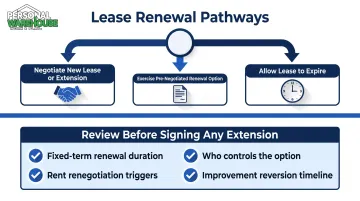
- Fixed-term renewal options with defined durations — open-ended extensions are a red flag
- Rent renegotiation triggers — what resets, when, and how the new rent is calculated
- Who controls the option — tenant-controlled options are more valuable but invite more statutory scrutiny
- What happens to improvements upon any extension — does the reversion timeline shift?
Common Misconceptions and Legal Risks
"A 99-year lease is basically ownership"
It isn't. The tenant never owns the land. Improvements revert at expiration. The leasehold interest decreases in value over time as the remaining term shrinks. Fee simple ownership — as defined by Cornell Law — grants unlimited duration and all traditional property rights. A leasehold is a non-freehold estate that expires.
That said, a well-structured 99-year leasehold functions very similarly to ownership for most practical purposes during the term — particularly when it supports SBA financing, subleasing, and resale.
That distinction matters even more when it comes to extension rights, where a second common misconception creates real legal exposure.
"You can extend a 99-year lease however you want"
Any extension that pushes the total tenant-controlled term past a statutory ceiling is void in affected states — full stop. The Tufeld case confirmed this and added the novation wrinkle (essentially treating the amended lease as a brand-new agreement): lease amendments can reset the clock in ways parties don't anticipate. Know which state's law governs before agreeing to any extension or amendment.
The Rent Reset Litigation Risk
Vague rent reset language is among the most litigated provisions in ground leases. The financial stakes are significant: a reset based on unencumbered land value versus lease-encumbered land value can produce significantly different numbers. If your lease doesn't explicitly define the valuation methodology, courts must interpret intent — and outcomes can be unpredictable.
Before signing any ground lease, confirm:
- How and when rent resets are triggered
- Whether the valuation is land-as-unencumbered or land-as-subject-to-lease
- Whether there are caps on reset increases
Frequently Asked Questions
How does a 99-year ground lease work?
The tenant gets long-term use of the land and can build or operate on it while paying ground rent to the landowner. When the lease expires, the land — and typically any improvements — revert to the landowner unless the lease specifies otherwise.
Why are leases 99 years instead of 100?
Many jurisdictions cap ground leases at 99 years to prevent perpetual land grants that restrict free development and alienability. A 100-year term historically risked being treated as a perpetual ownership transfer, running afoul of the Rule Against Perpetuities — which is why California Civil Code §718 and similar statutes draw a hard line at 99.
Can a 99-year ground lease be extended?
Extensions are possible through pre-negotiated renewal options or new agreements, but must be structured carefully. Any tenant-controlled extension that pushes the cumulative term past the statutory cap — 99 years in California and Alabama — is void, not merely voidable.
What happens to buildings and improvements at the end of a 99-year ground lease?
Unless the lease specifies otherwise, improvements revert to the landowner at expiration. Understanding the reversion clause before signing is essential for anyone investing in improvements on leased land.
Is a 99-year ground lease as good as owning property?
It provides near-ownership stability for the lease term, but it differs from fee simple ownership: the land never transfers to the tenant, the leasehold interest depreciates as the term shortens, and improvements revert at expiration. Strong long-term structure — but not a substitute for outright ownership.
Can you get a mortgage on a 99-year ground lease?
Leasehold financing is possible. Lenders typically require at least 30 years of remaining lease term beyond the loan maturity date, and rent reset provisions must be predictable enough to assess risk. Personal Warehouse works with preferred lenders offering SBA 504 and 7(a) financing on its units.