Introduction
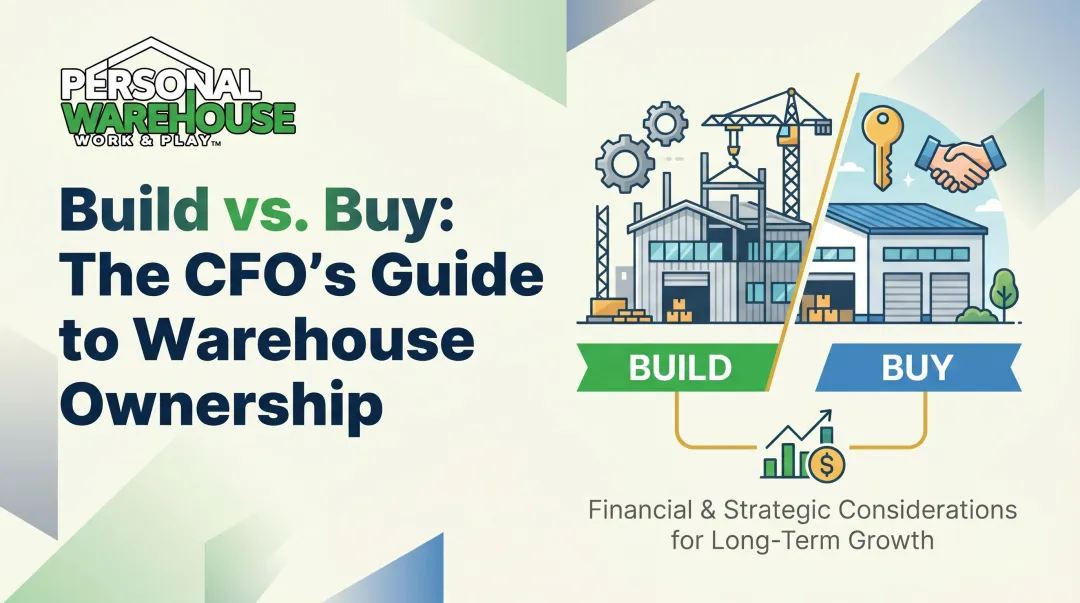
Deciding whether to own or lease a warehouse gets complicated fast. Ownership builds equity and gives you control — but it also locks in capital, creates fixed costs during slow periods, and puts operational responsibility squarely on you.
This guide is for three types of readers: small business owners evaluating their first facility, investors weighing warehouse space as an asset class, and individuals — collectors, hobbyists, RV and boat owners — exploring personal storage ownership. Each group faces different trade-offs.
CBRE reports that owner-occupier purchases of industrial facilities rose 32% year-over-year, with the average U.S. industrial sale price reaching $152.42 per square foot. That demand is significant — and it still needs to match your specific financial position and operational goals.
This article covers the three core ownership models, their honest pros and cons, what the full financial picture looks like, and how to match the right model to your goals.
TLDR
- Ownership builds equity and enables customization; leasing preserves capital and flexibility
- Industrial real estate is a strong asset class, but fixed costs persist regardless of utilization
- Warehouse condos and ground leases have made ownership accessible to smaller buyers
- SBA 504 and 7(a) loans lower the barrier to entry for qualifying buyers
- Stable, long-term needs favor ownership; variable or uncertain needs favor leasing
The Three Core Warehouse Ownership Models
Three distinct models shape how businesses and individuals hold warehouse space:
- Private/direct ownership — You purchase and operate the facility outright (or with financing). Full control, full responsibility.
- Leasing/outsourcing — You contract with a third-party facility for space, preserving capital and flexibility at the cost of equity and customization.
- Hybrid and alternative structures — A mix of both, or emerging options like warehouse condos and ground lease arrangements that blur the traditional own-vs-rent binary.
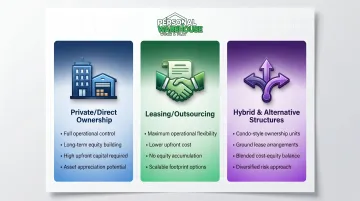
The right model depends on your situation: how stable your space needs are, how much capital you can commit, and whether you're optimizing for flexibility, equity, or long-term cost control.
What's changed in recent years is the range of available structures. Warehouse condos, 99-year ground leases, and shared small-bay facilities now give buyers real alternatives that the old own-vs-rent binary simply didn't include.
Private Ownership: The Advantages
Operational Control and Customization
Full ownership means no landlord approvals. You can reconfigure the layout, install custom racking, add mezzanines, specify your HVAC setup, or wire the space for three-phase power — whatever your operations require.
For lifestyle buyers, this matters just as much. A collector setting up climate-controlled car storage, or an RV owner who needs oversized overhead doors and a wash station, can't get that from a standard commercial lease.
Personal Warehouse, for example, offers unit configurations that include mezzanines (expanding usable space by up to 30%), optional restrooms with shower rough-ins, kitchenettes, concrete finished floors, and 100/150-amp three-phase electric service — options rarely available under standard lease terms.
Long-Term Wealth Building
Owned warehouse property appreciates over time, particularly in supply-constrained markets. According to Cushman & Wakefield's Q4 2024 Industrial MarketBeat, national average industrial asking rents reached $10.13 per square foot — up 4.5% year-over-year — even as the market absorbed a significant supply wave.
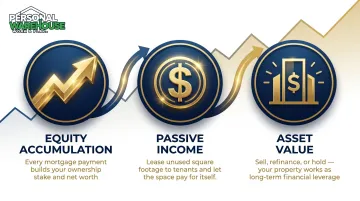
Three financial advantages compound over time:
- Equity accumulation — Every mortgage payment builds ownership stake; lease payments build none
- Passive income — Unused portions of owned space can be leased to other businesses or individuals, offsetting carrying costs
- Asset value — The property itself can be sold, refinanced, or held as part of a long-term investment portfolio
Predictability of Costs
A fixed-rate mortgage creates predictable monthly obligations. That stability matters in tight industrial markets where rents can spike at renewal — especially for tenants in markets where vacancy has fallen below 4-5%. Owners are insulated from two risks that tenants can't control: lease non-renewals and property sales that force relocation.
Private Ownership: The Drawbacks
High Upfront Capital Requirements
Commercial real estate financing typically requires larger down payments and stricter qualification criteria than residential loans. The SBA 504 loan program — one of the most accessible paths for small business buyers — structures financing as 50% from a lender, 40% from a Certified Development Company, and at least 10% borrower equity, with SBA debentures generally up to $5.5 million.
Even at 10-20% down, that's meaningful capital tied up in an illiquid asset. For an early-stage business, redirecting that capital away from inventory, staffing, or growth investments is a direct trade-off.
Fixed Costs Don't Stop When Business Does
Mortgage payments, property taxes, insurance, and maintenance don't pause when business slows down. This is where right-sizing matters: Cushman & Wakefield data shows vacancy for large-format product (300,000+ sf) reached approximately 10.7% in Q4 2024, compared to roughly 3.9% for sub-100,000 sf buildings. Owners of oversized facilities face meaningful downtime risk when demand softens.
The financial exposure doesn't end there — ownership also brings hands-on operational demands that many buyers underestimate.
Operational Responsibility
Ownership transfers full responsibility for maintenance, repairs, building compliance, and facility management. For businesses whose core competency isn't real estate, that's an ongoing cost that doesn't appear anywhere in the purchase price.
Before buying, budget for:
- Routine maintenance and repairs
- Periodic capital expenses (roof, HVAC systems, overhead doors)
- Property management if you're not self-managing
- Insurance and property tax obligations
Leasing: When Flexibility Wins
The Case for Leasing
Leasing preserves capital, reduces upfront risk, and gives businesses the ability to scale space up or down as needs change. It's particularly well-suited for:
- Businesses in growth phases where space needs are hard to forecast
- Companies testing new markets before committing to a location
- Operations with seasonal or uneven demand patterns
- Buyers who need space immediately rather than waiting on a purchase to close
Most industrial leases run on NNN (triple net) terms, meaning tenants pay taxes, insurance, and maintenance on top of base rent. That structure transfers operating cost exposure to the tenant — but it also means the landlord handles structural and capital repairs.
CBRE projects approximately 5% year-over-year growth in industrial leasing to nearly 1 billion square feet in 2026, with renewals accounting for more than 35% of activity.
That renewal volume reflects tenants extending rather than relocating — which means option windows and rent escalation clauses deserve close attention before you sign.
The Limitations of Leasing
The core drawbacks are financial and operational:
- No equity — Lease payments generate no ownership stake, regardless of how long the relationship lasts
- Renewal risk — Landlords can decline to renew, raise rents significantly, or sell the property
- Limited customization — Most leases restrict structural modifications, meaning your space adapts to you only within landlord-approved limits
- Personal use gap — Standard commercial leases rarely accommodate lifestyle-oriented uses like RV storage, collector garages, or workshop setups
Hybrid and Alternative Ownership Models
The Hybrid Approach
Hybrid arrangements work in two main configurations:
- Own the core, lease the overflow — Maintain a base facility for year-round operations and lease additional space during peak seasons or for market expansion
- Own the asset, outsource the operations — Retain property ownership while bringing in a third-party operator to handle staffing, logistics, and day-to-day management
Both approaches let owners capture the financial benefits of ownership — equity, appreciation, income potential — while managing the operational demands more flexibly.
Warehouse Condos as an Emerging Alternative
The warehouse condo model has broadened who can own commercial space. Instead of purchasing a standalone facility, buyers own individual units within a larger development — lowering the capital required while preserving the core benefits of ownership: equity accumulation, customization freedom, and resale potential.
Structures like the 99-year ground lease used by Personal Warehouse take this a step further. Owners acquire the unit itself rather than the underlying land, which reduces acquisition cost while still providing long-term tenure security. Personal Warehouse describes this as gaining "all the benefits of ownership without the high cost of land" — a structure built for long-term stability while keeping entry costs accessible.
The financing angle matters here. Personal Warehouse works with preferred lenders experienced in SBA 504 and 7(a) loans for owner-occupied micro-flex condominiums, and the company positions its financing terms as comparable to residential loan programs — a significant departure from traditional commercial mortgage qualification requirements.
These developments are increasingly popular for lifestyle use cases: RV and boat storage, collector garages, woodworking shops, and small business operations. Personal Warehouse offers dedicated product lines for exactly these buyers, including Garage Condos and Man Caves configured with:
- Three-phase electric for power-intensive hobbies and equipment
- Mezzanines to expand usable floor space by up to 30%
- Optional wet bars and restrooms for extended-use comfort
- Oversized insulated overhead doors built for large vehicles and equipment
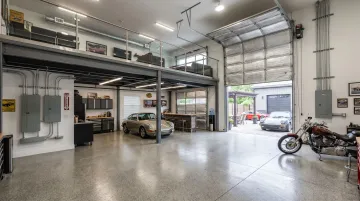
This makes them a practical option for buyers who want the financial upside of real estate ownership without the overhead of a full commercial facility.
The True Financial Picture: Hidden Costs and Long-Term Value
What Ownership Actually Costs
Purchase price is just the entry point. Ongoing ownership costs stack up across several categories:
- Property taxes: Rates vary widely by state and municipality — research local rates before you budget
- Insurance: Commercial property coverage plus liability; costs depend on building size and use
- Routine maintenance: HVAC servicing, door hardware, lighting, pest control — plan for 1–2% of property value annually
- Capital repairs: Roof replacements, major HVAC overhauls, dock equipment — infrequent but significant
- Property management fees: Relevant if you're not self-managing the space
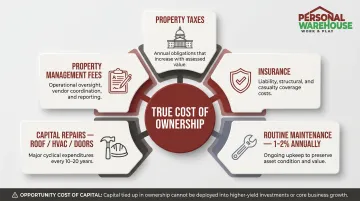
Add to this the opportunity cost of capital: funds tied up in real estate can't be deployed into inventory, hiring, or higher-yield investments. Model the full picture before committing — ownership can still win, but the math needs to account for all of it.
Comparing Long-Term Value Across Models
Consider a simplified 10-year scenario: a business leases warehouse space at $10/sf with annual escalations, versus purchasing a comparable facility with fixed-rate financing.
Over a decade, the owner builds equity through amortization (the gradual paydown of the loan principal), captures any appreciation in property value, and avoids rent escalations entirely. The lessee preserves upfront capital but builds no asset value — and faces renewal negotiations every three to five years in a market that has historically trended toward tighter supply.
Prologis research projects that bulk warehouse vacancy could decline 100+ basis points by the end of 2025 as new large-format deliveries fall approximately 65% year-over-year. Less new supply with sustained demand means tighter conditions for tenants at renewal — and stronger asset performance for owners.
The Resale and Income Upside
Owned warehouse space — particularly in high-demand markets or within condo developments — carries meaningful exit flexibility. Owners can:
- Sell the unit if operational needs change
- Lease unused portions to offset carrying costs
- Hold the asset as part of a long-term investment portfolio
- Refinance to access equity for other capital needs
Personal Warehouse describes this as the core advantage of ownership: the ability to "hold it, lease it, or sell it." That flexibility is something a lease agreement can't provide.
Best Practices for Choosing Your Model
Match the Model to Your Certainty Level
Honest self-assessment here matters more than market analysis. Ask:
- Are my space needs stable for the next 7-10 years, or likely to change significantly?
- Is this facility core to my operations, or supplemental?
- Am I prepared to manage a property, or would that distract from my business?
Stable, long-term needs favor ownership. Variable, exploratory, or short-term needs favor leasing.
Evaluate Financing Options Before Ruling Out Ownership
Many buyers dismiss ownership based on perceived financing barriers that don't actually apply to their situation. Before assuming you can't qualify:
- SBA 504 loans allow qualifying small business buyers to enter with as little as 10% down
- SBA 7(a) loans offer additional flexibility for owner-occupied facilities
- Warehouse condo programs offered by developers like Personal Warehouse may include access to preferred lenders with residential-style terms — often more straightforward than traditional commercial mortgages
If you're considering a condo-format development, contact the developer directly about lender introductions. Many buyers qualify for financing they didn't think was available to them.
Conduct Thorough Due Diligence
Before purchasing any facility or unit, work through this checklist:
- Structural inspection — Independent assessment of building condition, roof, foundation, mechanical systems
- Zoning verification — Confirm your intended use is permitted; check for any use restrictions
- Environmental assessment — Phase I environmental site assessment at minimum
- Cost responsibility clarity — In condo structures, understand exactly which costs are owner responsibility versus association or developer responsibility
- Location evaluation — Assess transportation access, proximity to customers or suppliers, and personal convenience factors
- Financing pre-qualification — Know your options before you're under time pressure to decide

Frequently Asked Questions
How profitable is owning a warehouse?
Profitability depends heavily on location, utilization, and financing terms. Owners generate returns through equity accumulation, potential rental income from unused space, and property appreciation — especially in markets where industrial space is scarce. In well-located, stable markets, warehouse ownership has historically outperformed many alternative asset classes over long holding periods.
Is it better to buy or lease a warehouse?
It depends on demand stability and capital availability. Ownership wins financially for stable, long-term needs, delivering equity, customization, and protection from rent increases. Leasing wins when flexibility, lower upfront costs, or short-term space needs are the priority.
What are the hidden costs of warehouse ownership?
Beyond the purchase price, expect ongoing property taxes, insurance, routine and capital maintenance (roof, HVAC, doors), and the opportunity cost of capital that can't be deployed elsewhere. Budget for these expenses even during slow periods when the space isn't fully in use.
Can individuals (not businesses) own warehouse space?
Yes, particularly through warehouse condo developments designed for personal use. Developers like Personal Warehouse offer dedicated configurations for collectors, RV and boat owners, and hobbyists — with financing terms closer to residential mortgages than traditional commercial loans.
What financing options are available for warehouse ownership?
SBA 504 and 7(a) loans are accessible paths for qualifying small business buyers, often requiring as little as 10% down. Some warehouse condo developers also partner with preferred lenders, which can expand eligibility for buyers who wouldn't qualify under standard commercial mortgage requirements.
What is the 5S rule in warehousing?
5S (Sort, Set in Order, Shine, Standardize, Sustain) is a workplace organization methodology from the Toyota Production System, widely applied in warehouse operations to maximize efficiency, reduce waste, and maintain a safe, organized facility. It applies equally whether the space is owned or leased.