Introduction
A classic car sitting in an unheated garage through a Montana or Wisconsin winter is not simply "parked." The damage accumulates steadily: rust forming under chrome trim, leather drying and cracking, gaskets shrinking with every cold night, moisture condensing on bare steel each time temperatures swing across freezing.
Many owners assume covered parking solves the problem. It doesn't. A standard garage blocks rain and snow, but it can't stop the humidity cycles and temperature swings that do the real damage during months of inactivity. The condensation that forms on a cold engine block on a warm February afternoon is a threat most owners never account for.
This article breaks down exactly what climate-controlled storage prevents, what uncontrolled environments cost you in real repair dollars, and how to get the most out of proper storage — whether you're protecting a numbers-matching muscle car or a carefully preserved survivor.
TL;DR
- Climate-controlled storage (55–85°F, 40–50% RH) eliminates the condensation cycles that trigger rust on unprotected steel
- Corrosion, interior cracking, and paint oxidation — the top three storage killers — are all preventable with stable temperature and humidity control
- Bodywork and paint restoration on a single classic can reach $40,000 (Hemmings); chrome work can exceed $63,000 (Hagerty)
- Hagerty data shows a nearly 10-percentage-point appreciation gap between top-condition and fair-condition collector cars over five years
- Owning your storage space — rather than renting — lets you control the environment year-round and treat it as a long-term asset
What Is Climate-Controlled Storage for Classic Cars?
Climate-controlled storage is an enclosed facility that uses HVAC systems and purpose-built insulation to hold temperature and humidity at stable levels year-round — regardless of what's happening outside. That's the fundamental distinction from a standard garage, which simply mirrors outdoor conditions with a roof.
The target operating range for classic car storage: 55–85°F for temperature and 40–50% relative humidity. The Canadian Conservation Institute notes that RH above 50% significantly accelerates corrosion of iron and steel — making that humidity ceiling non-negotiable for vehicles with uncoated steel bodies and frames.
Standard garages can't hold that range. Most lack:
- Active humidity control of any kind
- Insulation sufficient to buffer seasonal temperature swings
- Protection against condensation events — warm, moist air meeting cold metal — that initiate surface rust
Parking on moisture-retaining dirt or concrete makes it worse, pulling humidity up into the undercarriage continuously.
For classic cars, which lack modern galvanized coatings, sealed electronics, and synthetic material treatments, a controlled environment isn't a luxury upgrade. Without it, degradation starts the moment outside conditions shift — and with older vehicles, that damage compounds faster than most owners expect.
Key Advantages of Climate-Controlled Storage for Classic Cars
Advantage 1: Rust and Corrosion Prevention
Classic cars were built without the rustproofing applied to modern vehicles. Their frames, undercarriages, engine components, and chrome trim are all highly susceptible to moisture-driven oxidation — humidity is the primary trigger.
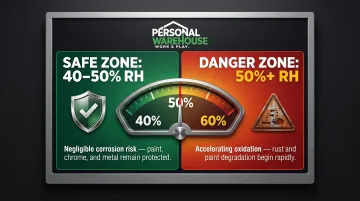
Climate-controlled storage eliminates this by holding relative humidity at 40–50%, preventing the condensation cycles that form when warm air meets cold steel. The Canadian Conservation Institute confirms that keeping RH below this threshold reduces corrosion to negligible levels. Once RH climbs above 50%, iron and steel corrosion accelerates measurably.
Why this matters financially:
The U.S. motor vehicles sector loses $23.4 billion annually to corrosion damage across modern, coated vehicles. Older cars without galvanization face proportionally higher risk. For individual owners, rust repairs on structural sheet metal — new floorpans, rocker panels, quarter panels — run approximately $4,500+ in parts and labor (Hemmings), before any paint or finish work begins.
This advantage matters most in:
- Montana, Wisconsin, Michigan, and Pennsylvania — states with freeze-thaw cycles where unheated garages experience repeated condensation events through the storage season
- Any region where outdoor temperatures cross 32°F multiple times per week, creating cyclical moisture buildup inside storage spaces
Measurable outcomes protected:
- Structural integrity and condition rating
- Repair cost avoidance
- Originality score for show and auction vehicles
- Long-term resale value
Advantage 2: Paint, Interior, and Mechanical Integrity
Rust is only part of the problem. Temperature swings physically stress every material in a classic car — paint, rubber, leather, and plastic all expand and contract with heat and cold. Repeated across 50+ freeze-thaw cycles in a single winter, the cumulative effect is cracking, crazing, and brittleness that no product application can reverse.
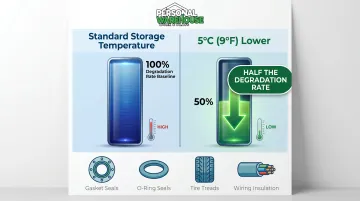
The Canadian Conservation Institute documents this with precision: lowering storage temperature by just 5°C (9°F) cuts the degradation rate of rubber and plastic materials in half. For gaskets, seals, tires, and wiring insulation on a 40-year-old car, that's the difference between components that survive storage and components that fail at first use.
Interior replacement costs:
Original interiors are among the hardest and most expensive things to restore correctly:
- Dashboard restoration, leather re-dyeing, headliner replacement, and upholstery work on a single classic can run $1,000 to $10,000+, depending on materials and availability
- Where original materials are discontinued or unavailable, reproductions reduce authenticity and collector value
The original paint premium:
Some collectors pay 40–50% more for survivor cars with authentic, unrestored paint over freshly restored examples. A car is only original once. Protecting that paint in storage is a direct financial decision, not a cosmetic preference.

This advantage matters most for:
- Long-term storage (6+ months) where cumulative thermal stress compounds
- Project cars mid-restoration with exposed surfaces
- Vehicles stored in high-altitude or hot climates with intense UV exposure and wide daily temperature ranges