The frustrating part? Most of this damage is entirely avoidable. Winter storage isn't complicated, but skipping even one step — especially around climate control — creates conditions that cause disproportionate harm over four to six months of inactivity.
This guide covers everything: how to prep your car before storage, why the storage environment itself matters as much as your prep work, and what to check when you pull the car back out in spring.
TL;DR
- Clean and wax thoroughly before storage to prevent acidic contaminants from etching your paint
- Fill the tank and add fuel stabilizer; ethanol-blended gas degrades in as little as 30 days
- Use a battery maintainer (not a trickle charger) to prevent sulfation and battery failure
- Store in a dry, climate-controlled space — humidity cycling causes more damage than cold alone
- Skip the parking brake; use wheel chocks instead to prevent pads from fusing to rotors
Why Climate Control Matters for Winter Car Storage
"Climate-controlled storage" means two things: stable temperature and managed humidity. Most people focus on temperature, but humidity is the bigger threat to a stored vehicle.
Temperature's Real Impact on Your Car
According to AccuWeather, citing NAPA Auto Parts data, a car battery loses approximately 35% of its strength at 32°F and 60% at 0°F. In Montana and Colorado — where winter lows can plunge well below zero — an unprotected battery in an unheated space can be dead before February.
Cold also thickens fluids, stresses rubber seals and gaskets, and makes plastic trim brittle. None of these effects require dramatic cold snaps; repeated freeze-thaw cycling through a typical Western winter does the same damage incrementally.
How Humidity Damages a Stored Vehicle
Temperature damage gets most of the attention, but humidity causes its own serious problems. Fluctuating moisture levels create condensation on metal surfaces — which means rust on brake rotors, corrosion on battery terminals, and mold growth in the interior.
Research from Cotes recommends keeping stored vehicles in an environment between 35–55% relative humidity. Above that range, corrosion accelerates. Below it, rubber seals dry out.
Concrete floors add another variable. Bare concrete wicks moisture from the ground upward, contributing to undercarriage humidity even when the air feels dry. A vapor barrier or sealed concrete surface eliminates this problem.
Unheated vs. Climate-Controlled Storage
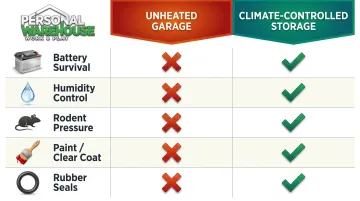
| Factor | Unheated Garage | Climate-Controlled Space |
|---|---|---|
| Battery survival | High failure risk | Maintained with a battery tender |
| Humidity control | None | Stable 40–50% RH |
| Rodent pressure | High | Significantly reduced |
| Paint/clear coat | UV and freeze-thaw damage | Protected |
| Rubber seals | Crack over season | Remain pliable |
Personal Warehouse units in Bozeman, MT are fully heated with optional A/C and high-efficiency insulation — a practical match for the temperature swings Montana winters deliver. Each unit includes 100/150-amp electrical service, making it straightforward to run a battery maintainer throughout the storage period.
Pre-Storage Car Prep: The Complete Checklist
Exterior
Wash and wax before you store — not after. Road salt, bird droppings, and bug residue are mildly acidic. Left on the surface for months, they etch through clear coat and cause oxidation that won't buff out. A coat of wax creates a moisture-resistant barrier over clean paint.
If you're storing indoors in a shared space, add a breathable car cover for dust protection. Avoid non-breathable covers — they trap moisture against the paint and promote the corrosion you're working to prevent.
Fluids
- Oil: Change it before storage exceeding 30 days. Used oil contains combustion acids that promote internal corrosion on cylinder walls and bearing surfaces during inactivity.
- Coolant: Verify antifreeze concentration. A standard 50/50 mix protects to approximately -35°F, which is adequate for most winters — but if you're storing in a region with extreme cold snaps, a 60/40 or 70/30 mix protects down to roughly -62°F.
- Fuel: Fill the tank to minimize airspace where moisture can accumulate, then add a quality fuel stabilizer.
Fuel Stabilizer
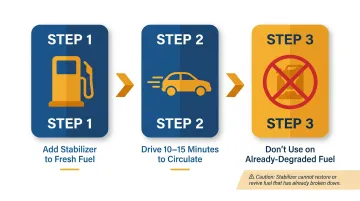
Ethanol-blended gasoline (E10, the most common pump gas) can begin degrading in as little as 30 days. Over a full storage season, untreated fuel leaves gummy deposits in fuel lines, injectors, and carburetors. When added to fresh fuel, stabilizer extends viability up to 12 months. To use it properly:
- Add stabilizer before the fuel has been sitting
- Drive 10–15 minutes afterward to circulate treated fuel through the system
- Don't add it to gas that's already degraded — it won't reverse existing gum deposits
Pest Sealing
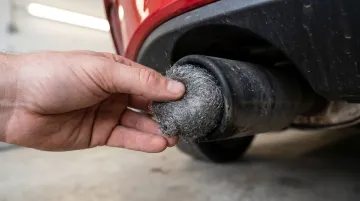
- Stuff steel wool into the exhaust tailpipe and air intake openings
- Write down every plug you place — it's easy to forget one at de-storage
- Block any other small gaps specific to your vehicle
Parking Brake
Don't use it. Brake pads pressed against rotors for months — especially in humid conditions — can bond to the surface, making them very hard to release without a shop visit. Use wheel chocks instead, or leave a manual transmission in gear.
Battery Care During Winter Storage
Why Batteries Die in Storage
Modern vehicles draw a parasitic current even with the ignition off — typically 50 to 85 milliamps — to maintain computer memory, alarm systems, and keyless entry modules. At 50 mA, a standard 60 Ah battery would theoretically deplete in roughly 50 days without charging. Cold temperatures compound this by slowing the battery's internal chemical reactions while also thickening oil and demanding more cranking power.
That drain leads directly to sulfation: lead sulfate crystals form on the battery plates when charge drops below 12.4 volts. According to Crown Battery, sulfation is the number one cause of premature lead-acid battery failure. Early sulfation is reversible; leave it long enough, and the battery is done.
Battery Maintainer vs. Trickle Charger
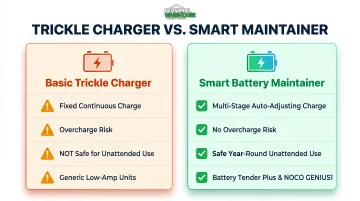
The two are often confused, but they behave very differently over months of storage.
| Basic Trickle Charger | Smart Battery Maintainer | |
|---|---|---|
| Charge delivery | Fixed, continuous | Multi-stage, auto-adjusting |
| Overcharge risk | Yes | No |
| Unattended use | Not safe | Safe year-round |
| Examples | Generic low-amp units | Battery Tender Plus, NOCO GENIUS1 |
A trickle charger delivers low current regardless of the battery's state. Over months, this causes heat buildup and plate damage. A smart maintainer monitors charge state and applies current only when needed — it's the right call for any vehicle sitting through winter.
If you don't have access to power in your storage space, disconnecting the negative terminal is a workable backup. It stops parasitic drain but leaves the battery vulnerable to self-discharge and cold. A maintainer is still the better choice wherever power is available.
On Starting the Car During Storage
Short idling sessions during storage cause more harm than simply leaving the car alone. Running an engine for five minutes doesn't heat the exhaust enough to vaporize condensation — it deposits moisture in the crankcase and exhaust system without the benefit of actually flushing contaminants. If you need to run the car, drive it for at least 20 minutes at full operating temperature — anything less does more harm than good.
Pest Prevention and Interior Protection
Why Stored Cars Attract Rodents
A parked car is essentially ideal rodent habitat. It's sheltered, dark, and packed with soft nesting materials — foam insulation, wiring jackets, and seat padding. Chewed wiring harnesses are among the most expensive storage outcomes, with repairs often reaching $2,000 or more. The problem is especially pronounced in colder, unheated spaces where rodents seek warmth.
What Actually Works
- Stuff steel wool into exhaust and intake openings — physical barriers are the most reliable deterrent
- Place peppermint oil sachets in the interior and engine bay; Orkin notes mice find menthol irritating, though reapplication every few weeks is necessary
- Plug in ultrasonic repellers if your storage space has power access
- Remove all food, wrappers, and organic debris before sealing the car up
One widely circulated home remedy — Irish Spring soap — is worth skipping. Greenix Pest Control notes that rodents may actually eat soap varieties containing animal fat, making it a potential attractant rather than a deterrent.
Interior Moisture Control
- Crack windows about an inch for air circulation to prevent stale air and mold buildup
- Place desiccant moisture packs inside on a disposable tray — AAA recommends these to manage interior humidity throughout storage
- Check and replace packs monthly; saturated desiccant loses effectiveness and can trap moisture against surfaces
What to Check When Taking Your Car Out of Storage
Don't just turn the key. A quick walk-around before starting can save you from costly mistakes and avoidable repairs.
Before starting:
- Check under the hood for rodent nests, chewed wires, or droppings
- Confirm all steel wool plugs and intake covers are removed
- Check all fluid levels — oil, coolant, brake fluid
- Reconnect or reinstall the battery
Tires and brakes:
- Check tire pressure — tires lose pressure over winter regardless of temperature
- Inspect for flat spotting or sidewall cracking
- Push the vehicle gently by hand before starting to confirm brakes aren't seized to rotors
First drive:
- Take it easy for the first 20 minutes, letting all fluids reach operating temperature before any hard acceleration
- If you stored with stabilized fuel, run the tank down and refuel with fresh gas at your first fill-up
Once everything checks out, your car should be ready to drive. A few minutes of inspection upfront is far cheaper than diagnosing a problem on the road.
Frequently Asked Questions
What's the best way to store a car for the winter?
Clean the car, change fluids, add fuel stabilizer to a full tank, manage the battery, and store it indoors in a space with stable temperature and humidity. That combination prevents the vast majority of winter storage damage.
Should you disconnect the battery when storing a car for the winter?
Disconnecting the negative terminal works as a simple option for short-term storage without power access. For long-term storage, a smart battery maintainer is the better choice — it actively prevents sulfation and keeps the battery ready to start in spring without overcharging it.
Is climate-controlled storage necessary for winter car storage?
For classic, collector, or high-value cars, yes. Unheated spaces can't control humidity cycling, freeze-thaw damage, or rodent pressure — all of which cause real damage over a full winter season.
Should I use a fuel stabilizer when storing my car for the winter?
Yes, for any storage period exceeding 30 days. Modern ethanol-blended gasoline degrades quickly and can leave gummy deposits that clog injectors and fuel lines. Stabilizer added to a full tank of fresh fuel protects the entire fuel system.
Should I use the parking brake when storing a car for the winter?
No. Brake pads held against rotors under constant pressure — especially in humid conditions — can fuse to the surface over months of storage. Wheel chocks or leaving a manual transmission in gear are the right alternatives.
How long can a car sit in storage without being started?
With proper preparation — fuel stabilizer, battery maintainer, fresh oil, correct tire pressure — a car can safely sit for a full winter season (four to six months) without being started. Periodic short idling sessions actually cause more harm than leaving the car undisturbed.