

Improper storage doesn't just scratch paint. It voids insurance policies, accelerates mechanical deterioration, and suppresses resale value in ways that can take years to surface. A 2023 break-in at a Colorado Springs storage facility — where broken gates, non-functioning cameras, and an unlocked unit led to the loss of a 1956 Chrysler Imperial and a 1964 Volkswagen Karmann Ghia — is a reminder that "stored" doesn't mean "safe."
This guide covers why storage is a financial decision for serious collectors, the four main storage models wealthy collectors use, what separates a premium facility from an ordinary one, and how to prepare a car before it goes in.
TL;DR
- Poor storage conditions — humidity, temperature swings, inadequate security — cause irreversible mechanical and cosmetic damage
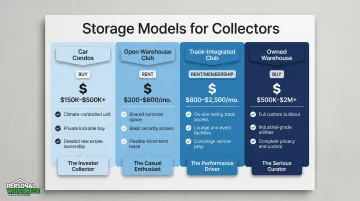
- Four main models: car condos, open warehouse/social club storage, track-integrated club storage, and owned warehouse units
- Top facilities provide climate control, multi-layer security, fire suppression, and concierge services
- Most specialist insurers require secure facility storage as a condition of policy eligibility
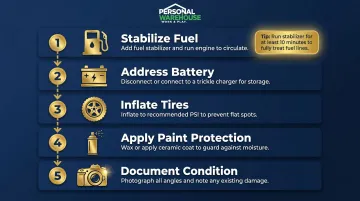
- Before storage: stabilize fuel, maintain the battery, inflate tires, wax the paint, and photograph everything
Why Proper Storage Matters for Collector Cars
Hagerty estimates roughly 43 million vehicles in the U.S. qualify as collector cars, representing approximately 16% of all registered vehicles. North American collector car auctions generated $2.2 billion in 2021 alone, with private sales adding an estimated $20–30 billion annually. At that scale, storage is asset management, not a logistics afterthought.
What Poor Storage Actually Does
The damage from inadequate storage is specific and compounding:
- Rust and corrosion form on metal components when moisture exposure is unchecked
- Rubber seals and tires crack and develop flat spots after months of stationary load
- Leather interiors dry out and crack when humidity drops below 30%
- Fluids degrade — fuel, brake fluid, coolant — when cars sit idle without treatment
- Rodents nest in upholstery and chew wiring, causing damage that's expensive to trace
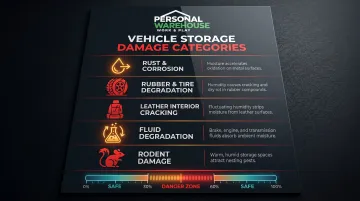
Humidity above 60% promotes mold and mildew; below 30% destroys leather and rubber. The acceptable window is narrow, and ordinary garages rarely hit it consistently.
The Insurance Angle
Specialist insurers are clear. Grundy Insurance requires vehicles to be "kept inside of a locked garage." Hagerty requires enclosed, secure storage for policy eligibility. Vehicles stored outdoors or in open carports are typically ineligible for coverage entirely — meaning an improperly stored car isn't just degrading, it's uninsured.
Storage and Resale Value
Condition at auction is unforgiving. Evidence of moisture damage, rodent intrusion, or flat-spotted tires suppresses offers and extends time-on-market. Conversely, a car with documented, consistent storage history commands a premium. The Hagerty Market Rating reached 61.01 in January 2025 — its first increase in 10 months — but median auction prices remain 20% below their 2022 peak. In a softer market, condition is one of the few variables a seller can control.
High-net-worth collectors also don't treat these cars as static displays. A properly stored vehicle comes out ready to drive; one stored poorly requires fluid checks, tire inspection, and mechanical review before it's road-safe — an inconvenience that discourages use and accelerates neglect.
Types of Collector Car Storage Solutions
Wealthy collectors don't use a single model. The right choice depends on collection size, access frequency, desired amenities, and whether they prefer to rent or own.
Car Condos — Purchasable Private Garage Units
Car condos are subdivided, purchasable garage units within a larger facility. Collectors buy the space outright and customize it to their specifications — epoxy floors, custom lighting, vehicle lifts, display cases, mezzanines.
Monterey Motorsport Park's 86-unit development illustrates the model well. Units range from approximately 700 to 2,100 sq ft, with amenities including fiber-optic internet, oversized rollup doors, and access-controlled entry. Initial pricing started at $250/sq ft in 2017 and appreciated to approximately $339/sq ft within 12–18 months — a 30%+ gain that made the purchase a real estate investment as much as a storage decision.
At the high end, T11 at Circuit of the Americas in Austin runs from $475,000 to $2.3M+ for units between 1,500 and 6,000 sq ft. Across the market, car condo purchase prices generally range from $250,000 to over $1.25 million depending on location and size.
The financial logic is straightforward: ownership builds equity, the purchase may qualify as a business expense, and well-located units in high-demand markets have demonstrated real appreciation.
Open Warehouse and Social Club Storage
The open warehouse model combines rental-based climate-controlled storage with social amenities — member lounges, events, rallies, and track days. OTTO Car Club in North Scottsdale (49,000 sq ft, opened 2018) is a well-documented example.
OTTO offers three storage tiers:
- Stacker suites — multi-level, air-conditioned, CO-monitored, 24/7 surveillance, trickle chargers included
- Main floor — independent parking with trickle chargers and display visibility
- Private garages — standalone units with individual alarms, climate control, and EV charger readiness
Social membership runs approximately $5,500/year; executive membership (which adds storage and collection management) is around $8,500/year, with monthly storage fees ranging from $400 to $1,000 depending on tier.
This model suits collectors who value community and curated automotive experiences alongside practical storage — and who'd rather not commit capital to a purchase.
Track-Integrated Club Storage
Track club storage puts collector cars steps from the pit lane. Members store vehicles at a private circuit and access them without trailering, enabling spontaneous track sessions on their schedule.
Apex Motor Club in Maricopa, Arizona operates on this model. Membership tiers range from a $25,000 initiation fee for under-35 members to $90,000 for Platinum (with $15,000 annual dues), granting 240+ annual track days and priority booking. It's the most lifestyle-integrated option available — suited to collectors who drive their cars at speed, not just park them.
Owned Warehouse Units
For collectors who want full control without the constraints of a shared facility, owned warehouse units offer the most flexibility. Unlike a track club or social storage model, there are no membership tiers, shared amenities fees, or facility rules dictating how you configure your space.
Personal Warehouse structures its units around a 99-year ground lease — giving buyers all the benefits of ownership without paying for the underlying land. Standard features include:
- Fully heated interiors with optional air conditioning
- Heavily insulated overhead doors
- All-LED lighting throughout
- 100/150-amp 3-phase electrical service
- Customizable mezzanines that expand usable space by up to 30%
That electrical spec matters for collectors running lifts, compressors, or EV charging — infrastructure that rental spaces rarely provide.
The Bozeman, MT project is currently under construction with 2026 delivery, accepting reservations now. SBA 504 and 7(a) financing is available through preferred lenders, making ownership accessible beyond a straight cash purchase. Personal Warehouse operates across markets including Montana, Colorado, Texas, and Florida — states where collector car culture has strong regional roots.
Every payment builds equity. That's the fundamental difference between owning a unit and renting one indefinitely.
What Wealthy Collectors Look for in a Storage Facility
When evaluating any facility, serious collectors work through a consistent checklist. These are the non-negotiables.
Climate and Humidity Control
The target environment is 50–70°F and relative humidity between 40–50%. Above 60% humidity, mold and mildew develop. Below 30%, leather and rubber dry out and crack. The temperature and humidity band is narrow enough that a thermostat "set and forgotten" isn't sufficient — continuous monitoring and documentation matter.
Security: Layers, Not Just Locks
Single-point security fails. The Colorado Springs theft proved it: non-functioning cameras, an unlocked unit, and plywood walls between bays were all thieves needed. The best facilities layer their security systems:
- Perimeter fencing with controlled vehicle access
- Continuous CCTV coverage across all areas
- Biometric or keycard entry for individual units
- Separate key and document strongrooms
- 24-hour staffing or remote monitoring
Birch, a high-security UK facility profiled by Robb Report, requires appointments before anyone enters — owners included. No unescorted access, period.
Fire Suppression and Pest Control
Collector car facilities need purpose-built fire suppression, not commercial sprinkler systems designed for office buildings. Birch's system includes a dedicated 90,000-liter water tank and 1,300 sprinklers, designed to isolate a thermal incident to a single vehicle without flooding an entire bay.
Rodent intrusion gets less attention than fire, but the damage is just as costly. It's one of the most common causes of wiring damage and interior destruction in stored vehicles — and straightforward to prevent with the right protocols in place.
Concierge and Collection Management Services
For collectors with large or geographically dispersed holdings, the right facility acts as a remote management hub. Top-tier operations typically offer:
- Battery trickle charging with app-based monitoring
- Detailing and valeting
- Mechanical maintenance coordination
- Domestic and international transportation logistics
- Photographic condition reports on intake
That last item matters for insurance and dispute resolution. Birch documents condition at intake as a baseline — not an add-on. If a facility doesn't offer it, collectors should conduct their own and request a co-signature.
Practical Tips for Preparing Your Collector Car for Storage
A premium facility can't compensate for a car stored in poor condition. Preparation before drop-off determines what you get back.
Essential pre-storage steps:
- Stabilize the fuel: E10 gasoline begins degrading in as little as 30 days. Fill the tank with fresh fuel (non-ethanol preferred), add a quality stabilizer — Hagerty's five-year test found STA-BIL the top performer — then run the engine until stabilized fuel reaches the carb or injectors
- Address the battery: Connect a quality battery tender regulated between 13.2 and 13.8 volts; if no charger is available, disconnect the negative terminal. If voltage drops below 11.5V before storage, remove and recharge separately
- Tires: Fully inflate to recommended storage pressure; for extended storage of six months or more, use tire cradles to distribute weight and prevent flat-spotting, or elevate on jack stands entirely
- Paint protection: Apply a fresh coat of wax before storage; place the car on a clean moisture barrier if it sits on a concrete floor
- Document everything: Photograph every panel, wheel, and interior surface before drop-off; ideally, have the facility co-sign a written condition report
Once in storage, don't leave the car completely static. Most experts recommend starting and exercising stored vehicles at least once a month. Run the engine to full operating temperature — not just idling — to circulate fluids, prevent brake rotor corrosion, and keep seals conditioned. A car left untouched for more than four weeks risks developing problems that preparation alone won't prevent.
Frequently Asked Questions
Are collector cars going down in value?
The broader market has experienced a correction from its 2022 peak — median auction prices are down roughly 20% — but the Hagerty Market Rating ticked upward in January 2025, suggesting stabilization. Well-maintained, properly stored examples with strong provenance consistently command premiums over poorly documented alternatives.
What is the ideal temperature and humidity for storing a collector car?
The recommended range is 50–70°F with relative humidity held between 40–50%. Above 60% humidity, mold and mildew form; below 30%, leather and rubber degrade. These targets require active monitoring, not just a thermostat setting.
How much does professional collector car storage typically cost?
Climate-controlled rental spaces run roughly $200–$450/month, while car condo purchases range from $250,000 to over $1.25 million depending on size and location. Owned warehouse units build equity with each payment — a meaningful difference from rental arrangements that produce no return.
Does proper storage actually lower insurance premiums for collector cars?
Secure, enclosed storage is a prerequisite for coverage with most specialist insurers — not just a discount trigger. Vehicles stored outdoors or in open carports are typically ineligible for policy coverage entirely, meaning proper facility storage is what makes the car insurable, not merely cheaper to insure.
How often should a stored collector car be started or driven?
Most experts recommend exercising a stored vehicle at least once a month. The goal isn't just running the engine — it needs to reach full operating temperature to vaporize condensed moisture internally. Simply idling in a garage doesn't accomplish this.
What car is hardest to steal?
Modern vehicles with factory immobilizers and GPS tracking are statistically harder to steal. For collector cars, which often lack current security tech, the facility matters most — controlled access, active CCTV, biometric entry, and 24-hour monitoring outperform any aftermarket device on the vehicle.