The honest answer is that it depends. Your car type, how long it'll sit, and where you live all shape the decision. A weekend driver being stored for two months in a mild climate needs a different setup than a '68 Mustang sitting through a Wisconsin winter.
This guide walks through what climate-controlled storage actually means, what happens to cars without it, which vehicles genuinely need it, and how to make the final call confidently.
TL;DR
- Climate-controlled storage maintains 55–85°F year-round and regulates humidity to 40–50%, preventing rust, mold, and cracking
- Classic cars, luxury vehicles, and anything stored 6+ months benefit most from full climate control
- Daily drivers stored short-term in mild climates are usually fine in a well-enclosed unit with proper prep
- Extreme cold (below 32°F), high humidity, and sustained heat can make climate control non-negotiable depending on your region
- A well-insulated enclosed unit with sealed overhead doors — like those at Personal Warehouse — offers a strong middle ground when full HVAC isn't required
What Climate-Controlled Car Storage Actually Means
Not all "indoor" storage is equal. Ask the wrong question when touring a facility, and you could end up paying for "climate control" that's really just a roof.
The Self Storage Association openly acknowledges that the storage industry has "played fast and loose" with the term "climate control" for decades — and that some states now hold facility owners legally liable for false claims. Before signing anything, ask specifically whether the unit uses active HVAC and whether humidity is regulated.
The Storage Spectrum
From least to most protective:
- Open outdoor parking — no protection from weather, UV, or temperature
- Covered carport — blocks rain and direct sun, nothing more
- Standard enclosed unit — protects from weather but doesn't regulate temperature or humidity
- Insulated enclosed unit — buffers temperature swings and reduces moisture intrusion without active HVAC
- Fully climate-controlled (HVAC) — actively maintains temperature (typically 55–85°F) and humidity (40–50% RH) year-round
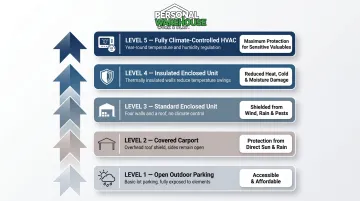
That gap between steps 3 and 5 matters more than most people expect. An enclosed metal building still tracks ambient outdoor temperatures — it just does so more slowly. On a Wisconsin January night averaging 6.7°F, even a well-insulated unheated structure will drop well below freezing.
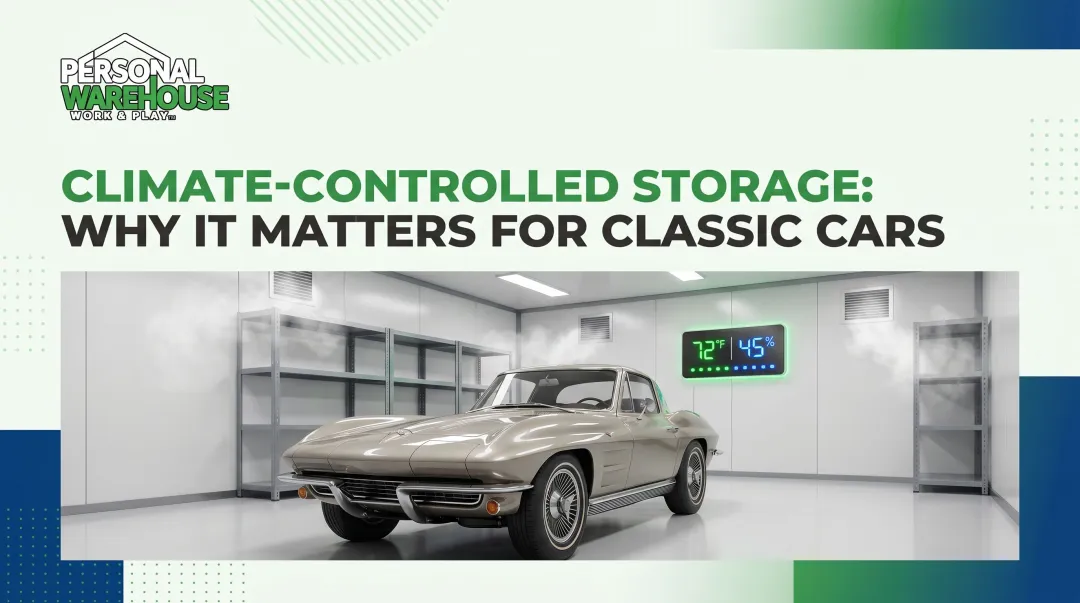
For collector vehicles, specialists often recommend a tighter range of 50–80°F and humidity held between 40–50% RH. Dantherm Group's automotive research confirms that negligible corrosion occurs when relative humidity stays in that 40–60% band — below 40%, and leather starts cracking; above 60%, rust accelerates markedly.
What Extreme Temperatures and Humidity Do to a Stored Car
Environmental damage in storage doesn't announce itself. It builds quietly over weeks and months — and by the time it's visible, the repair bill already reflects the delay.
Heat Damage
Sustained high temperatures affect multiple systems simultaneously:
- Rubber seals and weatherstripping dry out, crack, and lose elasticity
- Tires degrade from the inside out as rubber compounds break down
- Interior materials — leather, vinyl dashboards, plastic trim — fade, warp, and split
- Engine oil and fluids degrade faster, even without the engine running
Cold Damage
Cold creates a different set of problems, and some are severe. According to AAA's Automotive Research Center, a car battery loses roughly 35% of its strength at 32°F and approximately 60% at 0°F. Below freezing, that's a real startup failure risk — not a cosmetic one.
Beyond batteries:
- Engine oil thickens in cold temps, increasing wear during the first startup after storage
- Transmission fluid loses viscosity, reducing effectiveness
- Rubber components harden and crack with repeated freeze-thaw cycles
- Door seals and weatherstripping deteriorate faster under prolonged cold exposure
Humidity and Rust
Carbon steel corrosion begins in earnest once relative humidity climbs above 70–80%. But the real inflection point is around 60% RH — above that threshold, oxidation rates jump sharply. Coastal environments make this worse because salt air lowers the humidity level at which rust begins.
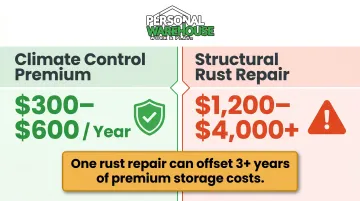
The cost gap between prevention and repair is stark. According to NewEnglandRust.com, structural or frame rust repair runs $1,200 to $4,000+. The climate-control premium over standard indoor storage? About $300–$600 per year. One rust repair incident can easily offset three or more years of premium storage costs.
Condensation and Mold
When a cold car is exposed to warm, humid air, moisture condenses inside the cabin and on electronics — even with windows cracked. That condensation creates two compounding problems: mold on upholstery, carpets, and steering wheels, and oxidation on electrical connectors. Hagerty has documented collector cars with mold blooms in enclosed storage where owners assumed "sealed and dry" meant safe. Electrical corrosion from moisture intrusion is particularly costly because it's labor-intensive to diagnose and trace before any parts are replaced.
Which Vehicles Actually Need Climate Control — and Which Don't
Classic and Collector Cars
Older vehicles are disproportionately vulnerable to environmental damage. The materials at risk include:
- Vintage wiring that cracks and shorts in temperature extremes
- Original rubber seals and gaskets that dry-rot in low humidity
- Irreplaceable trim pieces that warp or fade with moisture swings
A single humid summer or cold winter can degrade components that simply can't be sourced anymore. Climate control also protects resale value directly: collector car condition grading scales — like the widely used 1-to-6 system — factor environmental wear heavily, and a drop of even one grade can cut a vehicle's appraised value by 20% or more.
Daily Drivers and Modern Vehicles
Modern vehicles with factory paint protection, synthetic rubber seals, and corrosion-resistant coatings can generally tolerate standard storage conditions without significant degradation. If you're storing a vehicle you drive regularly and plan to return to use within a season, standard enclosed storage is usually sufficient.
That said, even daily drivers benefit from climate control in extreme climates — Montana winters and humid Southern summers accelerate battery drain, tire flat-spotting, and fluid breakdown regardless of vehicle age. The question isn't always about the car's value; it's about the conditions it will sit in.