Choosing climate-controlled storage is the right call, but it's only half the equation. A car stored with used oil, unstabilized fuel, and a battery slowly draining will deteriorate inside a climate-controlled unit just as surely as it would outside. The controlled environment protects a prepared car — it doesn't compensate for skipped steps.
This guide covers the exact preparation steps, the variables that determine how well your car holds up, and the mistakes that most commonly lead to expensive surprises at retrieval.
TL;DR
- Prep before storage matters most: clean the car, change fluids, stabilize fuel, protect the battery, and address tires
- Climate-controlled storage (55–80°F, 40–60% humidity) only protects a car that's been correctly prepared
- The most expensive mistakes are skipping the oil change, leaving fuel unstabilized, and ignoring the battery
- If you're storing a vehicle for 3+ months — especially a collector car or in a region with harsh seasons — climate-controlled storage is worth it
- Check in every 4–6 weeks even in a climate-controlled unit
How to Prepare Your Car for Long-Term Climate-Controlled Storage
Step 1: Clean and Detail the Car Inside and Out
Wash, dry, and wax the exterior before the car goes in. Dirt, road salt, and bird droppings left on paint don't become inert in storage — they continue reacting with the clear coat over months. A coat of wax creates a barrier against residual contaminants between the paint and any moisture that makes its way past the cover.
Inside, vacuum thoroughly, wipe down all surfaces, and remove every piece of food or organic material. Even a forgotten granola bar can attract rodents. Moisture trapped in carpet or upholstery promotes mold growth even inside a climate-controlled space.
Step 2: Change Fluids and Stabilize the Fuel
Each fluid in your car serves as either a protectant or a vulnerability during long-term inactivity. Address these three before storage:
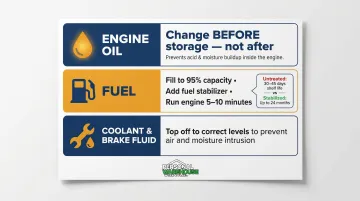
- Engine oil: Change it before storage, not after. Used oil accumulates acids, moisture, and combustion byproducts that corrode engine components during inactivity. Mobil 1's Grassroots Motorsports Coordinator David Swain confirms oil should be changed at least once per year regardless of mileage.
- Fuel: AAA notes gasoline has roughly a 30–45 day shelf life untreated. Fill to near capacity (STA-BIL specifies 95% full) to minimize condensation, add a fuel stabilizer, then run the engine for 5–10 minutes to circulate it. STA-BIL Storage keeps fuel fresh for up to 24 months.
- Coolant and brake fluid: Top both off to recommended levels. Low levels allow air and moisture into closed systems, accelerating internal corrosion.
Ethanol-blended fuels deserve extra attention. Ethanol is hygroscopic — it actively pulls moisture from the air and creates acidic compounds that corrode fuel system components. If your fuel contains ethanol, use a stabilizer rated specifically for ethanol blends.
Step 3: Protect the Battery
Modern vehicles draw current even with the key removed — computers, alarm systems, and other accessories can drain a connected battery in just a few weeks. OPTIMA Batteries confirms that sulfation begins when any 12-volt battery drops below 12.4 volts, and prolonged discharge creates irreversible crystalline deposits that no standard charger can break down.
Two options:
- Disconnect the negative terminal and store the battery separately in a cool, dry location
- **Connect a smart battery maintainer** — not a basic trickle charger — to the vehicle
A standard trickle charger applies fixed voltage indefinitely with no overcharge protection. A smart maintainer cycles through multiple charging stages, shuts off automatically when full, and can even perform desulfation. For older vehicles with more sensitive electrical systems, a smart maintainer is the only safe choice.
Step 4: Prepare Tires, Brakes, and the Undercarriage
Continental Tires documents that semi-permanent flat-spotting occurs after a vehicle sits under load for a month or longer, accelerated by cold temperatures and temperature swings. To minimize risk:
- Inflate tires to manufacturer's recommended PSI before storage (Continental recommends a slight increase of +0.2 bar; Michelin advises staying at placard pressure — check your tire type and follow the more conservative guidance if unsure)
- For storage beyond 3 months, place the vehicle on jack stands to eliminate contact patch pressure entirely
Apply a light coat of rust inhibitor to exposed undercarriage metal and brake components, particularly if the car has been driven in wet or salted conditions recently.
Leave the parking brake disengaged. AAA explicitly warns against using the parking brake during long-term storage — it can fuse brake pads to rotors, requiring significant mechanical work to free. Use wheel chocks to keep the vehicle stationary instead.
Step 5: Seal Against Pests, Cover the Car, and Document Its Condition
Block the exhaust pipe and any air intake openings with steel wool or purpose-made plugs. AAA warns that rodents can cause thousands of dollars in damage by nesting in stored vehicles. Leave a brightly colored tag visible in the cabin as a reminder to remove these plugs before starting.
Use a breathable fabric car cover, not plastic or vinyl. A breathable cover allows air circulation and prevents moisture from becoming trapped against the paint. A plastic cover creates the opposite effect — a sealed microclimate that concentrates humidity right where you don't want it.
Before storage, photograph the car from all angles. This condition record matters more than most owners expect if you ever need to file an insurance claim.
Key Variables That Affect How Well Your Car Holds Up
Proper preparation sets the baseline. These variables control whether the car maintains that condition throughout the storage period.
Temperature Stability
Fluctuating temperatures cause repeated expansion and contraction of rubber seals, gaskets, hoses, and plastic components. Even minor swings outside the 55–80°F ideal range accelerate material degradation over months.
Ask your storage facility how tightly temperature is regulated. Facilities with basic HVAC may still experience notable swings during extreme seasonal weather. Personal Warehouse units feature independent insulation in each unit — including heavily insulated overhead doors — rather than relying solely on centralized HVAC.
This means interior conditions stay stable at the unit level regardless of what's happening outside. That's especially relevant at locations like Bozeman, MT, where winter temperatures can be severe.
Humidity Control
Humidity is often more damaging than temperature alone. Cotes, a dehumidification specialist for classic car storage, recommends maintaining relative humidity between 35–55%. Above 60% RH, corrosion risk on metal surfaces increases significantly. High humidity also accelerates rubber seal deterioration, promotes mold on leather and upholstery, and causes electrical connection failures.
When evaluating a storage facility, ask whether humidity is actively monitored and logged — not just passively regulated. There's a meaningful difference between a facility that checks humidity occasionally and one that tracks it continuously.
Fluid and Fuel Condition at the Time of Storage
A car stored with fresh oil and stabilized fuel will need far less post-storage servicing than one stored with degraded fluids. The qualitative cost difference is real:
- Fuel system cleaning for clogged injectors and varnished lines: $300–$500+
- Battery replacement from irreversible sulfation: $150–$300
- Tire replacement from permanent flat-spotting: $400–$1,200
- Rodent damage to wiring harnesses: potentially thousands
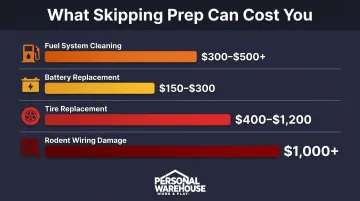
Those costs add up fast — and every one of them is avoidable with proper prep before the car goes in.
Check-In Frequency
Even in a climate-controlled unit, problems can develop — a slow fluid leak, pest entry despite precautions, a failing battery maintainer. Catching these early is what separates a minor inconvenience from an expensive repair.
Recommended schedule:
- Storage under 6 months: check in every 4–6 weeks
- Storage beyond 6 months: monthly visits
During each check-in: verify tire pressure, check beneath the car for fluid leaks, inspect the car cover, and confirm the battery maintainer is functioning.
Common Mistakes When Preparing a Car for Climate-Controlled Storage
These mistakes consistently lead to expensive damage discovered only at retrieval:
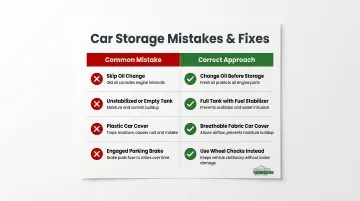
- Skipping the pre-storage oil change — used oil looks fine but is chemically active. It continues corroding engine internals during months of inactivity regardless of mileage since the last service. Change it every time, no exceptions.
- Leaving fuel unstabilized or storing with a near-empty tank — an empty tank allows moisture condensation on internal surfaces. Untreated fuel in a full tank will varnish fuel system components within 30–60 days. Full tank + stabilizer is the only correct combination.
- Using a plastic or vinyl car cover inside a climate-controlled unit — it traps humidity directly against the paint, creating exactly the moisture damage the controlled environment is designed to prevent. Breathable fabric covers only.
- Leaving the parking brake engaged — brake pads bond to rotors during extended storage, a common failure that requires a mechanic to fix. Use wheel chocks instead.
When Is Climate-Controlled Car Storage Worth It?
Climate-controlled storage adds roughly $25–$50 per month over standard indoor storage, according to 2025 data from Extra Space Storage. Over a 6-month storage season, that's $150–$300.
Compare that to a single set of replacement tires ($400–$1,200), a new battery ($150–$300), or fuel system cleaning ($300–$500+). For most vehicles facing those risks, the premium pays for itself after one repair avoided.
Climate-controlled storage is clearly justified when:
- The vehicle is a classic, collector, or high-value car where any depreciation matters
- Storage exceeds 3 months
- The region experiences extreme temperature or humidity swings — Montana winters, Florida summers, or coastal humidity year-round
- The vehicle has leather interior, sensitive electronics, original paintwork, or high-performance tires
Standard enclosed storage may be adequate when:
- The vehicle is a newer daily driver stored for a short period in a mild climate
- The storage period is under 60–90 days
- The car has already been properly prepped and will be checked on regularly
For owners who also use their storage space for maintenance work between drives, a rental unit has a ceiling. Owning a Personal Warehouse unit removes that ceiling entirely — with individually metered electrical service (100/150-amp 3-phase) for battery maintainers, lifts, and shop equipment, plus insulation and heating systems that hold stable conditions year-round.
How to Take Your Car Out of Long-Term Storage
Before touching the ignition:
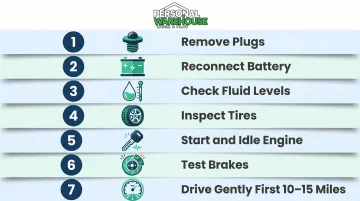
- Remove all intake and exhaust plugs — check your reminder tags; a missed plug can cause serious engine damage
- Reconnect or reinstall the battery — if discharged, use a dedicated battery charger rather than relying on the alternator
- Check fluid levels — top off anything that has dropped; inspect beneath the car for any leaks that developed during storage
- Inspect all four tires — check pressure and look for visible sidewall cracking or flat-spot deformation; inflate to correct PSI before moving
- Start the engine — let it idle for several minutes before moving
- Press the brake pedal firmly — brake components may need a brief re-seating period before the car rolls
- Drive gently for the first 10–15 miles — this allows fluids, seals, and tires to return to normal operating temperatures
If the vehicle was stored for more than 6 months, schedule a post-storage inspection with a mechanic before putting it back into regular use.
Avoid brief cold starts during storage. Briefly starting a stored car every few weeks does more harm than good — AAA notes it contaminates engine oil without reaching full operating temperature, and the energy used to crank the engine may exceed what a short idle replaces, accelerating battery discharge rather than preventing it.
Frequently Asked Questions
How do I prepare my car for long-term climate-controlled storage?
The five key steps are thorough cleaning, fluid changes with fuel stabilization, battery protection, tire and brake preparation, and pest and cover protection. Each works in tandem with the controlled environment. Skipping any one creates a vulnerability that climate control alone can't compensate for.
Can a car sit in storage for 6 months without being driven?
Yes, when properly prepared — fresh oil, stabilized fuel, a smart battery maintainer, and correct tire inflation. Periodic check-ins every 4–6 weeks are still recommended to catch any developing issues like slow leaks, a failing maintainer, or unexpected pest activity.
What temperature and humidity should climate-controlled car storage be set to?
The recommended range is 55–80°F for temperature and 40–60% relative humidity. Confirm with your storage facility that these levels are actively monitored year-round, not just passively regulated, particularly during extreme seasonal weather.
Should I keep the gas tank full or empty during long-term storage?
Full (or near-full) with fuel stabilizer added. An empty tank allows condensation to form on internal surfaces. Untreated fuel in any quantity will oxidize and leave varnish deposits in fuel lines and injectors within 30–60 days.
Do I still need a car cover inside a climate-controlled storage unit?
Yes — a breathable fabric cover protects against dust accumulation, prevents minor scratches, and adds a layer of moisture management. Never use plastic or vinyl; they trap humidity against the paint and cause the exact damage you're trying to avoid.
How often should I check on my car during long-term storage?
Every 4–6 weeks. At each visit, verify the battery maintainer is functioning, check tire pressure, look for fluid leaks beneath the vehicle, and inspect the car cover.