With vehicle values tied directly to condition, and AAA estimating Americans spend over $3 billion per year repairing rust damage from road de-icers alone, storage decisions carry real financial consequences. This guide breaks down both options honestly — costs, protection levels, trade-offs, and when each makes sense.
TL;DR
- Indoor storage — enclosed units, climate-controlled spaces, or private warehouse bays — offers the best protection for high-value, classic, or luxury vehicles stored long-term
- Outdoor storage (open lots or covered carports) costs less and works well for everyday vehicles, short-term needs, or oversized vehicles
- Climate matters: in Montana, Wisconsin, Michigan, or Colorado, indoor storage often pays for itself by preventing rust and component damage
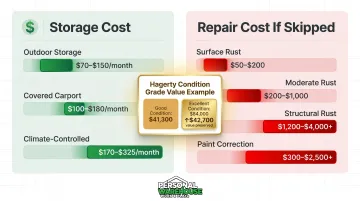
- Cost gap: outdoor runs $70–$180/month; indoor climate-controlled runs $170–$325/month — but one rust repair can cost $1,000–$4,000+
- Your best option comes down to vehicle value, local climate, storage duration, and total cost over time
Indoor vs. Outdoor Car Storage: Quick Comparison
| Feature | Uncovered Outdoor | Covered Carport | Enclosed Indoor | Climate-Controlled Indoor |
|---|---|---|---|---|
| Monthly Cost | $70–$150 | $100–$180 | $148–$270 | $170–$325+ |
| Weather Protection | None | Rain/snow blocked; sides exposed | Full enclosure | Full enclosure + temp/humidity control |
| UV Protection | None | Partial | Full | Full |
| Security | Fenced perimeter, basic lighting | Fenced lot, basic lighting | Surveillance, coded gate access | Controlled access, 24/7 monitoring |
| Accessibility | Drive in anytime | Drive in anytime | May have access hours | May have access hours |
| Best For | Short-term, daily drivers | Budget-conscious, moderate climates | Long-term storage, theft deterrence | Classic/collector cars, harsh climates |
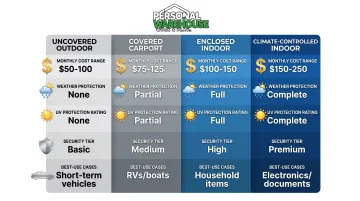
Cost data sourced from Extra Space Storage, RecNation Storage, and MyGoodMovers (2026).
Those figures vary widely by location. Denver averages around $241/month for vehicle storage, while Montana markets like Darby range from $50–$300/month depending on unit type. In rust-prone states — Montana, Wisconsin, Michigan — the indoor premium often pays for itself after a single paint or corrosion repair bill.
Indoor Car Storage: Types, Pros, and Cons
Indoor car storage comes in three main forms:
- Standard enclosed units — walled, roofed, with a rollup or overhead door, no dedicated climate controls. Functions like a large garage bay.
- Climate-controlled units — adds active temperature and humidity regulation, typically maintaining 55°F–80°F with humidity around 40%–50%.
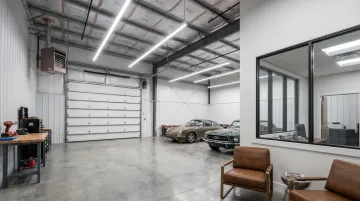
- Private warehouse units — owned rather than rented, fully customizable, and designed for long-term storage without the recurring cost of a lease.
Weather and Corrosion Protection
Enclosed storage eliminates the primary damage mechanisms that affect outdoor vehicles: direct UV exposure, precipitation, and ambient temperature swings. Climate-controlled environments go further by preventing condensation — the process by which moisture in the air settles on cool metal panels and undercarriage components, creating the conditions for oxidation.
In northern climates, this matters more than most owners realize. Freeze-thaw cycles cause rubber seals and gaskets to lose elasticity, tire sidewalls to develop micro-cracks, and metal surfaces to corrode wherever protective coatings have been compromised. A stable temperature above freezing eliminates this cycle entirely.
Security Advantages
Indoor facilities typically offer:
- Gated, coded entry access
- Surveillance camera systems
- Well-lit driveways and unit areas
- Individual locking mechanisms on each unit
Private ownership takes security further — the owner controls access completely, with no shared facility access to manage.
Honest Drawbacks
- Higher monthly cost than outdoor alternatives
- Large vehicles (lifted trucks, wide RVs) may not fit standard unit dimensions — always confirm clearances before reserving
- Some facilities restrict access hours
- Standard enclosed units without climate control can still see temperature swings in extreme climates
Personal Warehouse: An Ownership Alternative
Those drawbacks — monthly cost with no return, no equity, no control — are exactly what the ownership model addresses. Personal Warehouse offers condominium-structured units for collectors and enthusiasts who'd rather build equity than pay rent indefinitely. Units in Bozeman, MT (under construction, accepting reservations for 2026 delivery) include:
- Fully heated as standard, with optional A/C
- Heavy-gauge insulated overhead doors
- High-efficiency insulation throughout
- All-LED lighting inside and out
The financial structure shifts the equation. Buyers build equity in the unit, which can be held for personal use, leased for rental income, or sold. Financing is available through SBA 504 and 7(a) loans at terms comparable to residential mortgages — making ownership accessible without a large upfront cash outlay.
Outdoor Car Storage: Types, Pros, and Cons
Outdoor storage breaks into two straightforward options:
- Uncovered open lots — a designated parking space within a secured or fenced facility, no roof, minimal shelter
- Covered carports — open-sided, roofed structures that block direct sun, rain, and snow accumulation while leaving the vehicle exposed on the sides
Cost and Flexibility Advantages
Uncovered outdoor storage carries the lowest monthly costs of any storage type — $70–$150/month in most markets. That works well for everyday drivers who rotate vehicles frequently or owners with short-term storage needs. Covered carports offer a meaningful middle ground: noticeably better protection than an open lot at a fraction of indoor pricing.
Outdoor spaces also accommodate larger vehicles — wide trucks, RVs, boats on trailers — that often won't fit through standard indoor unit doors.
Weather and Degradation Risks
Those cost savings come with real tradeoffs, particularly for vehicles stored long-term. Three degradation risks stand out:
- UV exposure breaks down clear coat and pigment layers, causing oxidation, chalking, and eventual peeling
- Moisture and road salt accelerate rust on body panels and undercarriages
- Freeze-thaw cycles degrade rubber seals, wiper blades, and tires faster than controlled storage
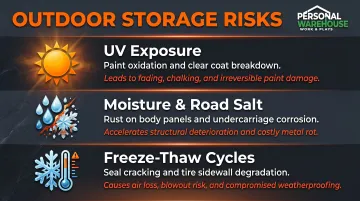
These risks translate directly into repair bills:
| Repair Type | Cost Range |
|---|---|
| Surface rust repair | $50–$200 |
| Moderate rust repair | $200–$1,000 |
| Structural/frame rust | $1,200–$4,000+ |
| Paint correction (basic) | $300–$500 |
| Paint correction (advanced) | $1,200–$2,500+ |
| Panel replacement | $1,000–$4,000 per panel |
A single moderate rust repair runs $200–$1,000 — more than one to two months of indoor storage at most facilities.
Security Limitations
Outdoor lots, even within fenced facilities, offer lower theft and vandalism protection than enclosed units. A quality car cover adds a layer of protection and reduces UV exposure, but it doesn't replace the structural security of four walls and a lockable door.
Where Outdoor Storage Makes Sense
- Daily-use vehicles driven several times per week (exposure risk accumulates slowly for frequently driven cars)
- Short-term storage in mild climates — storing a second car for a few weeks in a southern state
- Oversized recreational vehicles or work trucks that exceed standard indoor unit dimensions
- Budget-constrained owners prioritizing cost over maximum protection
Indoor vs. Outdoor Car Storage: Which Is Right for You?
There's no universal answer here. The right choice comes from four intersecting factors.
Factor 1: Vehicle Value and Type
Go indoor if:
- Classic, collector, or luxury vehicle
- Original paint or interior in good condition
- Significant sentimental or resale value
Outdoor may be fine if:
- High-mileage daily driver with no collector value
- Vehicle already shows wear and cosmetic damage
- You plan to sell within 6 months regardless of condition
Factor 2: Local Climate
In Montana, Wisconsin, Michigan, and Colorado, the case for indoor storage isn't theoretical — it's financial. Road salt use in 27 states means vehicles with any existing paint chips or undercarriage exposure face active corrosion risk even when parked. Covered outdoor storage in these climates is a reasonable compromise for short durations; for anything beyond 30–60 days, indoor storage is strongly advisable.
In mild southern or coastal climates, covered outdoor storage may be adequate for moderate-value vehicles stored short-term. That adequacy erodes quickly once you cross the 60-day mark.
Factor 3: Storage Duration
Vehicles stored beyond 30–60 days start accumulating compounding risks:
- Battery drain and sulfation
- Tire flat spots from prolonged stationary contact
- Fuel degradation
- Moisture infiltration into seals and interior
Climate-controlled indoor storage manages all of these risks more effectively. Short-term storage — a few days to a few weeks — rarely justifies the cost premium for an everyday vehicle.
Factor 4: Budget vs. Total Cost
The smarter frame isn't "how much does storage cost per month" — it's "what does the wrong storage decision cost over two years?" One moderate rust repair ($200–$1,000) or a full paint correction ($600–$2,500) can exceed 6–15 months of climate-controlled storage costs. For collector vehicles, Hagerty's condition rating data shows a single condition grade improvement can double a vehicle's market value — a 1974 Alfa Romeo GTV jumps from $41,300 in "Good" condition to $84,000 in "Excellent," a 103% premium driven largely by preservation quality.
Quick Decision Guide
Choose indoor if you:
- Own a classic, luxury, or collector vehicle
- Are storing for more than 2 months
- Live in a high-weather-risk state (MT, WI, MI, CO)
- Care about maintaining resale value
- Want theft protection beyond a fenced lot
Choose outdoor (covered) if you:
- Have an everyday vehicle with no collector value
- Need short-term storage (under 4–6 weeks)
- Are budget-constrained and in a mild climate
- Have an oversized vehicle that won't fit indoor unit dimensions
If the indoor column fits your situation and you're looking for a permanent solution — ownership rather than ongoing rental — Personal Warehouse offers condominiumized warehouse units built for exactly this use case. Their Bozeman, MT project is currently accepting reservations for 2026 delivery. Contact the team at personalwarehouse.com or call 303-222-0768 to explore unit options and financing.
Conclusion
Indoor storage offers stronger protection for vehicle condition and long-term value, particularly in harsh climates and for cars that carry real worth — financial or otherwise. Outdoor covered storage is a practical option for the right vehicle and the right duration, not a category to dismiss outright.
What matters is treating this decision as part of your vehicle maintenance strategy. The wrong storage choice doesn't just risk cosmetic damage — it accelerates mechanical deterioration and steadily cuts into resale value over months and years. The smarter move is matching your storage to what the vehicle is actually worth to you — and what degradation over a Montana winter, a Florida summer, or two years of neglect would actually cost to reverse.
Frequently Asked Questions
Is it worth getting climate-controlled car storage?
For high-value, classic, or luxury vehicles stored more than a couple of months (especially in regions with extreme temperatures or humidity), yes. Climate-controlled storage prevents rust, paint degradation, and seal failures that can cost far more to repair than the monthly premium.
Are cars safer in a climate-controlled storage unit than parked outdoors?
Significantly so. Climate-controlled units provide both physical security (enclosed walls, gated access, surveillance) and environmental protection from UV, moisture, and temperature swings. Outdoor parking offers neither.
Will cars rust if stored outdoors?
Outdoor storage increases rust risk, particularly in rainy, snowy, or humid climates where moisture and residual road salt corrode metal panels and undercarriages over time. A quality car cover reduces UV and moisture exposure but doesn't eliminate the risk.
Is it better to keep a car in a garage or outside?
A garage, even an unheated one, is generally better for long-term storage because it eliminates direct UV exposure, precipitation, and temperature extremes. A climate-controlled garage offers the highest level of preservation for vehicles that matter.
Can you legally store a car in a storage unit?
Yes, in most U.S. states. Facilities typically require a unit of at least 10×20 feet, valid registration and insurance, and a vehicle in working condition. Fire codes prohibit storing extra fuel inside. Always confirm the specific facility permits vehicle storage before reserving.