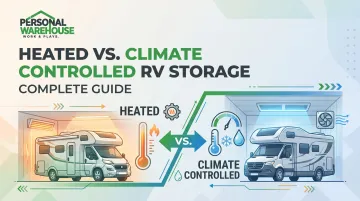
The confusion starts with terminology. "Heated" and "climate-controlled" get used interchangeably in storage facility marketing, but they describe meaningfully different environments. One keeps your RV from freezing. The other protects it from everything.
This guide breaks down exactly what each option delivers, what it doesn't, and how to match the right storage type to your RV, your climate, and your storage timeline.
TL;DR
- Heated storage keeps temperatures above freezing (45–65°F) in winter — prevents frozen pipes and battery damage, but doesn't control humidity or summer heat
- Climate-controlled storage holds 55–80°F year-round and regulates humidity, protecting fabrics, electronics, cabinetry, and roof membranes
- Heated storage is the minimum for cold-climate owners — climate-controlled is the smarter choice for long-term storage or high-value RVs
- Mold remediation averages $2,368 — the cost difference between storage tiers can pay for itself after one avoided repair
- Neither option replaces proper winterization, but both dramatically reduce risk compared to outdoor storage
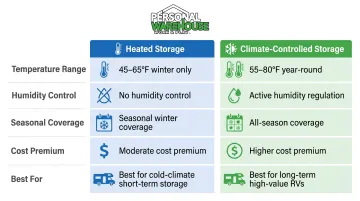
Heated vs. Climate-Controlled RV Storage: Quick Comparison
Before diving into each option, here's how they stack up across the dimensions that matter most for RV owners:
| Feature | Heated Storage | Climate-Controlled Storage |
|---|---|---|
| Temperature range | 45–65°F (winter only) | 55–80°F year-round |
| Humidity control | Usually none | Often included |
| Seasonal coverage | Winter-focused | All seasons |
| Cost | Moderate premium | Higher premium |
| Best for | Cold-climate winter storage | Long-term, high-value, multi-season |
Indoor storage is not the same as heated or climate-controlled. A basic enclosed unit may simply be a building with no temperature management — better than outdoor exposure, but offering none of the freeze or humidity protection discussed here.
Availability varies by region. In states like Montana, Wisconsin, and Michigan, heated storage is common because demand is driven by sub-zero winters. Climate-controlled options are more universally available across markets.
What Is Heated RV Storage?
Heated RV storage is an enclosed bay or building where active heating systems keep interior temperatures above freezing during winter months, typically in the 45–65°F range. The goal is straightforward: prevent the specific damage that occurs when temperatures drop hard and stay there.
What Heated Storage Protects
The components most vulnerable to sustained freezing are:
- Freshwater lines and holding tanks: water expands when it freezes, causing lines to crack and tanks to split
- Batteries: cold dramatically reduces charge capacity and lifespan; LiFePO4 batteries have manufacturer-defined storage limits as low as -15°F, but performance degrades well before that
- Slide-out mechanisms and rubber seals stiffen and become brittle in sustained sub-freezing temperatures; nitrile seals perform to about -40°F but lose elasticity near the limit
- LP gas regulators can freeze during shoulder-season temperature swings when moisture condenses at the restriction point
Montana's January average temperature sits below 25°F across most of the state, with recorded lows reaching -70°F at Rogers Pass. Wisconsin's statewide January average hovers around 15.3°F. Michigan's Upper Peninsula regularly sees January lows of 2–10°F. In these climates, freeze protection isn't a luxury — it's the baseline requirement.
What Heated Storage Doesn't Do
This is where many RV owners get caught off guard. Heated storage:
- Does not cool the RV in summer
- Does not manage humidity levels (unless explicitly included)
- Does not prevent mold if moisture is already trapped inside the RV's interior
The structural quality of the facility matters as much as the heater itself. A well-built heated facility relies on two structural elements above all else: high-efficiency insulation and insulated overhead doors. Without both, a heater just compensates for heat escaping through the walls — and Personal Warehouse's Montana spaces are built with exactly that in mind.
When Heated Storage Makes Sense
Heated storage is the right call when:
- You're storing primarily through winter in a hard-freeze climate
- You've completed proper winterization (drained water lines, stabilized fuel, managed battery charge)
- Storage duration is roughly 3–6 months
- Your RV is a Class A, B, or C motorhome or fifth wheel
It adds meaningful protection, but only when paired with proper winterization before the RV goes in.
What Is Climate-Controlled RV Storage?
Climate-controlled storage maintains a consistent temperature range year-round — typically 55–80°F — using both heating and cooling systems. Many facilities also actively regulate humidity levels, which is where it earns its premium.
The Humidity Problem Nobody Talks About Enough
Temperature gets most of the attention in cold climates. Humidity does most of the damage.
When warm, moist air gets trapped inside an enclosed RV and temperatures fluctuate, condensation forms. That moisture settles into upholstery, cabinetry, wall panels, and subflooring.
EPA guidance is clear: keep indoor relative humidity below 60% — ideally 30–50% — to prevent mold growth. Anything above that threshold, sustained over weeks or months, creates the conditions for mold colonies, musty odors, and structural damage.
Climate-controlled storage with active dehumidification addresses this directly. Without it, even a well-heated enclosed space can develop moisture problems if the RV's interior wasn't completely dried before storage.
Additional Components Climate Control Protects
Beyond freeze prevention, year-round temperature and humidity stability protects:
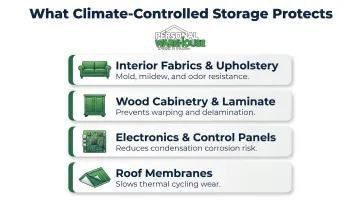
- Interior fabrics and upholstery — mold, mildew, and odor resistance
- Wood cabinetry and laminate panels — prevent warping and delamination from humidity swings
- Electronics and control panels — condensation on circuit boards causes corrosion; climate-stable environments reduce that risk significantly
- Roof membranes — EPDM and TPO are engineered for cold exposure, but repeated extreme thermal cycling accelerates wear
One Critical Caveat
Not every facility that advertises "climate-controlled" includes humidity management. Temperature regulation and dehumidification are different systems. Before signing any storage agreement, ask the facility directly: Do you actively manage relative humidity, and what's the target RH range? If they can't answer that, assume humidity isn't controlled.
Cost Context
Climate-controlled storage costs more than heated-only — that's the trade-off. As a reference point, a 10x20 indoor heated unit in Colorado runs around $230/month depending on the market. Climate-controlled units carry a premium above that. Compare either number to mold remediation costs averaging $2,368 — ranging $1,223–$3,755 for a typical job — and the math shifts quickly.
When Climate-Controlled Storage Makes Sense
That cost math points directly to who benefits most. This is the right choice for:
- RV owners storing 6+ months
- Owners of Class A diesel pushers ($150k–$300k new) or luxury fifth wheels ($26k–$250k+)
- Anyone in a region with both harsh winters and hot summers
- RVs with interior belongings stored year-round
- Owners who want a move-in-ready interior at the start of each season without deep cleaning and deodorizing
Heated vs. Climate-Controlled: Which Is Right for Your RV?
There's no universal winner. The right answer depends on three variables: local climate severity, storage duration, and RV value.
Situational Recommendations
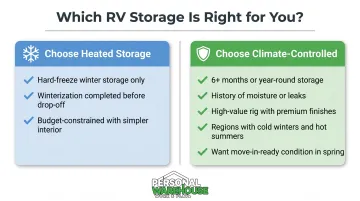
Choose heated storage if:
- You're in a hard-freeze climate storing through a single winter season
- Proper winterization is complete before drop-off
- Budget is a primary constraint and the RV interior is relatively simple
Choose climate-controlled if:
- You're storing 6+ months or year-round
- Your RV has a history of any moisture intrusion or leaks
- You own a high-value rig with sensitive electronics, custom interiors, or premium finishes
- You're in a market with both cold winters and hot summers (Montana, Colorado, Texas hill country)
- You want to open the door in spring and drive — not scrub
The Outdoor Storage Baseline
Even basic enclosed (non-heated) indoor storage beats outdoor exposure in cold climates. Outdoor storage exposes your RV to UV degradation, freeze-thaw cycling, precipitation, and pest entry — all of which compound over a winter season.
Uncovered outdoor storage in extreme-temperature regions isn't just inconvenient — accumulated repair costs from freeze-thaw damage and UV deterioration routinely exceed the money saved on monthly fees.
For RV owners in Montana, Michigan, Wisconsin, Colorado, and other cold-weather markets where Personal Warehouse operates, the most valuable next step is talking directly with a storage provider about the specific insulation, heating systems, and access features of their bays. Personal Warehouse units include fully heated bays with optional A/C, high-efficiency insulation, and heavy-duty insulated overhead doors — the structural details that separate genuine protection from a basic roof. If you're evaluating ownership options for long-term RV storage, reaching out to Personal Warehouse is a practical starting point.
Conclusion
Heated storage is the practical floor for any RV owner in a hard-freeze climate. Climate-controlled is the ceiling — full-season protection for the RVs and owners where long-term preservation matters most.
Neither is a wrong choice if it matches your actual situation. The real mistake is choosing based on price alone — that's how $3,000 mold remediation jobs happen to $150,000 rigs. The cost difference between storage tiers is almost always smaller than a single major repair, and far smaller than the resale value lost to interior damage that accumulates over a storage season.
Match the storage type to your climate, your rig, and how long it sits. That decision costs you nothing extra to make right — and it can save you thousands.
Frequently Asked Questions
What is the difference between climate-controlled storage and heated storage for RVs?
Heated storage manages winter temperatures only — keeping the interior above freezing to prevent pipe and battery damage. Climate-controlled storage maintains a consistent temperature range year-round and typically also manages humidity, making it the more comprehensive option for full-season RV preservation.
Is it better to store an RV indoors or outdoors?
Indoor storage — heated or climate-controlled — offers significantly better long-term protection. Outdoor exposure brings UV damage, freeze-thaw cycling, precipitation, and pest entry, all of which shorten lifespan and hurt resale value.
Is climate-controlled storage worth it for an RV?
For high-value RVs, long-term storage, or regions with both extreme heat and cold, yes. Mold remediation alone averages $2,368, and humidity-related damage to electronics, cabinetry, and fabrics can cost substantially more on higher-end units.
How should I store an RV in extreme heat?
Heat damages roof membranes, degrades rubber seals, warps interior laminate, and stresses electronics. Climate-controlled storage is the best option — at minimum, choose a shaded, enclosed indoor space with ventilation.
Can mold grow in climate-controlled RV storage?
Yes — if moisture is trapped inside before storage or if the facility regulates temperature only. Thoroughly dry and clean the interior before move-in, and confirm the facility actively maintains relative humidity below 60% (the EPA recommends 30–50% for mold prevention).