That's a mistake worth avoiding. The wrong storage decision doesn't just mean a dirty rig in spring. It can mean cracked seals, faded paint, mold remediation bills, or a battery pack that won't hold a charge. In climates like Montana — where Billings has recorded temperature extremes from -38°F to 108°F and UV radiation runs roughly 6% higher than sea level due to elevation — the consequences of under-protecting your RV are measurable and expensive.
According to RVIA's 2025 Go RVing RV Owner Demographic Profile, the median RV sits idle approximately 335 days per year. That's a long time to gamble on the wrong storage type. This guide breaks down what each option actually delivers — and how to match the right protection level to your rig, your climate, and your budget.
TL;DR
- Climate-controlled storage protects against UV, temperature extremes, moisture, and theft — best for high-value rigs and long storage periods
- Outdoor storage is the most affordable option but demands more maintenance and leaves your RV exposed year-round
- Your decision comes down to four factors: RV value, local climate, how long you're storing, and your monthly budget
- In harsh climates like Montana, the long-term cost of weather damage often exceeds the premium for enclosed storage
Climate Controlled vs Outdoor RV Storage: Quick Comparison
| Factor | Climate-Controlled | Outdoor |
|---|---|---|
| Monthly Cost | $150–$400+/month | $75–$150/month |
| Weather Protection | Full enclosure: UV, rain, snow, hail blocked | Direct exposure; cover helps but doesn't fully protect |
| Security | Building walls plus facility access controls | Varies: basic fencing to camera systems |
| Accessibility | Enclosed unit; facility hours may apply | Drive-in, open-lot access |
| Maintenance Impact | Reduced: less UV, moisture, and pest risk | Requires washing, cover checks, seal and tire inspections |
Cost data: HomeGuide, Feb 2024 and Extra Space Storage, Apr 2026
What Is Climate-Controlled RV Storage?
Climate-controlled RV storage means your rig lives inside a fully enclosed building — shielded from outdoor conditions year-round. The term covers a range, from insulated enclosed units with no active HVAC to fully heated and cooled facilities. Understanding what each level actually protects against helps you decide whether the added cost is worth it.
What It Protects Against
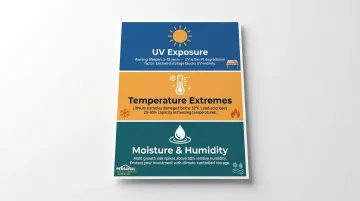
Three threats do the most cumulative damage to a stored RV:
- UV exposure: Roof sealants crack, awning fabric degrades, and paint oxidizes from sun alone. Carefree of Colorado reports that vinyl awning fabric lasts 5–15 years, with UV as the primary factor cutting that lifespan short. Enclosed storage blocks UV entirely.
- Temperature extremes: Lithium (LiFePO4) batteries can't be charged below 32°F without causing permanent plating damage. Lead-acid batteries lose 20–30% capacity at freezing and up to 50% at 0°F. Buffering these swings protects your battery bank and your plumbing.
- Moisture and humidity: Relative humidity above 50% creates conditions for mold growth inside stored RVs — a threshold that's nearly impossible to hold in outdoor or uncovered storage during wet seasons.
What Premium Enclosed Storage Looks Like
Not all indoor facilities are equal. When evaluating a climate-controlled option, look for:
- Insulated overhead doors (not just a basic roll-up)
- Active heating, with optional A/C for summer storage
- LED lighting throughout — adequate for inspecting the rig or doing basic maintenance
- Unit width sufficient to open your RV door after pulling in
- Wide drive aisles that allow easy maneuvering
Personal Warehouse facilities, for example, include high-efficiency insulated overhead doors, all-LED lighting, and full heating with optional A/C — features that maintain a stable interior environment across Montana's wide temperature swings.
The Trade-Off
Cost and logistics. Climate-controlled storage runs $150–$400+/month nationally, compared to $75–$150 for outdoor. Some facilities also have limited access hours, which can be inconvenient for spontaneous trips. This option makes the most sense for owners who store for months at a time and plan their outings in advance.
What Is Outdoor RV Storage?
Outdoor RV storage is exactly what it sounds like — a paved or gravel lot with marked spaces for RVs, ranging from 20 feet for small trailers up to 50+ feet for large Class A motorhomes. "Outdoor" can mean fully exposed, covered (roof only, open sides), or a hybrid arrangement.
Cost and Accessibility
Outdoor lots are the most affordable entry point and typically the easiest to maneuver in and out of. For owners who use their rig monthly or more, that combination of low cost and quick access has real value — no appointments, no narrow hallways, no waiting.
The Exposure Risks
Outdoor storage exposes your RV to:
- UV radiation that degrades roof membranes, fades paint, and weakens awning fabric
- Rain and humidity that invite mold and mildew, particularly in sealed interiors
- Hail and wind-driven debris — hail claims are on average 21.7% more costly to repair than standard comprehensive claims, according to CCC Intelligent Solutions
- Freeze-thaw cycling in northern states that stresses plumbing seals and gaskets over a Montana winter
What About RV Covers?
A quality cover helps — but it's not a substitute for enclosed storage. RV dealers and owners have documented specific problems with ill-fitting covers:
- Paint chafing and decal damage at nose caps from poor fit
- Moisture trapping that promotes mold rather than preventing it
- Installation friction — covers take time to put on, take off, and inspect regularly to stay effective
Security Varies Widely
Don't assume outdoor means unsecured — or that it means secure. Facilities range from well-lit, gated lots with camera systems and on-site managers to basic gravel areas with chain-link fencing. Evaluate each facility individually rather than making assumptions based on storage type.
That variability in security, combined with the exposure risks above, is what leads many owners to weigh climate-controlled options — especially for long-term or seasonal storage.
Climate Controlled vs Outdoor RV Storage: Which Is Best?
There's no universal answer. The right choice depends on four factors: your RV's value, your local climate, how long it sits idle, and your monthly budget. Here's how to weigh them.
Climate (Highest Weight for Many Owners)
In regions with punishing winters, heavy humidity, or intense UV — Montana, coastal Carolinas, Florida — weather damage accumulates fast. Bozeman's temperatures swing from 12°F to 84°F in a typical year, with lows staying below freezing for roughly five months. Every day temperatures cross the 32°F threshold, your seals and plumbing absorb another stress cycle.
The math often favors enclosed storage before you even run the numbers. These repair categories add up fast:
- Seal replacements
- Roof recoating
- Battery replacements
- Mold remediation
Each one can dwarf a year's worth of storage premium.
RV Value
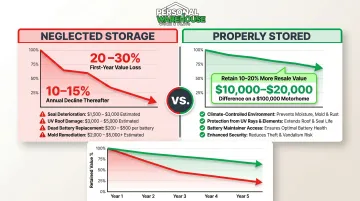
Your RV's value determines how much those repair costs actually matter. New RVs lose approximately 20–30% of value in the first year, then 10–15% annually after that. A properly stored rig can retain 10–20% more resale value compared to a neglected one. For a $100,000 motorhome, that's a $10,000–$20,000 swing — well beyond any storage cost difference.
General guidance across the industry: newer, higher-value rigs (Class A motorhomes, high-end fifth wheels) warrant stronger protection. Older pop-ups or frequently-used travel trailers may not justify the added expense.
Frequency of Use
- Use it monthly or more? Outdoor storage's easy access and lower cost make sense. You're moving the rig often enough that extended exposure windows are shorter.
- Store for 4–8 months at a stretch? That's the scenario where enclosed storage pays for itself. Northern-state owners who park the rig in October and don't retrieve it until April are exposing it to an entire winter's worth of UV, freeze-thaw cycles, and moisture — in an outdoor space.
The True Cost of Outdoor Storage
Outdoor storage might save $50–$150/month. But accelerated seal degradation, exterior refinishing, UV-related repairs, and reduced resale value are real costs that compound over time. Before deciding based on monthly rate alone, estimate a 3–5 year total cost of ownership across both scenarios.
Decision Summary
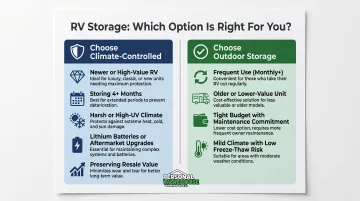
Choose climate-controlled if you:
- Own a newer or high-value RV (Class A, high-end fifth wheel, luxury build)
- Store for 4+ months in a cold or high-UV climate
- Have invested in interior electronics, lithium batteries, or aftermarket upgrades
- Want to preserve resale value over a multi-year ownership period
Choose outdoor if you:
- Use your RV frequently (monthly or more)
- Are storing an older or lower-value unit where premium protection isn't cost-justified
- Have a tight monthly budget and can commit to regular maintenance checks and quality covers
- Live in a mild climate with minimal freeze-thaw risk
Conclusion
Climate-controlled storage wins on protection and long-term preservation. Outdoor storage wins on cost and accessibility. The question is which trade-off fits your specific situation — your rig, your climate, and how you actually use it.
For RV owners in Montana and other states with harsh winters or intense summer UV, the long-term math often favors enclosed storage, even before factoring in a single repair bill.
For those thinking beyond month-to-month rental, Personal Warehouse offers something different: enclosed RV storage spaces you can own outright, secured by a 99-year ground lease, so your storage costs build equity rather than disappear each month.
To see available units in Bozeman, MT and other locations across the country, visit Personal Warehouse and explore what ownership looks like for your situation.
Frequently Asked Questions
Is it better to store an RV in climate-controlled storage or outdoors?
Climate-controlled storage is better for long-term protection, high-value rigs, and climates with harsh winters or intense UV. Outdoor storage suits budget-conscious owners with older or frequently-used rigs. The right call depends on your usage pattern, RV value, and local weather conditions.
Is drive-up storage better than climate-controlled storage for RVs?
Drive-up outdoor storage offers easy access and lower cost, making it practical for frequent users who prioritize easy access. Climate-controlled storage provides superior protection and is the better choice for long storage periods, high-value vehicles, and harsh climates.
How much does climate-controlled RV storage cost compared to outdoor storage?
Outdoor uncovered storage runs $75–$150/month nationally; indoor climate-controlled units run $150–$400+/month. The gap narrows when you factor in reduced maintenance costs and preserved resale value over a multi-year ownership period.
Does outdoor RV storage damage your vehicle over time?
Prolonged outdoor exposure to UV rays, moisture, and temperature swings does accelerate wear on seals, paint, tires, and awnings. The damage is gradual but cumulative, and can be partially mitigated with quality RV covers and consistent seasonal maintenance.
What should I look for in an RV storage facility?
Key features to prioritize:
- Unit size that fits your RV's length and height
- Gated security access and adequate lighting
- Convenient access hours and a well-maintained site
- Amenities like electrical hookups, dump stations, and wash bays for trip prep and post-season use
Is an RV cover enough protection for outdoor storage?
A quality cover reduces UV and moisture exposure but is not equivalent to indoor storage. Covers can shift in wind and scratch the exterior, and they must be properly fitted and inspected regularly to offer meaningful protection against the elements.