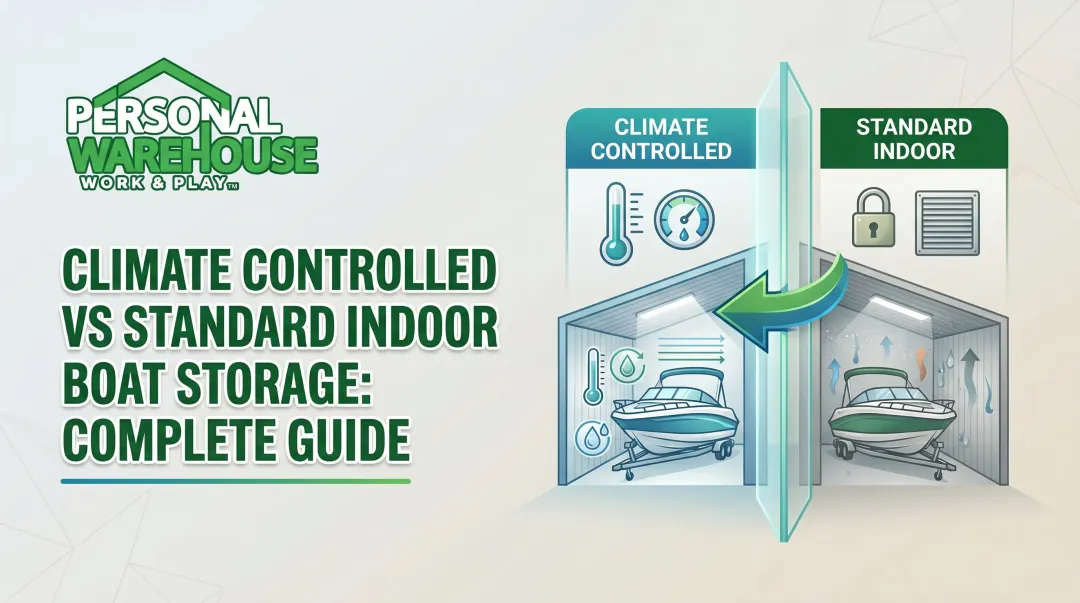
The honest answer: it depends entirely on what you're storing, how long it'll sit, and where you live. Both unit types offer secure, enclosed storage, but only one actively protects against heat, cold, and humidity. Get that choice wrong, and a warped guitar neck or moldy document collection can cost far more than months of upgraded rent.
This guide breaks down the key differences, real costs, and the four factors that determine which option actually makes sense for your situation.
TL;DR
- Climate-controlled units regulate temperature (55–85°F) and humidity (below 50% RH); standard units offer no environmental regulation
- Climate-controlled units typically cost 25–40% more per month — worth it for sensitive or high-value items
- Standard units work well for durable goods: tools, patio furniture, vehicles, seasonal decorations
- Your decision comes down to four factors: what you're storing, how long, your local climate, and your budget
- In weather-extreme states — Montana, Florida, Texas — climate control matters far more than in mild climates
Climate-Controlled vs. Standard Storage: Quick Comparison
| Factor | Climate-Controlled | Standard |
|---|---|---|
| Average monthly cost (10x10) | ~$134 | ~$119 |
| Premium over standard | 25–40% typical | Baseline |
| Temperature regulation | Yes (55–85°F) | No — mirrors outdoor temps |
| Humidity regulation | Yes (below 50% RH) | No |
| Access style | Interior hallways (typically) | Drive-up rollup door |
| Pest & dust protection | Better (sealed indoor environment) | Limited |
| Best for | Electronics, wood furniture, art, documents, instruments, antiques | Tools, vehicles, patio furniture, seasonal goods |
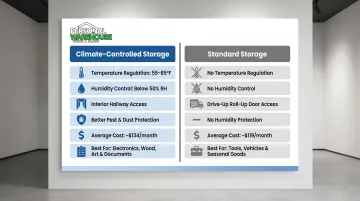
Cost data sourced from SpareFoot's 2026 U.S. Self-Storage Industry Statistics.
Personal Warehouse units combine climate control with direct drive-up access via insulated overhead doors — so you get temperature regulation without giving up the convenience of pulling your vehicle directly to the unit.
What Is Climate-Controlled Storage?
Temperature vs. Climate Control: An Important Distinction
The storage industry hasn't been consistent on this terminology. "Temperature-controlled" means a unit regulates heat and cold. "Climate-controlled" should mean it manages both temperature and humidity — and that distinction matters a great deal for certain items.
As the Self Storage Association notes, many operators market temperature-only control as "climate control." Before signing a lease for sensitive items, confirm the unit actively manages humidity, not just temperature.
True climate control typically maintains:
- Temperature: 55–85°F year-round
- Relative humidity: Below 50% RH
Why does the humidity threshold matter? The CDC recommends keeping indoor humidity at or below 50%. Above that level, mold can begin growing within 24–48 hours — and in storage, that often goes undetected until damage is done.
What Needs Climate Control and Why
| Item Category | Primary Risk Without Climate Control |
|---|---|
| Wood furniture | Warping, cracking from humidity swings |
| Electronics | Condensation, corrosion on circuit boards |
| Artwork & antiques | Mold, fading, structural deterioration |
| Important documents | Mold, brittleness, ink degradation |
| Musical instruments | Cracking, tuning instability, soundboard damage |
| Wine collections | Cork drying, oxidation, heat damage |
| Photographs | Mold, dye fading above 60% RH |
Why Geography Amplifies the Stakes
In mild-climate regions, an unregulated unit may be fine for months. In states with weather extremes, those humidity and temperature thresholds get breached far more often — and the damage follows.
Florida's morning relative humidity routinely runs 80–91% in major cities. Dallas-Fort Worth averages 85–93°F across July and August. Montana winters bring sustained sub-freezing conditions that crack brittle materials and affect adhesives. Colorado's Front Range combines wide temperature swings with low humidity — conditions that are particularly hard on wood and paper.
Personal Warehouse's Bozeman, MT development — currently under construction — was designed with exactly these conditions in mind. All units come fully heated, with optional A/C and insulated overhead doors built to handle Montana's sustained cold. For anyone storing sensitive items through that kind of winter, that's not a minor detail.
What Is Standard Storage?
Standard (non-climate-controlled) storage provides basic protection: a roof overhead, walls around your belongings, and a lock on the door. It keeps out rain, wind, and snow — but that's where environmental protection ends.
Interior temperatures in standard units track closely with outdoor conditions and, due to solar gain on metal construction, can climb well above outside temps on hot summer days. There's no active humidity management, which means moisture levels inside the unit reflect the surrounding climate.
Where Standard Storage Genuinely Works
Standard units are a practical, lower-cost choice for items unaffected by temperature or humidity shifts:
- Gardening tools and power equipment
- Seasonal outdoor furniture
- Holiday decorations (non-fragile)
- Vehicles, motorcycles, ATVs
- Kitchen appliances and basic household goods
- Workshop supplies and hardware
The Drive-Up Advantage
Standard units typically offer ground-level, exterior rollup door access — meaning you can back a truck directly to the door. For heavy, awkward, or bulky items (RV accessories, lawn equipment, workshop tools), this is a genuine practical benefit that many indoor climate-controlled facilities can't match.
Realistic Limitations
For short-term storage of non-sensitive items in a mild climate, standard units are often the smarter financial call. But longer storage terms, seasonal transitions, or high-humidity climates change the calculus — warping, rust, and mold become real possibilities by month six.
Which Type of Storage Unit Do You Actually Need?
Factor 1 — Nature of Your Items
This is the deciding factor. A simple rule: if the item would be damaged by extreme heat, freezing temperatures, or prolonged humidity exposure over weeks or months, it needs climate control. If it was built for outdoor or variable conditions, standard storage is sufficient.
Antiques, instruments, electronics, photographs, and fine wood furniture all fall into the first category. Tools, seasonal decorations, and patio furniture fall squarely into the second.
Factor 2 — Storage Duration
Time amplifies risk in unregulated units. Storing holiday decorations for three months through a mild winter is a low-risk decision. Storing a vintage guitar collection for two years through multiple seasonal cycles is a different situation entirely.
A good working rule: for storage extending beyond three to six months — especially across seasonal transitions — climate control is worth the cost for anything that isn't purely durable.
Factor 3 — Local Climate
Geography is a major variable that's easy to underestimate. A standard unit in San Diego behaves very differently from one in Jacksonville or Bozeman.
Key climate benchmarks from the research:
- Florida: Morning RH of 80–91% in major cities — among the highest mold-risk environments in the country
- Texas (DFW): July–August highs averaging 85–93°F — heat-sensitive items deteriorate fast
- Colorado Front Range: Wide temperature swings, low humidity — hard on wood, paper, and adhesives
- Montana: Extended sub-freezing winters — brittleness risk for documents, instruments, and certain electronics
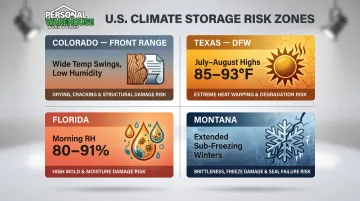
If you're storing in any of these regions, the climate risk isn't a hypothetical — it's a predictable seasonal pattern that plays out every year.
Factor 4 — Budget and Item Value
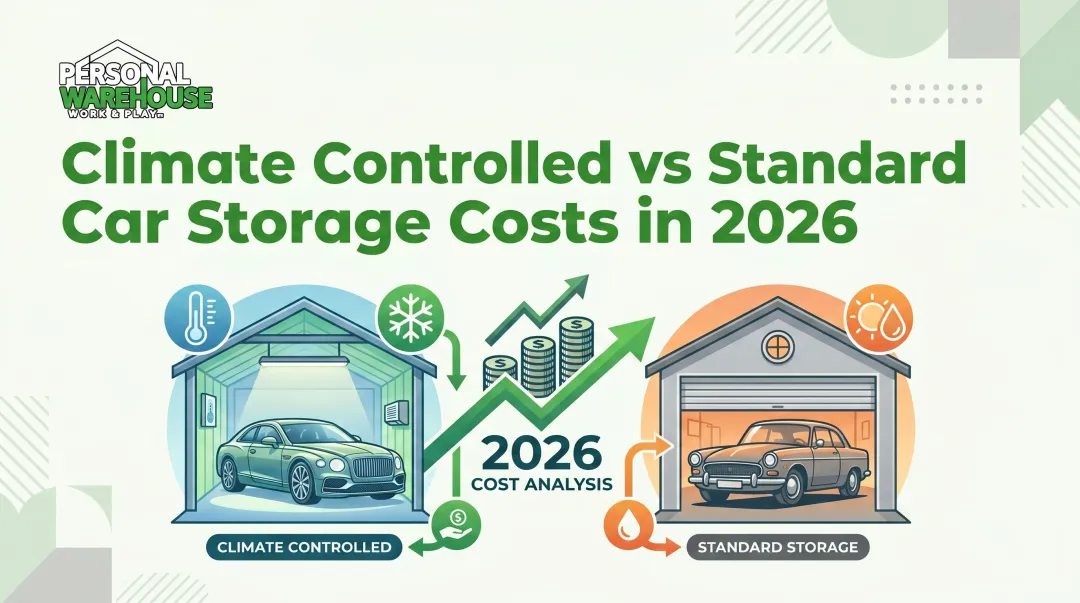
That climate risk connects directly to cost decisions. A 10x10 climate-controlled unit averages about $134/month versus $119 for standard — roughly a $15/month premium at the national average, though local markets and unit sizes can push that gap to 25–40%.
Ask one question: What would it cost to replace or repair damaged items, compared to the monthly premium for climate control?
A $5,000 antique collection or irreplaceable family documents justify the upgrade easily. A $200 set of seasonal tools does not.
Decision Summary
Choose climate-controlled if you're storing:
- Electronics, instruments, artwork, antiques, or important documents
- Items for longer than three to six months
- Anything in Florida, Texas, Montana, or other climate-extreme states
- High-value goods where replacement cost outweighs the monthly premium
Choose standard if you're storing:
- Durable goods unaffected by temperature or humidity
- Vehicles, equipment, or seasonal items on short timelines
- Budget-sensitive situations with non-sensitive goods
- Large items where drive-up access is a priority
Conclusion
Neither unit type is universally better. The right choice depends on what you're storing, how long it'll sit, where you live, and what those items are worth to you.
A few quick guidelines:
- Sensitive, valuable, or irreplaceable items in regions with extreme heat, cold, or humidity — climate control is the clear call
- Durable goods on shorter timelines — standard storage handles the job without the added cost
- Long-term storage in unpredictable climates — err toward climate control; the cost difference rarely outweighs damage risk
If you're working through this decision for a specific situation, Personal Warehouse develops customizable warehouse spaces across multiple states — from Montana's cold winters to Florida's humid summers — with options that include heating, air conditioning, and high-efficiency insulation built in. The team can help you find the right configuration for your needs. Reach out at 303-222-0768 or info@personalwarehouse.com.
Frequently Asked Questions
Is a climate-controlled storage unit worth the extra cost compared to a standard unit?
For sensitive or high-value items — electronics, antiques, documents, instruments — the premium is worth it. For durable goods unaffected by heat or humidity, standard storage is the more cost-effective choice. Match the unit type to what you're storing, not to a general preference.
Is it better to have drive-up access storage or climate-controlled?
These serve different needs rather than competing directly. Drive-up access suits large, heavy, or frequently accessed items; climate control protects sensitive belongings from heat and humidity damage. Personal Warehouse units offer both features — insulated overhead doors with optional climate control.
Can I store clothes in a climate-controlled storage unit?
Yes, and long-term storage of natural fabrics like wool, leather, or silk benefits from humidity control. Most everyday clothing is fine in standard units for shorter durations, provided it's kept dry and the unit is clean and pest-free.
What is the difference between temperature-controlled and climate-controlled storage?
Temperature-controlled units regulate heat and cold only. Climate-controlled units manage both temperature and humidity — and it's the humidity control that prevents mold, mildew, rust, and condensation damage. Confirm which you're getting before storing sensitive items.
What items should NOT be stored in a standard storage unit?
Items most vulnerable to temperature and humidity damage include: electronics, solid wood furniture, artwork, wine, musical instruments, important documents, photographs, antiques, and film. In states with extreme heat or cold — like Texas, Montana, or Florida — the risk of damage in unregulated units is significant.
How much more expensive is climate-controlled storage than standard storage?
On a 10x10 unit, climate-controlled storage runs 12–15% more per month nationally, though competitive or high-demand markets can push that gap to 25–40%. For sensitive or irreplaceable items, the premium is usually modest compared to replacement costs.