According to SpareFoot's 2026 industry data, approximately 30% of all self-storage demand comes from commercial users, and the average unit holds an estimated $3,339 in contents — with 18% of renters storing $10,000 or more. At those values, storage type isn't a minor operational detail. It's a risk management decision.
This guide breaks down both options, compares costs, and helps you match your inventory to the right environment.
TL;DR
- Climate-controlled units hold 55°F–80°F with regulated humidity — essential for electronics, pharmaceuticals, cosmetics, and documents
- Drive-up units offer direct vehicle access with no hallways or elevators, making them ideal for heavy, durable, or bulk goods with frequent turnover
- Expect to pay 13–28% more for climate control — a $468/year premium against $10,000+ in sensitive inventory is a defensible trade-off
- Geography matters: businesses in Montana, Florida, or South Carolina face far higher environmental risk in unregulated storage
- For growing businesses, owning warehouse space builds equity — indefinite month-to-month renting does not
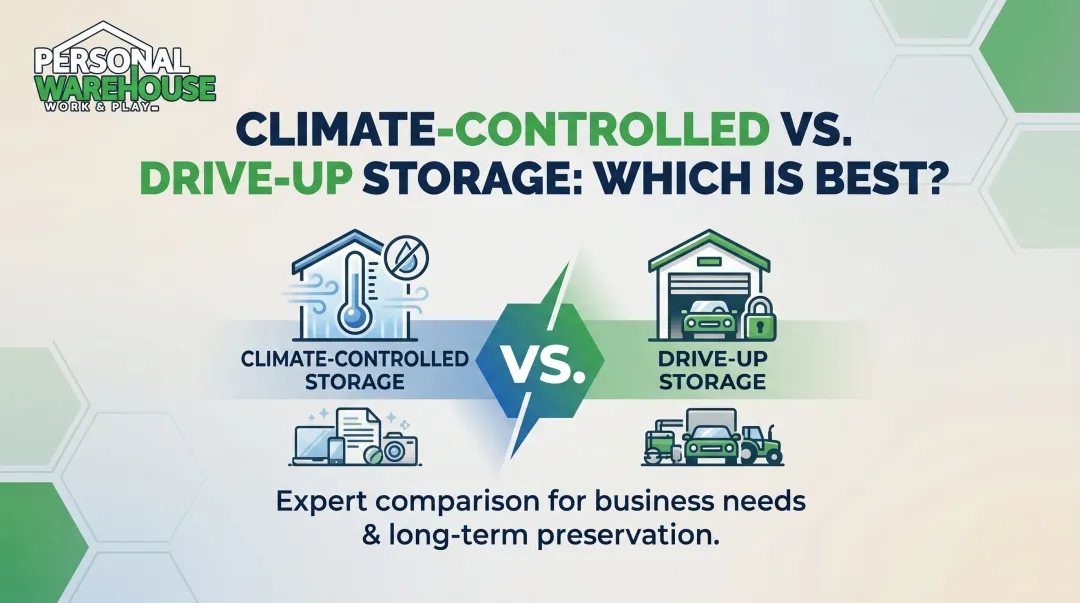
Climate-Controlled vs. Drive-Up Storage: Quick Comparison
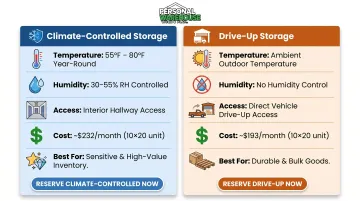
| Factor | Climate-Controlled | Drive-Up |
|---|---|---|
| Temperature | 55°F–80°F year-round | Ambient — tracks outdoor conditions |
| Humidity control | ~30–55% RH | None |
| Vehicle access | Interior units; hallways required | Pull directly to door |
| Monthly cost (10x20) | ~$232/month | ~$193/month |
| Best for | Sensitive, high-value inventory | Durable, bulk, heavy goods |
| Equity | Month-to-month rental only | Month-to-month rental only |
The Real Cost of Climate Control
The price gap widens considerably with unit size. SpareFoot's January 2026 pricing data shows:
- 10x10 unit: $134 (climate-controlled) vs. $119 standard — 13% premium
- 10x20 unit: $232 vs. $193 — 20% premium, roughly $39/month more
- 10x30 unit: $327 vs. $256 — 28% premium, $71/month more
For a business storing $10,000 in temperature-sensitive inventory, that $468/year premium is less than 5% of inventory value — a reasonable tradeoff against spoilage, warping, or product loss.
Both unit types are typically available on month-to-month terms, which keeps entry costs low. The tradeoff: neither option builds equity — every dollar paid in rent is a sunk cost. For businesses with storage needs that aren't shrinking, that's worth factoring into the long-term math.
What Is Climate-Controlled Business Storage?
Climate-controlled storage actively maintains temperature and humidity regardless of outdoor conditions — typically between 55°F and 80°F with 30–55% relative humidity. The unit stays within those parameters whether it's a July heat wave or a January freeze.
For businesses, that stability translates to real money: fewer product losses, fewer returns from heat or humidity damage, and fewer insurance claims filed.
Inventory That Requires Climate Control
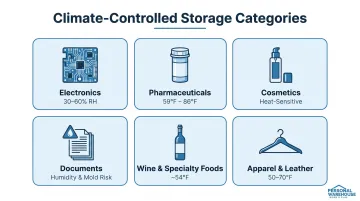
Not every product needs it. But these categories have no margin for environmental error:
- Electronics and circuit boards — moisture causes corrosion; IPC/JEDEC standards require 30–60% RH for most components
- Pharmaceuticals and health products — FDA/USP defines controlled room temperature as 59°F–86°F; products stored outside this range may lose potency
- Cosmetics and personal care — heat separates emulsions and degrades active ingredients
- Printed materials and documents — humidity warps paper and promotes mold
- Wine and specialty foods — ideal storage around 54°F with 60–70% humidity
- High-end apparel and leather goods — recommended at 50–70°F with 45–55% RH
Why Geography Changes the Calculation
A drive-up unit that's "good enough" in San Diego can be a real liability elsewhere. Miami averages 73% relative humidity year-round — well above the 30–60% RH range required for safe electronics storage. Charleston's morning humidity hits 88–90% in late summer. Bozeman, MT sees average winter lows of 12–14°F, while Denver swings from 18°F in January to 90°F in July.
None of those extremes are compatible with sensitive inventory in an unregulated unit. For businesses operating in these markets — including Personal Warehouse's Bozeman, MT location and its planned projects in Florida, South Carolina, and Colorado — climate control becomes a practical requirement, not an optional upgrade.
Business Use Cases
- E-commerce sellers shipping health, beauty, or electronics nationwide who can't absorb returns caused by heat or humidity damage
- Pharmaceutical reps and medical device companies storing product samples with temperature compliance requirements
- Specialty food and beverage brands holding perishable-adjacent inventory — wine, chocolate, supplements — that degrade outside a narrow temperature window
- Document-heavy businesses (legal, financial, healthcare) storing physical records that must remain legible and mold-free
What Is Drive-Up Storage for Business Inventory?
Drive-up storage is exactly what it sounds like: a ground-level unit with a roll-up door where you pull a vehicle directly to the opening. No hallways. No elevators. No additional handling. You open the door, load or unload, and leave.
That access model is the point. For businesses moving inventory multiple times per week — restocking vans, rotating seasonal product, staging outgoing shipments — every trip through a building interior adds friction and time.
Inventory That Suits Drive-Up Storage
Drive-up makes sense when your goods can tolerate ambient temperature swings and your priority is throughput:
- Construction tools and equipment
- Outdoor power equipment (generators, compressors, pressure washers)
- Event and trade show materials
- Bulk packaging supplies
- Automotive parts and supplies
- Large furniture or fixtures
- Palletized retail goods with weather-tolerant packaging
A Step Up From Standard Self-Storage
If your inventory fits that list, the next question is what kind of drive-up unit actually protects it. Standard self-storage units offer access convenience but little else.
Personal Warehouse's owned warehouse spaces close that gap with features standard roll-up units don't offer:
- Heavily insulated overhead doors that outperform typical self-storage construction
- Full heating with optional A/C for climate buffer in variable seasons
- Ownership structure that builds equity instead of compounding rent
That combination delivers the loading convenience of drive-up access with significantly better environmental performance — which matters when you're storing inventory worth protecting, not just boxes you'd replace anyway.
Business Use Cases
- Contractors, landscapers, and trades businesses that need to load trucks quickly at variable hours without navigating a building interior
- Seasonal retailers (holiday goods, outdoor gear, sporting equipment) rotating large volumes of durable inventory who need flexible, scalable space
Which Storage Type Is Right for Your Business?
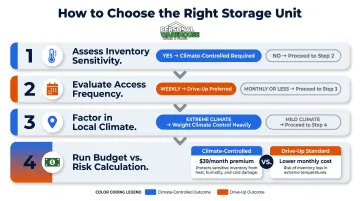
Four questions determine the right choice. Work through them in order.
Step 1: Assess Inventory Sensitivity
Start here. Ask one question: is anything in that unit susceptible to temperature or moisture damage?
- Yes → Climate-controlled is non-negotiable. Move to cost comparison.
- No → Drive-up likely works. Assess access frequency and geography next.
Step 2: Evaluate Access Frequency
Neighbor.com data shows 42% of business customers visit their unit at least once per week. If you're in that group — loading vans, rotating stock, staging shipments — drive-up access saves meaningful time over dozens of trips through interior hallways.
Businesses that access inventory monthly or less frequently won't feel that difference. For them, geography becomes the more important variable.
Step 3: Factor in Your Local Climate
Geography amplifies risk for drive-up users. A contractor storing metal tools in a Bozeman drive-up unit watches temperatures drop to single digits in January. An e-commerce seller in Tampa using a standard unit faces humidity that routinely exceeds safe thresholds for most packaged goods.
If your region has extreme seasonal swings, high humidity, or both — Personal Warehouse operates across Montana, Florida, South Carolina, Colorado, Texas, Georgia, and beyond, most of which qualify — weight climate control more heavily in your decision.
Step 4: Run the Budget vs. Risk Calculation
Drive-up is cheaper monthly. But the math shifts when you account for what's at risk:
- Monthly premium for climate control (10x20): ~$39/month ($468/year)
- Typical business inventory on hand: $3,339 in stored value (SpareFoot 2026 survey)
- Acceptable damage threshold for e-commerce: 1–5% of inventory before it affects margins
A single heat-related loss on $5,000 of electronics or cosmetics wipes out years of savings from the cheaper unit. Before defaulting to drive-up because it's less expensive, calculate what one bad outcome actually costs.
Conclusion
Neither storage type is universally better. Climate-controlled is the right call when inventory value and environmental sensitivity are high. Drive-up is the efficient, cost-effective choice when goods are durable and access frequency is high.
For businesses whose storage needs are growing, the more important question is whether month-to-month renting still makes sense at all. Paying rent indefinitely builds no equity — and over a few years, that cost adds up considerably.
Personal Warehouse offers an alternative: ownable warehouse spaces with insulated overhead doors, superior insulation, full heating, and optional A/C, combining the practical benefits of drive-up access with structural performance standard self-storage doesn't deliver.
With SBA 504 and 7(a) financing available and projects under construction in Bozeman, MT, with planned expansion across Florida, South Carolina, Colorado, and beyond, it's worth evaluating ownership before signing another month-to-month lease.
Frequently Asked Questions
Frequently Asked Questions
Can I write off a storage unit for my business?
Storage rent used exclusively for business inventory or operations generally qualifies as a deductible "ordinary and necessary" business expense under IRS Publication 535. Consult a tax professional to confirm eligibility based on your specific business structure and how the unit is used.
Which is better for business inventory: drive-up or indoor storage?
It depends on what you're storing. Drive-up suits durable, high-volume goods that need frequent loading access. Climate-controlled indoor storage is the better choice for temperature-sensitive, fragile, or high-value inventory that can't tolerate humidity or heat fluctuations.
Is it illegal to run a business in a storage unit?
Storing inventory is legal and common. Operating a business inside a storage unit — meeting clients, manufacturing, or conducting transactions — typically violates facility lease terms and may conflict with local zoning laws, which can result in lease termination or enforcement action.
What are the golden rules of storage?
Match storage type to inventory sensitivity first. Place high-turnover items near the front. Label everything clearly, including SKU numbers on containers and shelves. Never overpack units in ways that restrict airflow or make retrieval difficult.
Do I need climate control for electronics storage?
For most electronics, climate control is strongly recommended. Electronics are vulnerable to moisture-related corrosion and heat-related battery and component degradation. IPC/JEDEC standards require 30–60% relative humidity for most components — conditions that drive-up units in humid climates routinely exceed.
Can a small business use a storage unit as a warehouse?
Self-storage units work well as warehouse alternatives for small businesses managing inventory on a limited budget. For businesses with consistent or growing volume, owning dedicated warehouse space typically delivers better long-term value and operational flexibility than indefinite month-to-month rental.