The short answer: yes, storing business inventory in a self-storage unit is legal, widely done, and often a smart interim solution. But whether it works well for your business depends on what you're storing, what the lease permits, and how your operations are set up. This guide covers everything you need to know before signing a lease.
TL;DR
- Storing business inventory in a self-storage unit is legal and common for small businesses and e-commerce sellers
- Most facilities allow inventory storage, but operating a business from the unit — meeting clients, running equipment on-site — is typically restricted
- Climate-controlled units are essential for electronics, cosmetics, apparel, and paper-based goods
- Flammable liquids, perishables, hazardous chemicals, and living things are prohibited from all storage units
- Consistently maxing out your unit or needing daily high-volume access signals it's time to upgrade to dedicated warehouse space
Is It Legal to Store Business Inventory in a Storage Unit?
Storing products in a self-storage unit is different in one important way from operating a business out of one — and that distinction matters.
Most self-storage facilities explicitly allow commercial inventory storage. The U.S. self-storage industry spans over 2.1 billion square feet across 50,000+ facilities, and a large portion of that space is occupied by businesses holding stock between sales cycles. The activity is mainstream, not a gray area.
What the Lease Actually Governs
The lease agreement is where the details live. Before signing, look for clauses addressing:
- Commercial use permissions — most leases permit passive storage of business goods
- Prohibited activities — packaging, assembling, or shipping from the unit is often restricted
- Employee access — regular employee presence or customer visits may violate terms
- Operational restrictions — running machinery or equipment inside the unit is typically banned
Public Storage, for example, explicitly states that "living in or working out of your storage space is prohibited." Storing inventory there? Fine. Running daily fulfillment operations from inside the unit? Not permitted.
Zoning Considerations
Self-storage facilities are typically zoned for light commercial or industrial use. Storing goods there generally falls within permitted activity. Activities like regular employee presence, in-unit packaging operations, or customer visits can run into local ordinance restrictions. When in doubt, confirm acceptable use directly with the facility and your local municipality.
Insurance: Don't Assume You're Covered
Standard renters insurance covers personal property off-premises — but that coverage is commonly capped at 10% of the policy's Coverage C limit and typically excludes business property entirely.
If you're storing business inventory, you need commercial property coverage or inland marine insurance to protect your stock at an offsite location. Confirm your coverage before moving anything in.
What Types of Business Inventory Work Best in a Storage Unit?
Not all inventory is equally suited to self-storage. Compatibility depends on the product's sensitivity to temperature, humidity, size, and how frequently you need to access it.
Inventory That Thrives in Standard or Climate-Controlled Units
These product types store well with minimal risk:
- Packaged retail goods and boxed merchandise
- Apparel, textiles, and accessories (in sealed bins or bags)
- Books, media, and printed materials
- Craft supplies and hobby equipment
- Seasonal merchandise and holiday stock
- Promotional materials and trade show supplies
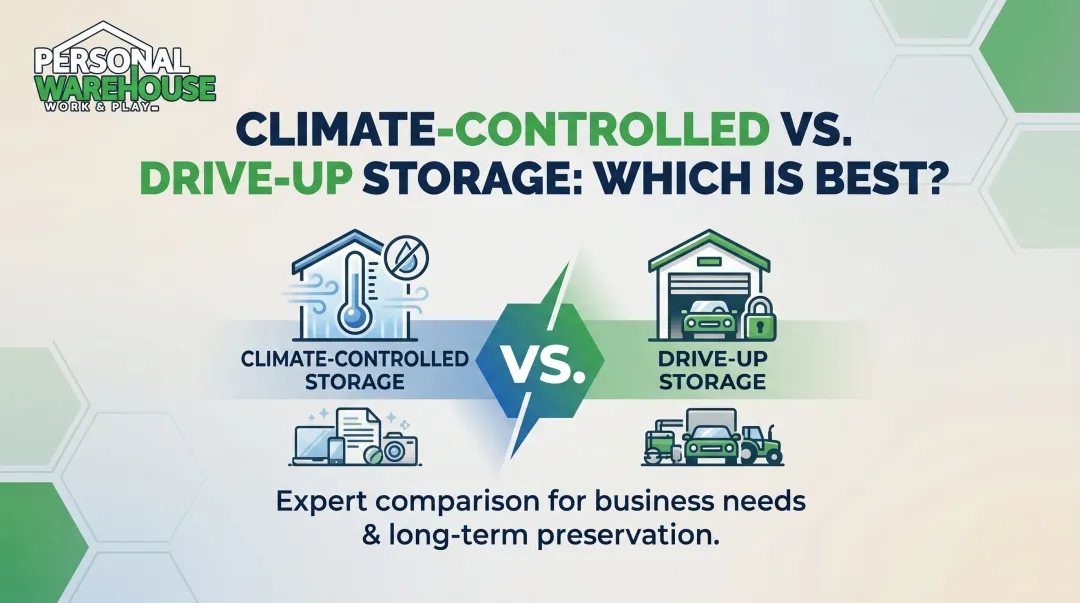
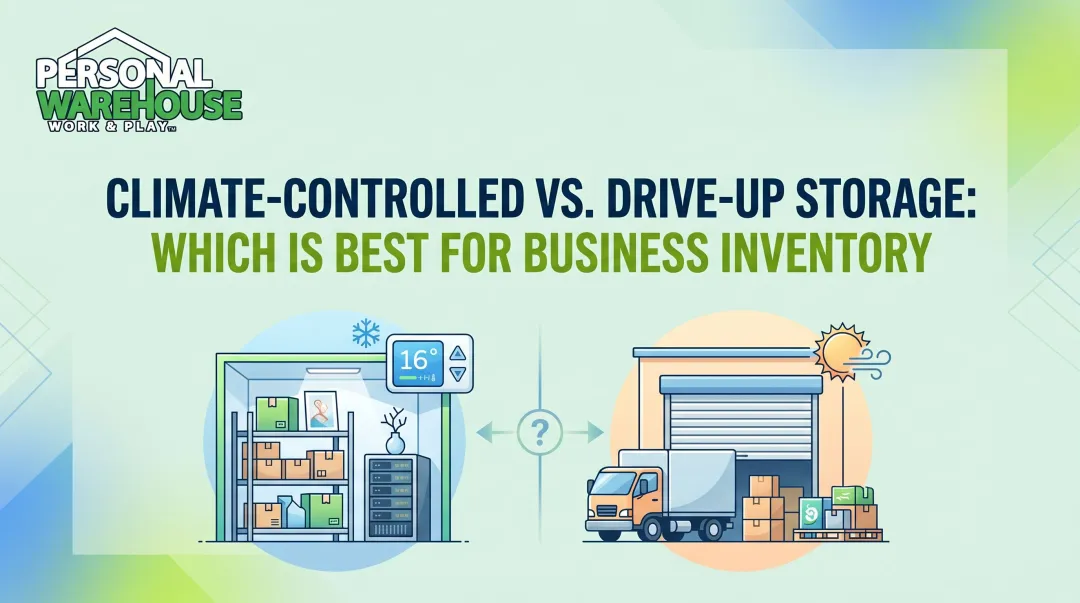
For temperature-sensitive goods, climate-controlled units maintain temperatures between 55–80°F and regulate humidity, preventing warping, mold, and product degradation. Extra Space Storage recommends climate control for electronics, wooden furniture, artwork, cosmetics, candles, and paper-based products.
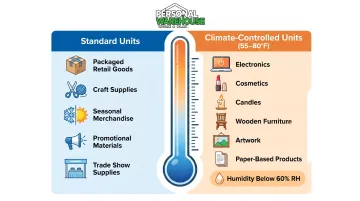
Two specific thresholds matter here: cosmetics and skincare are typically stable between 59–86°F per FDA stability guidelines, and electronics should stay below 60% relative humidity to avoid corrosion. A quality climate-controlled unit meets both standards.
Inventory That Requires Special Consideration
Some inventory types create practical complications in a standard storage unit:
- Large or heavy items requiring forklifts or loading docks, which most units can't accommodate
- Fragile goods that need specialized racking systems standard units don't provide
- High-turnover stock requiring daily access, where storage unit hours and layout can slow fulfillment
- Flammable, perishable, or hazardous goods, which most facilities prohibit entirely
If your inventory falls into any of these categories, a standard self-storage unit may cost you more in workarounds than it saves in rent. Ownable warehouse spaces with drive-in access and customizable interiors tend to be a better fit for businesses with heavier volume or specialized storage needs.
Key Benefits of Using a Storage Unit for Business Inventory
Cost Savings
Self-storage is considerably cheaper than commercial warehouse leasing, especially for early-stage businesses. According to SpareFoot's 2025 pricing data, typical monthly costs break down like this:
| Unit Type | Avg. Monthly Cost |
|---|---|
| All sizes (average) | $85.30 |
| 10×10 non-climate | $119 |
| 10×10 climate-controlled | $134 |
The Self Storage Association puts typical rents at $0.50–$4.00 per square foot per month, depending on market.
Traditional industrial leases, by comparison, average $8–$15 per square foot per year in most US markets — several times higher. For a business storing a few hundred SKUs, the difference is significant.
Flexibility and Scalability
Self-storage leases are almost universally month-to-month. That structure lets you:
- Scale up during peak seasons without a long-term commitment
- Downsize quickly if inventory volume drops
- Test storage needs before committing to a larger commercial space
- Rent multiple units simultaneously if you need to separate inventory categories
This flexibility is difficult to replicate with traditional warehouse contracts, which often require 12–36 month minimums.
Operational Clarity
Separating inventory from your home or office creates structure. Order fulfillment becomes more systematic when everything has a single dedicated location. Tracking becomes easier. Clutter disappears from your primary workspace. For home-based businesses in particular, that separation often cuts fulfillment errors and frees up space that was quietly slowing you down.
What You Cannot Store in a Storage Unit
Every self-storage facility maintains a prohibited items list, and the categories below are universally banned across major operators.
Prohibited categories include:
- Flammable liquids such as gasoline, propane, kerosene, and paint thinners are banned under fire codes (OSHA 1926.152 and NFPA 30 govern flammable liquid storage requirements)
- Explosive materials, including fireworks, ammunition, and pressurized canisters
- Perishable food items that can spoil, attract pests, or create biohazards
- Hazardous chemicals, including industrial cleaners, acids, and corrosives — bulk chemical inventory violates both fire safety codes and lease terms
- Living things: plants, animals, or any living organisms
- Illegal goods, with no exceptions regardless of business type
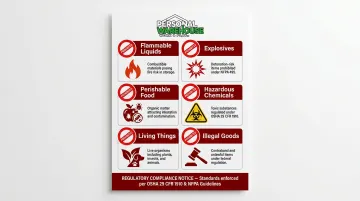
These restrictions stem from fire codes, health regulations, and facility liability. Even if your business legitimately sells cleaning products or flammable goods, you cannot store bulk quantities in a standard self-storage unit.
Beyond universal prohibitions, individual facilities may add restrictions on large machinery, certain high-value items, or specific electronics above a certain threshold. Check the specific storage policy at any facility you're considering — restrictions vary more than most business owners expect.
How to Organize and Manage Inventory in a Storage Unit
Getting the setup right from the start saves you time, prevents fulfillment errors, and keeps your stock accessible as your business grows.
Choosing the Right Unit Size
Standard unit sizes and approximate cubic capacities (based on 8-foot ceilings):
| Unit Size | Square Footage | Cubic Capacity |
|---|---|---|
| 5×5 | 25 sq ft | ~200 cu ft |
| 5×10 | 50 sq ft | ~400 cu ft |
| 10×10 | 100 sq ft | ~800 cu ft |
| 10×15 | 150 sq ft | ~1,200 cu ft |
| 10×20 | 200 sq ft | ~1,600 cu ft |
| 10×30 | 300 sq ft | ~2,400 cu ft |
To size correctly:
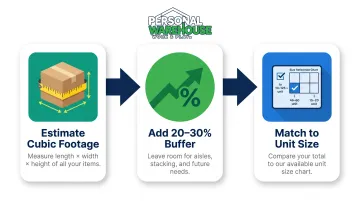
- Estimate the cubic footage of your current inventory
- Add 20–30% buffer for aisle space and near-term growth
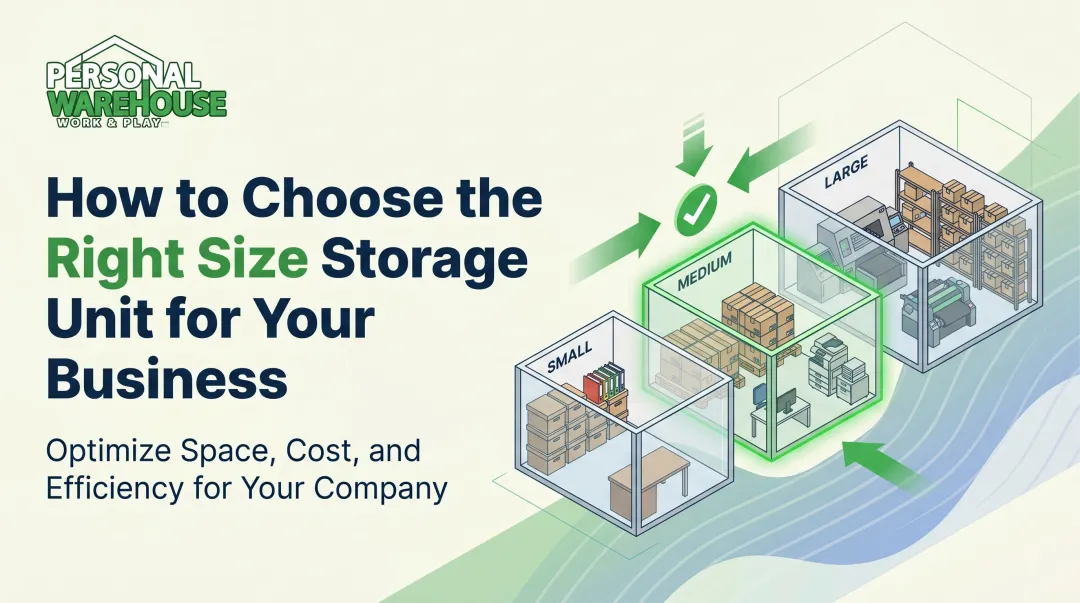
- Match the total to the unit size above
Undersizing forces an early move to a larger unit; oversizing burns budget you don't need to spend yet.
Shelving, Layout, and Tracking
Layout basics:
- Install industrial shelving along the walls to maximize vertical space
- Leave a clear central aisle for easy navigation
- Organize by SKU, product type, or fulfillment frequency — fastest-moving items near the door
Inventory tracking:
- Maintain a digital log that maps physical locations in the unit
- Tools like Sortly or a simple spreadsheet work well for smaller inventories
- Fishbowl integrates with QuickBooks for more complex SKU tracking across locations
Access and Security
Before committing to a facility, evaluate:
- Confirm access hours — 24/7 availability matters more than you'd expect during busy fulfillment periods
- Check for camera surveillance and on-site security personnel
- Use cylinder or disc locks instead of standard padlocks for stronger protection
- Prioritize drive-up units if you're loading and unloading multiple times per week
When to Upgrade Beyond a Standard Storage Unit
Self-storage is a practical starting point, not a permanent solution for growing businesses. Watch for these signs that you've outgrown it:
- You're consistently maxing out unit capacity
- You need daily high-volume access that strains facility hours
- You require a loading dock or forklift capability
- You want to combine storage with an active workspace or shipping station
- You're paying rent on multiple units and the math no longer favors renting
At that point, the conversation shifts from "which storage unit?" to "what kind of space do I actually need?"
The Case for Owning Your Space
This is where businesses like Personal Warehouse offer a materially different option. Rather than renting storage indefinitely, Personal Warehouse sells customizable warehouse units designed for business owners who need more than temporary storage — and who want to stop paying rent on space they'll never own.
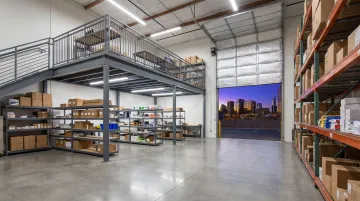
Standard units come equipped with:
- 100/150-amp 3-phase electrical service for power-intensive operations
- LED lighting and insulated overhead doors built for heavy daily use
- Optional HVAC systems for climate-controlled inventory storage
- Add-ons like restrooms, kitchenettes, and high-speed internet
Mezzanine additions can expand usable square footage by up to 30%, creating separate zones for storage, operations, and office work within a single unit.
The financial logic is straightforward: every month you rent a storage unit, that money disappears. Owning a warehouse unit through SBA 504 or 7(a) financing — with terms comparable to a residential loan — builds equity instead. Personal Warehouse units can also be leased out or resold, giving owners options that perpetual renters simply don't have. The company's 99-year ground lease structure provides long-term stability without requiring the capital outlay of land purchase.
That's a fundamentally different financial position — and for a growing small business, it can change how you think about space entirely.
Frequently Asked Questions
Can I use a storage unit for business purposes, including storing business inventory?
Yes. Most self-storage facilities explicitly permit commercial inventory storage. Review your lease for clauses about commercial activity — storing goods passively is typically allowed, while operating a business from the unit (meetings, machinery, fulfillment) often is not.
Can I run an e-commerce or shipping business out of a storage unit?
Storing inventory there is fine, but fulfilling and shipping orders from inside the unit may violate facility policies. Most e-commerce sellers handle order processing and label printing from a separate location.
What are you not allowed to store in a storage unit?
Most facilities prohibit flammable liquids, perishable food, hazardous chemicals, explosives, and living things. Individual facilities may add restrictions beyond these, so review the specific policy before signing.
Can I write off a storage unit as a business expense?
If the unit is used exclusively for business inventory storage, the rental cost is generally deductible as an ordinary business expense. Confirm the specifics with a tax professional before filing.
Can I rent two storage units at the same time?
Absolutely. Most facilities allow tenants to lease multiple units at once. This works well for separating inventory types, maintaining temperature-specific storage, or scaling capacity during peak seasons.