A warehouse is an active operational hub where goods move in, get processed, and ship out. Self storage is a passive space where your belongings sit until you need them. That distinction drives every other difference: price, access, security, services, and scalability.
This guide covers both options side by side — what each is, who it's for, what it costs, and where a third option (private warehouse ownership) fills the gap for people who need more than storage but less than full logistics.
TL;DR
- Warehouses are active commercial facilities built for inventory management, order fulfillment, and distribution
- Self storage units are passive, tenant-managed spaces rented monthly for personal or overflow business use
- Key differences: purpose, services, size, security, cost, and who manages your goods
- Average self storage runs around $114–$134/month; warehouse space averages $10–$15/sq ft annually, with full logistics costs layered on top
- Personal Warehouse units offer a third option: ownable, warehouse-grade space with no 3PL service contract required
Warehouse vs. Self Storage: At a Glance
| Category | Warehouse | Self Storage |
|---|---|---|
| Purpose | Active inventory management and distribution | Passive storage of personal or overflow items |
| Typical User | Businesses, e-commerce, manufacturers, importers | Individuals, small businesses, collectors, RV/boat owners |
| Size/Scale | 25,000–500,000+ sq ft | 25–300 sq ft per unit |
| Services Included | Receiving, pick-and-pack, WMS, shipping coordination | None — tenant manages everything |
| Security Level | Staff, integrated CCTV, access-controlled docks | Perimeter fencing, padlocks, general surveillance |
| Cost Model | Per pallet, per sq ft, or service contract | Flat monthly rental |
| Access Type | Controlled, scheduled, or staff-managed | 24/7 self-access (varies by facility) |
This comparison covers traditional commercial warehouses and standard self storage units. A third category — Personal Warehouses® — fills the gap between them: owner-occupied, warehouse-grade spaces without the staffing, logistics contracts, or rental-only terms of either model.
What is a Warehouse?
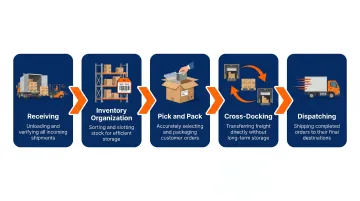
A warehouse isn't just a big room with shelves. It's an operational node in a supply chain — receiving inbound freight, organizing inventory by SKU, picking and packing orders, and dispatching outbound shipments. The defining characteristic is active flow. Goods move through a warehouse; they don't just sit in one.
Core Warehouse Functions
- Receiving — logging and inspecting inbound shipments
- Inventory organization — storing goods by SKU, lot, or batch with real-time tracking
- Pick and pack — pulling specific items for individual orders
- Cross-docking — transferring freight directly between inbound and outbound vehicles without long-term storage
- Dispatching — coordinating outbound shipments via carrier
Types of Warehouses
- Distribution centers — hold finished goods and dispatch to retail or end customers
- Fulfillment centers — process individual e-commerce orders (pick, pack, ship)
- Cold storage warehouses — temperature-controlled for perishables and pharmaceuticals
- Bonded/customs warehouses — hold imported goods pending customs clearance
- Public warehouses (3PLs) — shared facilities operated by third-party logistics providers on a contract basis
Warehouses primarily serve wholesalers, e-commerce businesses, manufacturers, retailers, and importers with high-volume inventory and regular inbound/outbound freight.
Use Cases
The warehouse model makes sense when goods are constantly moving. An e-commerce brand shipping hundreds of orders daily needs a pick-and-pack operation, not a storage unit. A retailer managing seasonal inventory spikes needs scalable receiving capacity, not a padlocked room.
For businesses that don't want to own infrastructure, a 3PL warehouse relationship lets volume flex up or down without capital investment — the U.S. 3PL market generated $131.5 billion in net revenue in 2024.
Businesses that want their own dedicated space — without service contracts or shared facilities — can own rather than rent. Personal Warehouse units, for instance, support this model with features like mezzanines that expand usable space by up to 30% and owner-customizable buildouts.
What is Self Storage?
Self storage means renting a unit, moving your belongings in, and managing everything on your own. No staff handles, tracks, or moves your items. The facility provides the space — what you do with it is entirely up to you.
Types of Self Storage Units
- Drive-up units — outdoor access, roll-up doors, ideal for furniture and boxes
- Climate-controlled indoor units — temperature and humidity regulated, better for electronics, art, or documents
- Vehicle/RV/boat storage — covered or uncovered spots sized for large vehicles
- Mini-storage lockers — small spaces (5×5 ft) for a few boxes or seasonal items
- Portable storage — containers delivered to your location, then stored off-site
The size range runs from a 5×5 ft locker ($52/month) up to a 10×30 ft drive-up unit ($327/month for climate-controlled), with the average 10×10 non-climate unit running about $119/month nationally.
Who Uses Self Storage
According to industry data, 77% of self storage renters are individual/residential users. The breakdown of why people rent:
- 44% cite an upcoming or recent move
- 34% need more space at home
- Remaining users include home renovation, decluttering, and life transitions
Business users make up about 18% of renters — small operations keeping overflow office supplies or seasonal merchandise.
Use Cases and Limits
Self storage works well for low-turnover, low-access scenarios: transitional storage between moves, seasonal vehicle parking, personal collections, and short-term overflow.
For businesses that need more than a place to park excess inventory, the limitations become harder to ignore:
- No inventory management support
- Security responsibility falls entirely on the tenant
- Unit sizes cap out around 300 sq ft — impractical for palletized goods or equipment
- No scalability as volume grows
These gaps are precisely where warehouse-style spaces start to make more sense — a distinction worth understanding before committing to either option.
Key Differences: Warehouse vs. Self Storage
Purpose: Active vs. Passive
This is the root of everything else. Warehouses exist to move goods — inbound, processed, outbound. Self storage exists to hold things until you want them back. One is a logistics operation; the other is a long-term holding solution.
That active/passive distinction explains why warehouses cost more, require more security, offer more services, and operate at a completely different scale.
Size and Scale
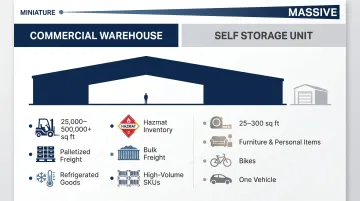
The gap here is dramatic:
- Commercial warehouses: 25,000 to 500,000+ sq ft, handling palletized freight, industrial equipment, and perishables
- Self storage units: 25 to 300 sq ft, suited for furniture, personal items, bikes, or one vehicle
Warehouses also handle things self storage simply can't — refrigerated goods, hazmat inventory (with proper licensing), bulk freight, and high-volume SKU counts.
Services and Management
| Feature | Warehouse | Self Storage |
|---|---|---|
| Inventory tracking (WMS) | ✅ Often included | ❌ |
| Pick and pack | ✅ Available | ❌ |
| Receiving/dispatching staff | ✅ Standard | ❌ |
| Cross-docking | ✅ Available | ❌ |
| Tenant manages logistics | ❌ | ✅ Always |
This service gap is the primary reason warehouse costs are higher. You're paying for space plus the full operational infrastructure that runs it.
Security
Commercial warehouses embed security into their operating model: staffed facilities, integrated CCTV, access-controlled loading docks, and alarm systems. These aren't optional add-ons; they're part of the facility's operational cost.
Self storage security varies widely. About 80% of self storage facilities offer 24-hour video surveillance and roughly 75% use electronic gate access — but the individual unit's security typically comes down to the tenant's own padlock. 84% of self storage customers identify security as their top selection factor, which signals that the industry hasn't fully resolved this concern — and it's worth weighing when comparing facility types on cost.
Cost
Self storage pricing is simple: one flat monthly rate, all-inclusive.
Warehouse pricing is multi-layered:
- Base rent: $6–$15/sq ft annually (national average around $10–$11/sq ft)
- Labor: represents 40%–60% of total warehouse operating costs
- Utilities: $1–$3/sq ft annually
- WMS software: $500–$3,000/month
- 3PL pick-and-pack: $3.00–$5.50 per order
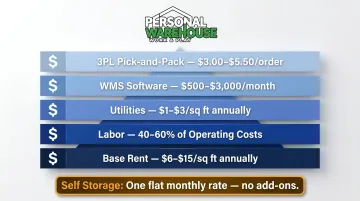
The warehouse costs more upfront, but for businesses shipping 500+ orders per month, a 3PL arrangement often offsets those costs through avoided labor, technology, and infrastructure expenses.
Which Storage Solution Is Right for You?
Choose Self Storage If:
- You need short- to medium-term space for personal belongings
- You're storing seasonal items — motorcycles, camping gear, holiday decorations
- You want vehicle parking for an RV or boat (basic outdoor spots work fine)
- Volume is low and you don't need staff or services
- Monthly rental flexibility matters more than long-term cost
Choose a Commercial Warehouse If:
- Your business ships regular inbound/outbound freight
- You need inventory management, pick-and-pack, or kitting services
- Volume fluctuates enough that flexible 3PL contracts make more sense than owned infrastructure
- You handle perishables, high-value goods, or palletized freight
Consider a Private Warehouse Unit If:
If neither option fits cleanly, you're not alone. A growing segment of buyers — small business owners, collectors, RV and boat owners, trades professionals — need more than a storage unit but have no use for full logistics services.
Personal Warehouse units occupy this middle ground. These are owned spaces (not monthly rentals) built to warehouse-grade specs:
- Insulated overhead doors and all-LED lighting
- 100/150-amp 3-phase electrical service
- High-efficiency insulation with full heating and optional AC
- Optional upgrades: mezzanines, restrooms, kitchenettes, full HVAC
The ownership model changes the financial picture. Instead of writing a monthly check indefinitely, owners build equity and retain resale value. If needs change, the unit can be leased to a third party.
Personal Warehouse structures units around a 99-year ground lease — you own the building, the land is leased — with financing available through preferred lenders using SBA 504 and 7(a) programs.
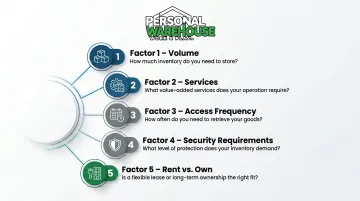
The decision comes down to five factors:
- Volume — total quantity stored and how frequently it moves in or out
- Services — whether you need pick-and-pack logistics or simply secure, accessible space
- Access frequency — are you in daily for operations, or stopping by once a month?
- Security requirements — what you're storing and what it's worth
- Rent vs. own — whether perpetual rental or long-term ownership better serves your financial goals
Frequently Asked Questions
What is the difference between warehouse storage and self storage?
Warehouse storage is an active, managed commercial facility used for receiving, organizing, and shipping inventory — typically with staff, software, and logistics services included. Self storage is a passive, tenant-managed space where you store your own items with no operational support from the facility.
What are the main types of storage facilities?
Common options in each category:
- Self storage: drive-up units, climate-controlled indoor units, vehicle/RV/boat storage, mini lockers
- Warehouses: distribution centers, fulfillment centers, cold storage, bonded customs warehouses, public 3PL warehouses, and private warehouse units like those offered by Personal Warehouse
How much does warehouse space cost per square foot to rent?
U.S. warehouse space averages $10.16–$11.08/sq ft annually, with regional variation from around $5.74/sq ft in markets like Columbia, SC to $15.74/sq ft in the Northeast. Self storage runs roughly $114–$134/month for a standard 10×10 unit — a completely different cost structure since it includes no services.
Can I use a warehouse unit for personal storage, not just business?
Yes. Private warehouse units are increasingly used for RV and boat storage, classic car collections, workshop space, hobby studios, and entertainment rooms. Personal Warehouse offers units for these lifestyle applications, including mezzanines, climate control, and custom finishes unavailable in standard self storage.
Is self storage or a warehouse unit better for storing an RV or boat?
Standard self storage vehicle spots work for basic outdoor parking, but a private warehouse unit offers enclosed, climate-appropriate space with better security, full lighting, and enough room to do maintenance work. For high-value vehicles, the enclosed option is worth the premium over outdoor parking.
What should I look for when choosing between a warehouse and self storage?
Key factors to weigh:
- How much volume you need to store and how frequently you'll access it
- Whether you require logistics services or just raw space
- The value of your goods and your security requirements
- Whether monthly renting or long-term ownership makes better financial sense