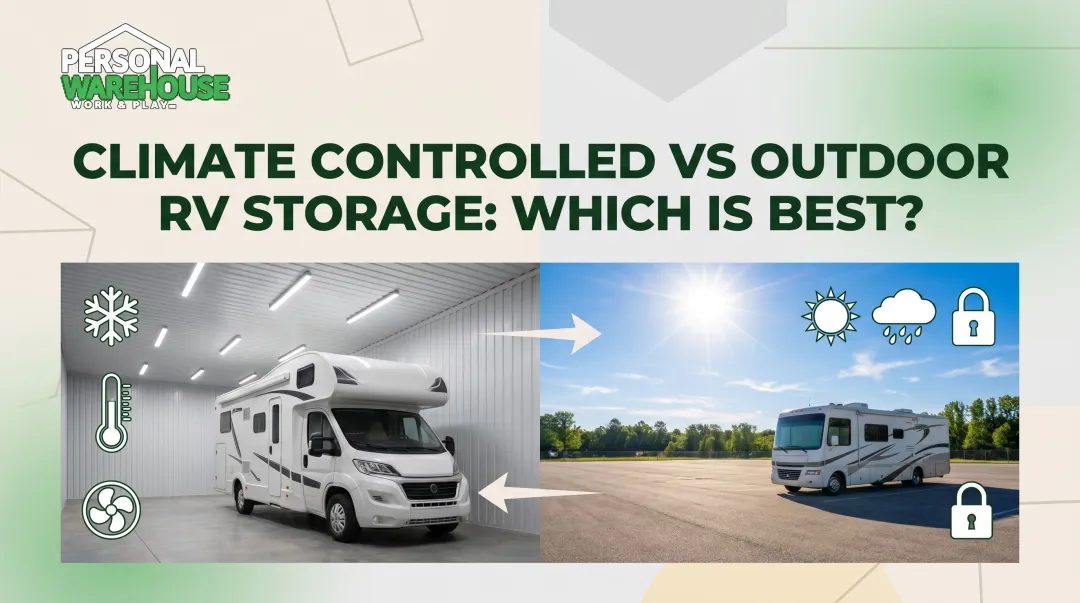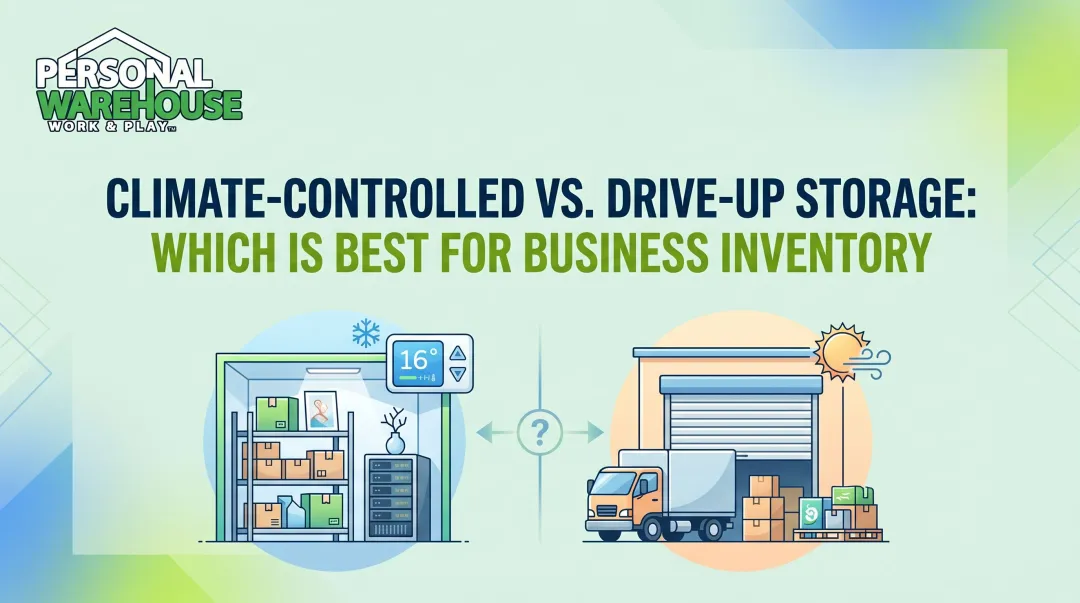
Not all storage units offer the same protection. Climate-controlled and drive-up units serve fundamentally different purposes, and confusing the two is an expensive mistake. This article breaks down exactly how each type works, what belongs in each, and how to choose based on your specific situation — including why location matters more than most renters realize.
TL;DR
- Electronics, wood furniture, artwork, and documents need climate-controlled storage to stay protected from temperature swings and humidity year-round
- For durable items, heavy loads, or frequent retrieval, drive-up storage gives you direct vehicle access at ground level
- Climate-controlled units cost 25–50% more per month than standard drive-up units
- Your best option depends on what you're storing, your local climate, and how often you need access
- Many renters use both types for different categories of belongings
Climate-Controlled vs. Drive-Up Storage: Quick Comparison
| Factor | Climate-Controlled | Drive-Up |
|---|---|---|
| Monthly Cost | 25–50% premium over standard units | More affordable; no HVAC infrastructure costs |
| Temperature | Commonly maintained at 55°F–85°F year-round | Mirrors outdoor conditions |
| Humidity | Regulated; targets below 50–55% RH | No regulation; fluctuates with weather |
| Access | Indoor corridors or elevators; less convenient for bulky items | Pull vehicle directly to door; ideal for heavy loads |
| Best For | Sensitive, valuable, or long-term storage | Durable goods, equipment, vehicles, frequent retrieval |
| Security | Inside secured building with multiple access barriers | Depends on facility features; lockable enclosed units |
The cost difference is real but not always prohibitive. According to industry data, climate-controlled units typically run $20–$50 more per month for standard sizes, climbing to $40–$70 more for larger units like 10x20s. The real question is whether your items justify that extra cost — or whether a drive-up unit's convenience and lower price point is the smarter fit.
What Is Climate-Controlled Storage?
Climate-controlled storage uses HVAC systems to maintain a consistent interior environment regardless of what's happening outside. The temperature is commonly kept between 55°F and 85°F, though no formal industry standard exists — this range is a widely adopted benchmark, not a regulated requirement.
Why Humidity Matters More Than Temperature
Temperature gets most of the attention, but humidity is usually the primary damage driver. According to the Self Storage Association, mold and corrosion growth increase exponentially once relative humidity exceeds 50–55%. Quality climate-controlled facilities target 45–50% RH, which requires more than just air conditioning — it often means standalone dehumidification systems working alongside HVAC.
That distinction matters when evaluating facilities: a unit that only regulates temperature isn't truly climate-controlled. Before committing, ask specifically about humidity management.
What Belongs in Climate-Controlled Storage
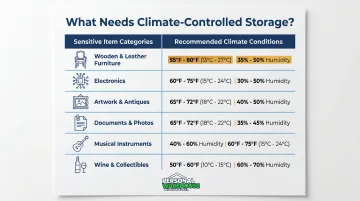
These item categories are most vulnerable to temperature swings and humidity fluctuations:
- Wooden and leather furniture — wood warps and cracks with humidity changes; leather degrades with temperature extremes
- Electronics — circuit corrosion accelerates above 55% RH; recommended storage range is 59°F–77°F at 30–40% humidity
- Artwork and antiques — materials degrade under combined heat and moisture exposure
- Documents and photographs — the U.S. National Archives recommends storing family papers below 75°F and 65% RH; black-and-white photos require 55–61°F at 30–40% humidity
- Musical instruments — Gibson recommends 70–75°F at 45–55% humidity for guitars; temperature changes can crack nitrocellulose finishes
- Wine and collectibles — integrity depends on consistent temperature and controlled light exposure
Climate control matters most to collectors, creative professionals, small business owners archiving records, and anyone storing items for 6+ months in regions with significant seasonal swings.
In a location like Belgrade, Montana — where temperatures typically range from 11°F to 86°F annually, with recorded extremes of -43°F to 105°F — climate control isn't a luxury for sensitive items. It's the baseline protection they require.
What Is Drive-Up Storage?
Drive-up storage works like a personal garage: ground-level units with wide drive aisles that let you pull a vehicle directly to the door. No elevators, no corridors, no maneuvering a sofa through a hallway. You back up, open the door, and load or unload.
The Real Advantage: Access Without Friction
For some users, quick, unobstructed access is a functional necessity, not a nice-to-have. A contractor hauling tools and materials daily can't afford 10 extra minutes per visit navigating an indoor facility. An RV owner retrieving their rig seasonally needs clearance for a large vehicle. A small business owner turning over inventory weekly needs a setup that doesn't slow operations down.
Drive-up units at quality facilities are enclosed and lockable — not exposed outdoor storage. Personal Warehouse units, for example, feature heavy-duty insulated overhead doors engineered for frequent, heavy-use access, with wide drive aisles sized for large vehicles, RVs, and work trucks.
What Belongs in Drive-Up Storage
Drive-up works well for items that can tolerate temperature variation:
- Outdoor and patio furniture
- Lawn and garden equipment
- Sports and recreational gear
- Bicycles and tools
- Construction materials and hardware
- Vehicles, boats, and RVs
- Weather-resistant containers with non-sensitive contents
Who benefits most: RV and boat owners, contractors and tradespeople, small business owners with high inventory turnover, and anyone who prioritizes hassle-free access to large or heavy items. More than 10% of homeowners already use storage specifically for vehicles, boats, or RVs — and for those users, drive-up access isn't optional.
Which Type Is Right for You?
Four questions cut through the noise:
- What am I storing? Is it sensitive to temperature or moisture?
- How long will it be stored? Weeks, months, or years?
- How often do I need access? Daily, weekly, or rarely?
- What's my local climate? Mild and stable, or extreme?
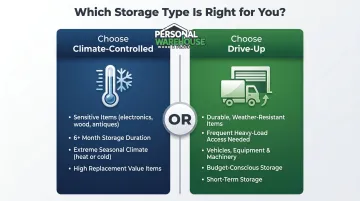
Choose Climate-Controlled When:
- Items are sensitive — electronics, wood furniture, documents, instruments, artwork
- Storage duration is 6+ months
- Your region has extreme seasonal swings (Montana winters, Texas summers)
- The replacement cost of your belongings significantly exceeds the monthly cost premium
Choose Drive-Up When:
- Items are durable and weather-tolerant
- You need frequent, heavy-load access
- You're storing vehicles, boats, RVs, or equipment
- Budget is a primary concern
- Storage is short-term
What If You Need Both?
Many renters — particularly small business owners and collectors with diverse inventories — use climate-controlled units for valuables alongside a drive-up unit for bulkier, durable gear. A woodworker might keep finished pieces in climate-controlled storage while tools, lumber, and equipment stay in a drive-up unit. A retailer might archive records in a climate unit while rotating seasonal inventory through a drive-up space.
For those who want both in a single unit, Personal Warehouse spaces offer a third path: drive-up access combined with full heating, optional A/C, and high-efficiency insulation throughout the building envelope. This configuration isn't the industry norm, but it's available at select facilities — and for buyers who need convenience and protection, it removes the need to choose between them.
Geographic context matters here. Belgrade, Montana's annual temperature range runs roughly 75 degrees between typical highs and lows — with a record spread of nearly 150 degrees at historical extremes — putting it well outside the 55–85°F range that most unprotected storage units experience. For anyone storing wood furniture, instruments, or electronics in that environment, the cost difference between unit types is likely far smaller than the cost of damaged goods.
Frequently Asked Questions
Is it better to have drive-up access storage or climate-controlled?
Neither is universally better. Drive-up suits durable items and frequent loaders; climate-controlled suits sensitive or valuable items. The right choice depends on what you're storing, how long, and what seasonal extremes your storage location experiences.
What is the difference between climate-controlled and non-climate-controlled storage?
Climate-controlled units use HVAC systems to maintain consistent temperature (commonly 55°F–85°F) and regulated humidity year-round. Non-climate-controlled units reflect outdoor conditions with no humidity management, making them vulnerable to seasonal temperature extremes.
What are the three main types of storage facilities?
Three primary types exist:
- Climate-controlled — indoor units with temperature and humidity regulation
- Drive-up or standard — ground-level access with no climate regulation
- Specialty storage — vehicle, boat, RV, or warehouse spaces designed for specific use cases
What items absolutely need climate-controlled storage?
These categories are most vulnerable to temperature swings and humidity:
- Electronics and appliances
- Wooden and leather furniture
- Artwork, antiques, and collectibles
- Important documents and photographs
- Musical instruments and wine
How much more does climate-controlled storage cost compared to drive-up?
Expect to pay 25–50% more per month for climate control — roughly $20–$50 additional for standard units and $40–$70 more for larger units. For high-value or irreplaceable items, that premium is nearly always justified.
Can I get a unit with both drive-up access and climate control?
Some facilities offer climate-controlled units with ground-level drive-up access, though it's not the industry standard. Personal Warehouse units combine drive-up overhead doors with full heating, optional A/C, and high-efficiency insulated construction — a practical configuration for buyers who need both convenience and climate protection.
Match the protection level to what you're actually storing. Sensitive and valuable items belong in climate-controlled units. Durable, bulky, or frequently accessed items belong in drive-up units. When in doubt, inventory what you have — that list will make the decision for you.
If you're exploring flexible warehouse solutions that combine drive-up convenience with premium construction and optional climate control, contact Personal Warehouse or call 303-222-0768 to learn about available spaces in Belgrade, MT and other locations.