Introduction
There's a particular kind of frustration that hits when your workspace is fighting you. You sit down to sketch out a concept, but the desk is buried under client invoices. You finally clear space to focus on a proposal, but your reference materials are somewhere in the pile behind you. The environment that was supposed to support your work is generating friction instead.
Creative entrepreneurs face a workspace challenge that generic office advice doesn't address: you need a single space that can shift between open-ended creative production and disciplined business management, sometimes within the same hour. Neither mode works well when the environment is set up for the other.
According to MBO Partners' 2025 State of Independence report, the US independent workforce reached 72.9 million workers in 2025, with independent content creators alone growing 13% to 10.1 million. A record 5.6 million of those independent workers earned over $100,000 that year. For this group, workspace design isn't an aesthetic choice — it's an operational one that directly affects income.
This guide covers how to design a creative office that actually supports both modes of work — the freewheeling production side and the disciplined business side — whether you're fitting out a spare bedroom or building a dedicated studio from scratch.
TL;DR
- Zone your space into distinct creation, business, and inspiration areas — context-switching between tasks drains creative energy fast
- Lighting is your highest-impact design variable — use tunable lighting to shift between warm (brainstorming) and cool (focused execution)
- Keep frequently used materials visible and accessible; hide only what you rarely use
- White noise at around 45 dB and instrumental-only playlists support creative focus without mental distraction
- Owning a dedicated studio space builds equity; renting one just covers someone else's mortgage
What Makes a Creative Entrepreneur's Office Different
Most office design advice is written for one type of work: screen-based, task-oriented, linear. Creative entrepreneurs need two types of environment in close proximity.
One environment is open and tolerant of mess — where ideas form and materials spread out freely. The other is structured and distraction-free — where proposals get written, invoices go out, and client emails get answered thoughtfully.
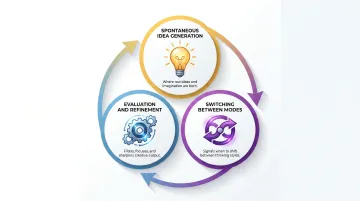
Research published in the Conscious Cities Journal maps the creative process to three distinct brain networks: the Default Mode Network (for spontaneous idea generation), the Executive Control Network (for evaluation and refinement), and the salience network (for switching between the two). Each phase requires a different spatial configuration. A single undifferentiated desk serves none of them well.
Who benefits most from intentional creative office design:
- Photographers and videographers (equipment access, color-accurate light, shooting space)
- Graphic designers and illustrators (monitor quality, reference materials, drawing surfaces)
- Product makers and fabricators (tool storage, assembly surfaces, material organization)
- Content creators and writers (distraction management, recording setup, digital organization)
- Creative-business hybrids running their own studios, agencies, or product lines
The real goal is removing friction — between where you are and where your ideas need to go, and between the creative work and the business infrastructure that keeps it funded.
Zone Your Space: Creation, Business, and Inspiration
The most effective creative offices divide available space into distinct functional zones rather than treating the whole room as one work area. Zoning reduces context-switching fatigue, which is particularly costly for creative professionals who need deep focus in both creative and administrative modes.
The Creation Zone
This is where the actual making happens. It needs:
- Generous open surface area for sketching, building, photographing, or recording
- Frequently used supplies within arm's reach — no hunting mid-project
- A clear-down routine that resets the space after each session, so mess is temporary and intentional
- Minimal competing visual input in your immediate sightline
The creation zone should feel more permissive than the rest of the space — not messier by default, but structurally designed to allow it. That distinction matters when you're trying to get into a generative headspace.
The Business Zone
Proposals, client calls, invoices — the business zone handles all of it. Where the creation zone is permissive, this one is structured: clean surfaces, a proper monitor setup, and a visual environment that says "get it done."
Key elements:
- An ergonomic chair and properly adjusted monitor height — workstation ergonomics matter more than most creatives realize
- Organized storage for contracts, invoices, and client files
- A dedicated device setup that stays in business mode — ideally a separate monitor or even a separate laptop profile
A randomized controlled trial in Industrial Health found that workstation adjustments alone produced statistically significant pain reductions across neck, shoulder, upper back, and wrist — intervention group neck pain averaged 1.0 versus 2.9 in the control group after 36 weeks. That's a meaningful difference for anyone logging long hours at a desk.
The Inspiration Zone
A dedicated inspiration zone — a wall, corner, or surface reserved for mood boards, reference imagery, and current project direction — is different from scattered decor. It becomes an active tool.
The key distinction: update it regularly. An inspiration zone that reflects a project you finished six months ago becomes wallpaper. A quick refresh at the start of each new project — new imagery, a revised color palette, a few printed references — takes fifteen minutes and reorients your focus every time you glance up.
Lighting, Acoustics, and Ambiance
These three elements are consistently underestimated in workspace design. Together, they determine whether your space energizes you or drains you.
Lighting
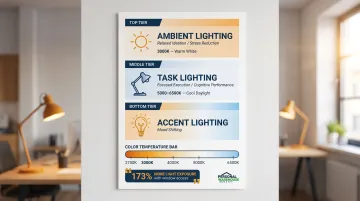
A creative office needs three layers:
- Ambient — general room brightness
- Task — directed light for detailed work at the desk or creation surface
- Accent — mood lighting that can shift the feel of the space
Color temperature matters more than most people realize. Research in the Journal of Environmental Psychology (2025) found that warm light (3000 K) effectively reduces stress, while cool light (7000 K) enhances cognitive performance. This isn't an either/or decision — it's an argument for tunable or adjustable lighting that lets you shift temperature based on what you're doing.
For natural light: a landmark study from Northwestern Medicine found that office workers with window access received 173% more white light exposure during the day and slept an average of 46 minutes more per night than windowless counterparts. Position your primary desk within 20–25 feet of a window, angled to minimize glare on screens. If natural light is limited, full-spectrum bulbs compensate reasonably well.
Visual creatives — photographers, designers, illustrators — need color-accurate light. The professional standard for monitors is Delta E ≤ 2, with 99%+ sRGB or Adobe RGB coverage depending on your output medium.
Acoustics
Sound is the overlooked twin of lighting. Research in Scientific Reports (2022) found that white noise at 45 dB improved sustained attention, accuracy, and creativity while also reducing stress — but at 65 dB, stress increased and accuracy declined. Low-level white noise in the background during focus sessions hits a useful sweet spot.
For music: task-based studies show instrumental tracks boost creative originality, while vocal music interferes with verbal working memory and hurts output. Keep playlists instrumental during ideation sessions.
Practical acoustic improvements (no renovation required):
- Area rugs absorb floor reflection
- Bookshelves and curtains break up parallel wall surfaces
- Acoustic panels for anyone doing audio recording or video calls from the space
Ambiance
Ambiance is the sum of sensory inputs that signal to your brain: this is a space for focused, creative work. Temperature, scent, wall color, the presence of plants or meaningful objects — these are environmental cues that support the mental shift into deep work. Studies on color psychology suggest blue-green tones aid focus, while cooler room temperatures (around 68–70°F) keep alertness sharp without physical discomfort.
Organization Systems That Work With Your Creative Brain
Traditional organization advice assumes a linear, tidy workflow. Creative work isn't linear. The goal isn't to make everything invisible — it's to make everything findable and accessible without slowing you down.
The operative concept is organized visibility: frequently used materials stay within sight and reach; rarely used items go into storage.
Physical Organization
A tiered approach works well:
| Tier | Location | What Belongs Here |
|---|---|---|
| Tier 1 | Desktop surface | Daily-use tools and active project materials only |
| Tier 2 | Nearby shelving | Weekly-use supplies and current project files |
| Tier 3 | Deep storage | Archived work, seasonal supplies, reference materials |
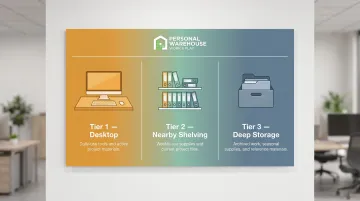
Every item should have a consistent "home" — a specific spot it returns to after use. This allows you to clear and restore a desk quickly between sessions without spending mental energy deciding where things go.
Label everything. For visual creatives, color-coded organization adds a layer of quick-scan efficiency. Open shelving works well for physical materials; filing drawers or binders keep documents from becoming a pile.
Digital Organization
Physical organization only solves half the problem. Digital clutter generates the same cognitive friction — it's just less visible. A McKinsey Global Institute study found that knowledge workers spend 20% of their workweek searching for information or tracking down documents. For a solo creative running a business, that's time you don't have.
Practical digital organization habits:
- Organize folders by project and date — consistent, predictable, and easy to search
- Apply file naming conventions before saving, not retroactively
- Schedule a weekly desktop and downloads cleanup; don't rely on willpower
One addition worth building in early: document your repeatable processes — client onboarding, invoicing, content publishing — as simple standard operating procedures (SOPs). When these tasks run on autopilot, they stop interrupting creative flow with decision fatigue.
Technology and Gear
The right technology setup removes friction and amplifies output. The wrong setup creates daily workarounds that quietly drain hours.
Core recommendations by discipline:
- Visual creatives — a color-accurate monitor (Delta E ≤ 2, 99%+ sRGB or Adobe RGB) is non-negotiable for design, photo editing, or video work. A dual-monitor setup adds significant workflow efficiency
- Audio creatives — quality studio monitors and acoustic isolation; a treated recording environment if audio output is part of your business
- Writers and content creators — a distraction-minimizing interface; consider a dedicated writing device or app that limits notifications
- All disciplines — fast, reliable internet. The FCC's 2024 broadband benchmark is 100 Mbps download / 20 Mbps upload — and video creators working in 4K need upload capacity well beyond that
Desk and cable management matter more than they get credit for. A tangled, cluttered desk creates background stress that accumulates through the day. Simple fixes:
- Cable channels or clips routed behind or under the desk
- A monitor arm to free up surface area
- A dedicated charging station to keep devices off the workspace
Your specific work dictates what comes next: a quality webcam and microphone for client calls, a printer/scanner for contracts and physical proofs, and discipline-specific hardware like drawing tablets, MIDI controllers, or photography lighting. The standard is simple — every tool earns its spot by removing friction, not adding to it.
When Your Creative Business Needs More Room to Grow
At some point, the home office stops being a limitation you manage and starts being a ceiling you've hit. Common signals:
- Equipment or inventory has spread into living areas
- You can't take on new types of work because there's nowhere to do it
- Client or collaborator visits aren't feasible
- The line between professional and personal space has essentially disappeared
Outgrowing your space isn't a problem — it's evidence that the business has real physical requirements. The question is what to do about it.
Many creative entrepreneurs eventually need a dedicated studio, workshop, or storage-equipped commercial space. This is where purpose-built warehouse units designed for creative use start making practical sense.
Personal Warehouse offers customizable units built specifically for creative professional applications: photo studios, gallery spaces, fabrication areas, woodworking shops, and creative offices. Standard features include:
- All-LED lighting inside and out
- 100/150-amp 3-phase electrical service for professional equipment
- Superior insulation for year-round climate control
- Heavy-duty insulated overhead doors wide enough to move large equipment and materials
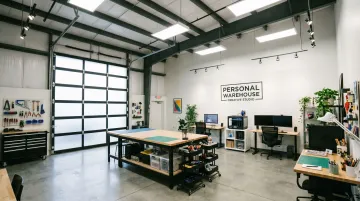
Optional mezzanines can expand usable space by up to 30%, adding multi-level functionality that a typical commercial lease won't offer.
Rather than leasing commercial space and building a landlord's equity, Personal Warehouse units are structured for ownership. Financing options include SBA 504 loans with as little as 10% down on terms up to 25 years — numbers comparable to a residential mortgage. The SBA 504 program is specifically designed for small business real estate acquisition, and Personal Warehouse works with preferred lenders experienced with these loan structures.
Owning rather than leasing means stable, customizable space that builds equity over time. For any creative professional planning to keep growing, that's a fundamentally different financial position than signing another lease. Current projects include Bozeman, MT (under construction, accepting reservations for 2026 delivery), with additional markets under development across the US.
Frequently Asked Questions
What does a creative entrepreneur do?
A creative entrepreneur builds a business where the central product is creative or intellectual output — a freelance design studio, a photography business, a content platform, or a product line built around a craft. Creativity isn't incidental to the business model; it is the business model.
What is the most profitable creative business?
Profitability varies by model more than by discipline. Digital products and services (design, content, software) tend to generate strong margins because overhead stays low as revenue scales. The global graphic design industry alone reached approximately $55.7 billion, growing at a 4.0% CAGR — and those gains concentrate in productized and passive models, not hourly work.
Should a creative entrepreneur work from home or rent a dedicated studio?
Most creatives start at home and move to a dedicated space as revenue justifies it. Work type, equipment needs, client interaction, and storage all factor in — but the clearest signal is when home limitations start capping growth rather than just creating inconvenience.
How do I keep my creative office organized without losing spontaneity?
Use the "organized visibility" approach: keep active project materials accessible and in view, archive completed work, and give every item a consistent home. The goal is a space that's ready to use quickly — not one that requires setup before every session or feels too controlled to think freely in.
What lighting is best for a creative workspace?
Use three layers: ambient (overall brightness), task (directed light for detailed work), and accent (mood). Prioritize natural light where possible — position desks within 20–25 feet of windows. Tunable lighting lets you shift between warm (3000 K for relaxed ideation) and cool (6500 K for focused execution); visual creatives should ensure full-spectrum, color-accurate sources at both the desk and monitor.