Introduction
Most people treat creativity as a mental discipline — something you develop through practice, mindset shifts, or the right team. What gets far less attention is the room you're sitting in while you try to think.
The physical environment either amplifies or suppresses creative thinking — and most offices are designed without that in mind. The focus tends to land on efficiency metrics: desk density, meeting room ratios, square footage per employee. The result is spaces that process tasks fine but actively work against original thought.
For small business owners, creative professionals, and entrepreneurs, this matters in concrete terms. A cluttered, generic, or poorly configured workspace doesn't just feel uninspiring — it depletes the mental conditions your brain requires to generate ideas.
This article covers the neuroscience behind why space affects creative output, which design elements actually support it, and one counterintuitive finding that should give anyone pause before copying popular office design trends.
TL;DR
- Your brain's creativity network is sensitive to physical surroundings, meaning workspace design directly affects cognitive output
- High ceilings, blue tones, natural light, and biophilic elements are among the highest-evidence design investments
- Open offices can reduce face-to-face interaction — always pair them with dedicated quiet zones
- Unconventional "creative" spaces can backfire by causing cognitive fixation; thoughtful function matters more than novelty
- Giving workers control over their environment consistently outperforms both bare offices and fully employer-decorated ones
Why Your Physical Workspace Is a Creativity Engine
The brain has a network specifically associated with imagination, spontaneous thinking, and original idea generation: the default mode network (DMN). It activates during mind-wandering and internally-directed thought, and research published in Neuropsychologia found that people with stronger creative ability show greater functional connectivity between the DMN and areas linked to divergent thinking.
The DMN doesn't operate in isolation. It works in dynamic interplay with the executive control network — one generates ideas, the other evaluates them. Environmental factors influence how freely that interplay happens. High-stimulation, cognitively demanding spaces suppress the DMN. Spaces that allow mental breathing room support it. That makes workspace design a functional decision with measurable consequences.
Gensler's 2025 Global Workplace Survey found that only 26% of employees strongly agree their current workspace helps them do their best work. That's not a minor inconvenience — it means the overwhelming majority of workers are operating in environments that undercut their output.
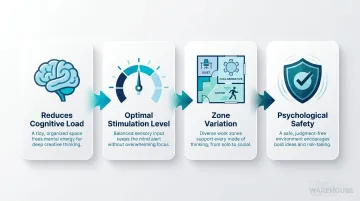
What a creativity-supporting space actually does:
- Reduces unnecessary cognitive load so mental resources stay available for ideation
- Provides enough stimulation to engage the brain without overwhelming it
- Offers variation — different zones for different cognitive states
- Signals psychological safety, so people feel comfortable taking creative risks
Core Design Elements That Unlock Creative Thinking
Ceiling Height and the Cathedral Effect
Research by Meyers-Levy and Zhu (2007) demonstrated that ceiling height primes different cognitive modes. High ceilings activate concepts of freedom and openness, pushing the brain toward abstract, relational thinking — exactly what brainstorming requires. Low ceilings prime confinement and encourage detail-focused, item-specific processing.
Practical implication: Use larger, taller spaces for ideation sessions. Reserve smaller, lower-ceilinged rooms for tasks that require precision and attention to detail — they're actually better suited for it.
Color Psychology
Color is a functional design tool, not decoration. A landmark study published in Science found:
| Color | Effect | Best Use |
|---|---|---|
| Blue | Boosts creative task performance via approach motivation | Brainstorming rooms, ideation zones |
| Red | Sharpens detail-oriented accuracy via avoidance motivation | Proofreading, quality review stations |
| Green | Reduces stress, supports restoration | Break areas, focus zones |
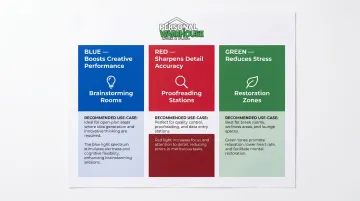
Purely white or monochrome offices miss this entirely. A neutral base with strategic color accents in task-specific zones is more effective than any single color scheme applied uniformly.
Natural Light
Office workers with window access receive 173% more white light exposure during work hours and sleep an average of 46 minutes more per night than those in windowless offices, according to a study in the Journal of Clinical Sleep Medicine. Better sleep means better mood, sharper cognition, and more mental energy available for creative work.
Where windows aren't possible, high-quality daylight-mimicking LED systems can partially replicate these effects — though they're a workaround, not a replacement.
Flexible Furniture
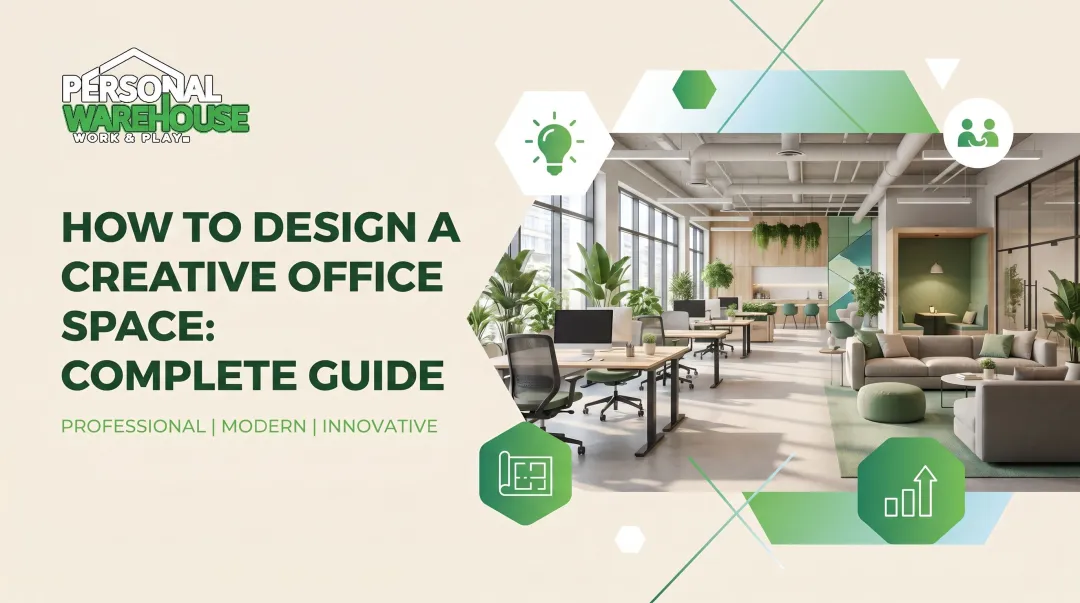
Modular desks, movable partitions, and reconfigurable layouts let workers physically shift their environment to match the cognitive task at hand. Brainstorming looks different from deep work, and the furniture arrangement should reflect that.
Personalization
This one is often overlooked. Knight and Haslam (2010) compared three office conditions: bare lean offices, employer-decorated enriched offices, and empowered offices where workers chose their own decor. Empowered offices produced the highest productivity and wellbeing of all three conditions — outperforming even thoughtfully decorated spaces.
When workers add personal touches — photos, plants, small objects — they're not being precious. They're building psychological ownership, which reduces anxiety and increases willingness to take creative risks.
That sense of ownership matters most when you control the space itself. Personal Warehouse offers Professional Work Suites that can be configured from scratch — mezzanines that expand usable square footage by up to 30%, all-LED lighting, HVAC, kitchenettes, and optional Juliet balconies that bring natural light into upper levels. For small business owners and creative professionals, it's a direct way to apply every element covered here without negotiating around a standard lease.
Balancing Open Collaboration Zones with Quiet Focus Spaces
The Open Office Paradox
Open offices were designed to increase spontaneous collaboration. The results have been mixed. When two Fortune 500 companies transitioned to open-plan layouts, Harvard researchers found face-to-face interaction dropped by roughly 70% — with email and instant messaging filling the gap. Workers instinctively retreat from environments they perceive as exposing.
Pixar's central atrium — designed by Steve Jobs — is the more cited example of collision zones done right. By placing mailboxes, the cafeteria, and meeting rooms in a single shared space, Jobs created conditions where animators, engineers, and business staff crossed paths organically. The key word is organically. He didn't mandate interaction; he designed for serendipity.
Two Phases, Two Kinds of Space
That serendipity only pays off when workers also have the conditions to do something with the ideas it sparks. Creative work has two distinct phases with very different cognitive demands:
- Divergent thinking — generating multiple possibilities, benefiting from stimulation, interaction, and loose association
- Convergent thinking — evaluating and refining ideas into something actionable, requiring solitude and sustained focus
Most workplaces support one or the other. Effective creative environments support both.
How to structure this practically:
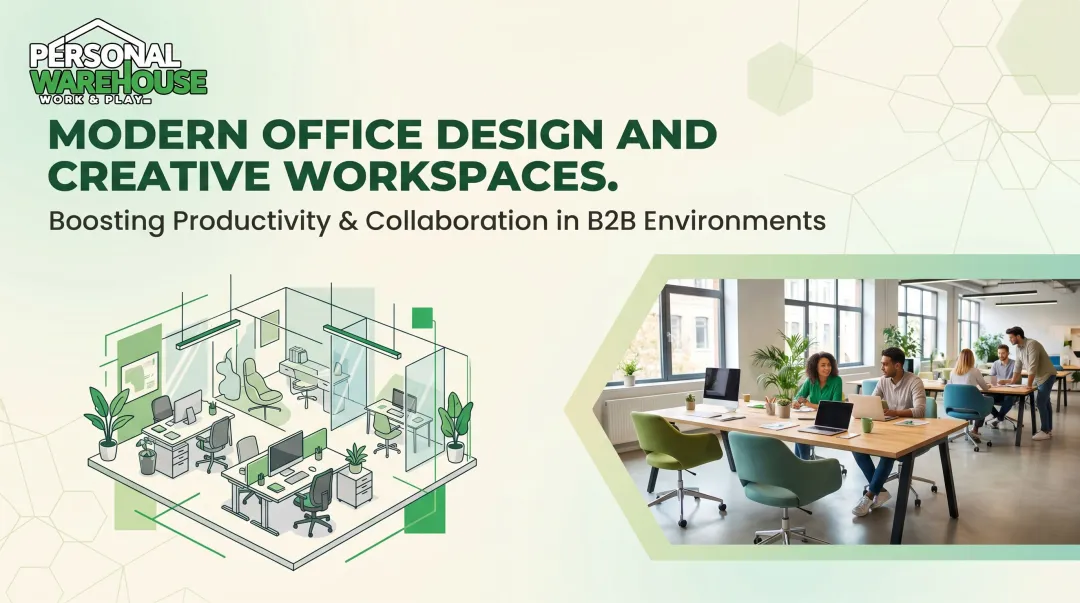
- Collaboration zones: Open, brighter, acoustically live, with informal seating clusters that invite impromptu conversation
- Quiet zones: Sound-absorbing panels, single-person work pods, carpeting to dampen noise, lower visual stimulation
- Worker choice: Let people select which zone fits their current task — research links environmental autonomy directly to higher creative output
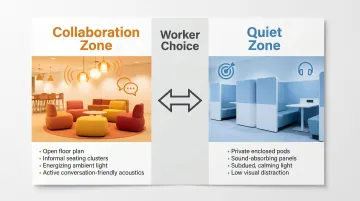
The goal isn't a 50/50 split. It's making sure workers can actually move between modes — and that the space makes doing so feel natural, not disruptive.
The Power of Biophilic Design
Biophilic design means intentionally integrating natural elements — plants, wood, stone, water, natural textures — into indoor spaces. The evidence for its effectiveness is unusually consistent.
Nieuwenhuis et al. (2014) ran three field experiments in commercial offices and found that adding plants to previously bare spaces increased productivity by 15%, alongside improvements in concentration and workplace satisfaction. Plants are among the highest evidence-to-cost interventions in workspace design.
Biophilic environments also reduce stress. Natural materials like wood and stone lower cortisol activation, and views of outdoor greenery cut job stress measurably. Multisensory approaches — combining plants with natural light and organic materials — outperform any single element alone.
High-impact biophilic additions to prioritize:
- Indoor plants, particularly those with air-quality benefits
- Living green walls in high-traffic areas
- Wood accents and natural material finishes over synthetic surfaces
- Window placement that captures outdoor views wherever possible
- Nature sounds in break areas (if outdoor access isn't available)
These elements do more than improve comfort. Spaces that feel calm and alive lower defensiveness — people are more willing to voice half-formed ideas in environments that don't feel institutional or high-stakes. For creative work, that psychological safety is where innovation actually starts.
When "Creative" Design Backfires
Here's where the conventional wisdom about creative workspaces falls apart.
Research by Lee and Sosa (2025), published in Management Science, tested whether unconventional, visually stimulating workspaces actually improve divergent thinking. The answer: it depends — and often, they make things worse.
When the visual elements in a creative space are directly related to the task being performed, workers fixate on those cues rather than generating original ideas. In one experiment, participants in a room with a Mickey Mouse drawing on the wall drew fewer and less unique objects — their thinking anchored to what was already visible. This is called cognitive fixation — a well-documented constraint on divergent thinking.
The implication cuts against a lot of expensive office redesigns:
- Novelty alone isn't enough — a space delivers creative benefit only when it feels genuinely novel and its visual elements aren't tied to the specific work being done there
- Trendy office designs copied from tech companies don't transfer automatically. The effect depends on the user's perception of novelty, which degrades once a space becomes familiar
- Task-related iconography in creative spaces narrows thinking rather than opening it up
These findings point toward a more targeted solution. Rather than overhauling an entire office, designate one breakout space with a genuinely different feel — reserved for brainstorming, not daily work. Preserving the novelty effect requires that space to remain occasional. Abstract visual elements — art unrelated to the work, nature imagery, architectural interest — serve the function better than literal creative iconography.

Beyond Design: Workplace Habits That Amplify Creative Spaces
A well-designed space with a fear-based culture will underperform a simple space with genuine psychological safety. Space sets the conditions — culture determines whether people actually use them.
The Default Mode Network (DMN) — the brain system that drives creative insight — activates during rest, mind-wandering, and unstructured thought. Forced brainstorming sessions, back-to-back meetings, and relentless task pressure suppress exactly the brain states that produce original ideas. Some of the best creative breakthroughs happen in the mental space between concentrated efforts.
Three culture habits that complement good space design:
- Protect unstructured time — scheduled blocks where no deliverable is expected, giving the brain room to make unexpected connections
- Celebrate idea attempts, not just outcomes — when people see that voicing an imperfect idea doesn't carry social cost, they generate more of them
- Gather regular feedback on the workspace itself — ask employees what the space does and doesn't support, then act on it. The process of iterating on the environment models the same experimental thinking you want to cultivate
Google's Project Aristotle — a two-year study of 180 internal teams — identified psychological safety as the single strongest predictor of team effectiveness. It outranked dependability, structure, and shared purpose. The implication for small teams and independent professionals is direct: before investing in another design upgrade, assess whether people in the space feel safe enough to think out loud.
Frequently Asked Questions
Frequently Asked Questions
How do you design a workspace that fosters both creativity and efficiency?
Combine flexible furniture, natural light, and distinct zones for collaboration and focused solo work. Giving workers autonomy over which zone they use — rather than assigning fixed seats — is one of the most reliable ways to support both modes simultaneously.
How does the design process itself foster creativity?
Observing how people work, testing layouts, and gathering feedback models iterative, experimental thinking. Treating a workspace as a hypothesis to be tested builds the same habits that drive creative innovation.
How do you foster creativity and innovation in the workplace?
Combine physical design (varied zones, natural elements, flexible furniture) with cultural practices: psychological safety, unstructured thinking time, and an environment where experimentation is visibly rewarded rather than discouraged.
Does open office design always improve creativity?
No. Open offices encourage spontaneous conversation but can harm focused creative work through noise and visual distraction. Research shows face-to-face interaction can actually decrease in fully open plans. The better approach pairs open zones with accessible quiet spaces.
How does natural light affect creativity at work?
Natural light regulates circadian rhythms, reduces cortisol, and improves mood and mental clarity. Workers with window access sleep nearly 50 minutes more per night than those without — cognitive recovery that directly supports creative thinking.
What role does personalization play in a creative workspace?
Allowing employees to personalize their space increases psychological ownership, reduces anxiety, and builds the sense of control that research links to greater willingness to take creative risks. It consistently outperforms both bare and employer-decorated environments on productivity measures.