
Whether you're a small business owner weighing whether to buy or lease warehouse space, a collector looking for permanent storage, or an investor exploring non-residential real estate, understanding the relationship between ownership structures and property classifications matters. This article answers three questions directly: what makes property "industrial," what a condominium actually is under the law, and whether those two things can overlap.
They can — and often do.
TL;DR
- A condominium can be classified as industrial property — the ownership model doesn't change how the space is zoned or used.
- "Industrial" status is determined by local zoning and land use — manufacturing, storage, distribution, processing — not by the ownership model.
- Industrial condos let individual buyers own a unit inside a larger industrial building while sharing common infrastructure.
- Converting a building to condo form doesn't change its industrial tax classification — each unit keeps its status.
What Makes a Property "Industrial"?
Industrial Is a Land-Use Classification
"Industrial" describes how a property is used, not who owns it or how title is structured. According to NAIOP, the Commercial Real Estate Development Association, an industrial building is "a structure used primarily for manufacturing, research and development, production, maintenance, and storage or distribution of goods."
Industrial buildings fall into three primary categories: manufacturing, warehouse/distribution, and flex.
Uses that qualify as industrial include:
- Manufacturing and production
- Large-scale warehousing and distribution
- Processing of raw materials
- Wholesale operations
- Self-storage and flex-industrial facilities
- Research and development (in many jurisdictions)
Industrial vs. Commercial: The Key Distinction
These two categories get conflated, but they're meaningfully different. Commercial property is used for buying and selling goods or services directly to customers — think retail stores, offices, and hotels. Industrial property is used for producing, storing, or moving physical goods, with minimal direct customer interaction.
For tax purposes, some jurisdictions group them under a single major class but maintain separate subclasses. Cook County, Illinois assigns classification code 5-89 specifically to "Industrial condominium unit" under Major Class 5B (Industrial), assessed at 25% of market value.
That's a separate code from 5-99, which covers commercial condo units — meaning assessors treat industrial and commercial condos as distinct categories, not interchangeable ones.
Zoning Is the Official Designation
Local municipalities set zoning designations — typically structured as tiered zones:
| Zone | Name | Common Permitted Uses |
|---|---|---|
| M-1 | Light Industrial | Assembly, warehousing, storage, R&D, flex |
| M-2 | Heavy Industrial | Heavy manufacturing, chemical processing, large distribution |
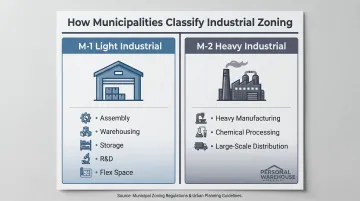
So whether a property is owned outright or structured as a condominium, its industrial status depends on the zoning designation — which is exactly what makes the condominium question worth examining.
What Is a Condominium, Really?
A Form of Title, Not a Property Type
A condominium is not a type of property. It's a legal method of subdividing real estate into individually owned units plus shared common elements.
The Texas Uniform Condominium Act (Property Code Section 82.002) makes this explicit: the Act "applies to a commercial, industrial, residential, or other type of condominium in this state." The statute confirms that condominiums are an ownership structure applied to any property type — not a property category of their own.
Illinois, which authorized condominiums in 1963 under the Illinois Condominium Property Act (765 ILCS 605), similarly applies the statute without limiting it to residential use. The Act has been on the books for over 60 years and was never written to be residential-only.
How a Condominium Is Created
A developer records a condominium declaration (also called a master deed) along with a condominium plat or map with the county. This legally subdivides a building into:
- Individually owned units — each gets its own deed, legal description, and property tax parcel number
- Common elements — shared infrastructure, parking, structural components, and exterior areas owned collectively by all unit owners
Each unit is assigned a percentage of ownership interest in common elements. The Cook County Assessor's Office explains it this way: "Each condo unit is assigned a percentage of ownership — meaning a fractional share of the building's total value — determined when the unit is built."
Unit owners collectively govern common elements through a condo owners' association (COA), which collects assessments for maintenance and manages shared infrastructure — similar in function to a residential HOA.
The Condo Structure Doesn't Change Zoning
Converting a building to condominium form does not change its zoning, land use, or industrial classification. Colorado's Common Interest Ownership Act (C.R.S. Section 38-33.3-106(2)) states this as a legal prohibition: no zoning law may "impose any requirement upon a condominium or cooperative which it would not impose upon a physically identical development under a different form of ownership." An industrial warehouse that becomes an industrial warehouse condominium is still zoned industrial.
Can a Condominium Be Classified as Industrial Property?
Yes. A condominium can be — and regularly is — classified as industrial property.
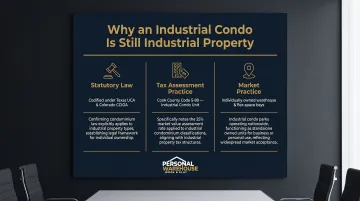
The classification is determined entirely by the property's land use and zoning, not by the ownership structure layered on top of it. Three independent lines of evidence confirm this:
- Statutory law: Texas UCA Section 82.002 affirmatively states condo law applies to "commercial, industrial, residential, or other" property types. Colorado's CCIOA prohibits treating condo-form properties differently under zoning law.
- Tax assessment practice: Cook County's classification code 5-89 explicitly designates "Industrial condominium unit" as industrial property under subclass 5B — a distinct, named code that exists precisely because industrial condos are recognized as a real category.
- Market practice: Industrial condo parks — where businesses, tradespeople, collectors, and storage users own individual warehouse or flex-space bays — exist across the country.
Personal Warehouse, for example, sells individually owned, customizable warehouse units across multiple states. Buyers can hold, lease, or sell their unit independently — the same flexibility you'd expect from any titled industrial property.
That evidence matters for one practical reason: buyers sometimes worry that the condo form changes a property's standing. It doesn't.
What Stays the Same After an Industrial Building Converts
When an industrial building converts to condominium form:
- Zoning designation stays industrial
- Property tax assessment remains based on industrial use
- Permitted uses under local regulations are unchanged
- Each unit simply receives its own separate tax parcel and deed
The condo declaration reshapes ownership and title structure. The industrial classification — and everything that comes with it — stays intact.
Benefits of Owning an Industrial Condo vs. Leasing
Equity and Long-Term Value
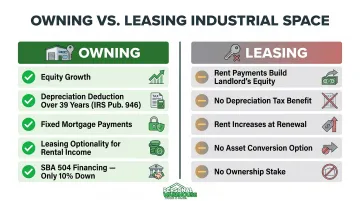
When you lease, every payment builds equity for your landlord. When you own, it builds for you. According to Cushman & Wakefield's Q4 2024 U.S. Industrial MarketBeat, 43% of tracked markets posted five-year rent growth of 50% or higher since 2019 — six markets exceeded 100% growth. Owners who purchased industrial space during that window built substantial equity while tenants absorbed those increases.
Underlying demand supports continued value growth. NAIOP projects net absorption to reach 345.9 million square feet in 2026, up from approximately 135 million square feet in 2024 — a signal that industrial space remains a tight, competitive market.
Tax Advantages
Industrial condo ownership unlocks two tax benefits unavailable to tenants:
- Depreciation: Per IRS Publication 946, nonresidential real property depreciates over 39 years using the straight-line method — generating an annual deduction that offsets income
- Leasing optionality: Owners who outgrow their space can lease it to another business, converting the unit into an income-producing asset rather than an ongoing expense
Financing and Cost Predictability
Industrial condo units can be individually mortgaged — a key distinction from larger industrial buildings, which typically require far more capital. SBA 504 loans require as little as 10% down with fixed rates over 10, 20, or 25-year terms, making ownership accessible to small businesses that couldn't otherwise enter the industrial market.
Personal Warehouse connects buyers with preferred lenders experienced in SBA 504 and 7(a) programs. The resulting loan structures — fixed payments over long terms — mirror what most buyers already know from residential mortgages. That consistency matters: unlike commercial leases, where landlords can adjust rents at renewal, a fixed mortgage payment stays the same.
What to Know Before Buying an Industrial Condominium
Read the Declaration First
The condominium declaration governs what you can and can't do with your unit. Before purchasing, review:
- Whether your specific operations are permitted — manufacturing, hazardous materials, and heavy equipment are often subject to restrictions
- Subletting rules, so you know whether you can lease to another business if your needs change
- How common area costs are allocated and what authority the association has to levy special assessments
- How difficult it is to amend the rules if the association needs to adapt
Understand Shared Costs
Owning an industrial condo means sharing infrastructure costs with other unit owners. Monthly assessments typically cover:
- Common area maintenance (parking lots, driveways, exterior lighting)
- Property insurance on shared structures
- Reserves for major capital repairs (roofs, structural components)
- Shared utilities or infrastructure
Before purchasing, review the reserve fund study. The Community Associations Institute recommends updating reserve studies every three to five years. An underfunded reserve means future special assessments — sometimes running into tens of thousands of dollars — for existing owners.
Verify Zoning and Get the Right Lender
Two separate due-diligence steps that buyers sometimes skip:
- Confirm zoning at the local government level for your intended use — don't assume industrial zoning covers every activity
- Find a lender experienced with industrial condos early in the process, not after you're under contract. Underwriting criteria vary significantly, and not all commercial lenders are familiar with this property type.
Frequently Asked Questions
What is considered industrial property?
Industrial property is real estate used primarily for manufacturing, processing, storage, distribution, or warehousing of physical goods, as defined by local zoning codes and assessment systems. It's distinct from commercial property, which is oriented toward buying and selling goods or services directly to customers.
Are condos considered commercial property?
Not necessarily. A condominium is an ownership structure, not a use category — so a condo unit can be residential, commercial, or industrial depending on how it's zoned and used.
Is an HOA considered a commercial property?
No. A homeowners' or condo owners' association is a legal governing entity, not a property classification. The properties an HOA or COA governs can be residential, commercial, or industrial — the association itself is not a property type.
What is the difference between an industrial condo and a commercial condo?
Both apply the condo ownership structure to non-residential property, but the underlying use differs. Industrial condos occupy buildings zoned for manufacturing, warehousing, or distribution; commercial condos are in buildings used for retail, office, or service businesses.
Can you get a mortgage to buy an industrial condo unit?
Yes. Industrial condo units can be individually financed, most commonly through SBA 504 loans (10% down, fixed-rate terms) or conventional commercial mortgages. Seek lenders experienced with this property type — some developers, including Personal Warehouse, provide direct lender introductions.
How is an industrial condo unit assessed for property taxes?
Each unit receives its own parcel number and is assessed individually based on its value and industrial use classification. The condo structure doesn't change the assessment category; each owner simply receives a separate tax bill instead of the building being taxed as a whole.