Introduction
Most people hear "condominium" and picture a high-rise downtown or a beachfront unit in Florida. That mental image is understandable — and completely understandable. But it misses most of the story.
The condominium model is a legal ownership structure, not a building type. The same framework that governs a Miami apartment tower also applies to ski resort hotels, industrial warehouses, marina slips, and collector garages.
That distinction matters for buyers. Understanding where the condo model gets applied opens up ownership opportunities most people don't realize exist.
According to the CAI Fact Book 2024, approximately 75.5 million Americans — roughly 30% of the U.S. population — live within a community association, with condominiums making up 35–40% of those associations. This isn't a niche ownership structure. It's mainstream real estate.
Yet most coverage focuses almost entirely on residential. This guide covers all three main development types — residential, resort, and industrial/commercial — so buyers can make informed decisions across the full range of what condo ownership actually includes.
TL;DR
- A condominium describes ownership structure, not building type — it applies to homes, hotels, warehouses, and more
- Residential condos suit buyers prioritizing housing stability and reduced maintenance
- Resort and condo-hotel units combine lifestyle ownership with managed rental income potential
- Industrial/commercial condos let business owners and hobbyists build equity instead of paying rent
- Financing terms, governance rules, and resale liquidity vary across all three types — knowing the differences shapes which option fits your goals
What Is Condominium Development?
The Legal Foundation
A condominium is a legal form of property ownership where portions of real estate are designated for separate ownership and the remainder is designated for common ownership by all unit owners collectively. That definition comes directly from the Uniform Condominium Act, originally drafted in 1977 — and it has been adopted in 14 U.S. states, with 9 additional states adopting the related Uniform Common Interest Ownership Act.
The critical point: the distinction between a condominium and any other property type is legal, not architectural. Two identical buildings on the same street could be structured completely differently — one a condo, one a rental complex — depending purely on how ownership is documented.
Three Components Every Condo Shares
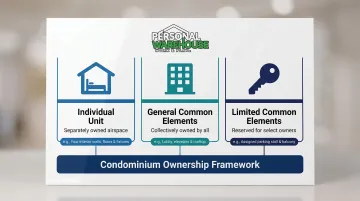
Regardless of whether a condominium contains apartments, hotel rooms, or warehouse bays, every development shares the same three ownership components:
| Component | What It Means | Examples |
|---|---|---|
| Individual Unit | Separately owned portion, typically defined as the airspace within walls/floors/ceilings | Dwelling unit, hotel room, warehouse bay |
| General Common Elements | Collectively owned by all unit owners | Land, hallways, structural systems, landscaping |
| Limited Common Elements | Reserved for use by one or a subset of owners | Assigned parking, balconies, storage lockers |
A homeowners or condominium association handles day-to-day operations — collecting assessments, enforcing bylaws, and maintaining common elements. Those monthly fees also fund reserves for future capital work.
That operational structure sits on top of the same legal framework regardless of property type. Because the model is defined by ownership documents rather than building design, it applies across a wide range of real estate — from urban high-rises to industrial warehouse parks.
Residential Condominium Developments
Types and Market Position
Residential condominiums come in several forms:
- High-rise urban towers — stacked units with shared amenities like gyms, pools, and concierge services
- Townhouse-style condos — two- or three-story attached units with private entrances, often resembling traditional homes
- Site condominiums — where individual units consist of land parcels rather than interior airspace, resembling a traditional subdivided lot but governed under condominium statutes rather than subdivision platting rules
Site condominiums have grown particularly popular in suburban and rural markets. Under Michigan's Condominium Act (Act 59 of 1978), for example, units in a condominium project can be designated as land parcels — giving the owner both the building and the ground beneath it, while still sharing a common-element framework with neighbors.
Who Buys Residential Condos — and Why
Per the NAR 2025 Profile of Home Buyers and Sellers, first-time buyers purchase condominiums at 7% — more than double the 3% rate for repeat buyers. Single female buyers show the highest condo preference at 16%, compared to 3% for married couples.
Those numbers reflect clear practical motivations:
- Reduced maintenance burden — HOA handles exterior upkeep, landscaping, and snow removal
- Access to shared amenities — pools, fitness centers, clubhouses at a fraction of what private ownership would cost
- Ownership in otherwise expensive areas — condos frequently provide entry points into high-demand markets that detached homes price out
Governance Realities
Those same buyer motivations make governance worth examining closely. What an HOA covers — and how well it's funded — directly affects both day-to-day ownership and long-term resale value. Key factors to review before closing:
- Monthly HOA assessments — covering insurance, maintenance, and reserve contributions
- Reserve funds — adequately funded reserves protect against special assessments; underfunded associations are a red flag
- Bylaws — governing pet policies, rental restrictions, short-term rental prohibitions, and exterior modification rules
For buyers who prioritize location and low maintenance over land ownership, a well-governed condo association is an asset, not a constraint.
Resort Condominiums and Condo Hotels
Two Models, One Destination Category
Resort condominiums and condo hotels share a vacation-area setting but operate quite differently.
In a traditional resort condo, the owner holds title to a unit in a vacation-area building, using it for personal stays and managing any rental activity independently. The experience is similar to owning an apartment — private, but without hotel-level services.
In a condo hotel, individually owned units are placed into a centralized rental pool managed by the hotel operator when owners are not in residence. Owners receive hotel-level amenities during their personal stays — room service, housekeeping, front desk — while the management company handles rental logistics the rest of the year.
Why Condo Hotels Attract Both Buyers and Developers
For buyers, the model offers three clear advantages:
- Units generate rental income when vacant rather than sitting idle
- Professional management eliminates self-managing rental headaches
- Access to hotel amenities makes personal stays more comfortable than a standalone resort condo
For developers, condo hotels solve a capital timing problem. A Cornell Hospitality Quarterly study of 3,699 newly opened U.S. hotels found that average stabilization takes 3.08 years — meaning traditional hotel developers wait years for positive cash flow. Condo hotel developers collect sales proceeds near or at opening, dramatically improving their return timeline.
Legal and Regulatory Complexity
Condo hotels occupy complicated regulatory territory. Four areas warrant close attention:
- Under the federal Howey test, units marketed with rental income projections can be classified as securities — safe harbor guidelines require emphasizing personal use, not investment returns
- Florida's revised rules (effective October 2024) mandate disclosures on maintenance responsibilities, shared facility fees, and building operator roles
- Units in a rental pool typically qualify as public accommodations under ADA Title III; units used primarily as residences may not
- New York classifies condo hotels under Commercial property (Category 400), not Residential, regardless of individual unit ownership
The right condo hotel buyer wants resort ownership without the hassle of vacancy or self-management. They also need to accept that financing will look more like a commercial loan than a conventional mortgage.
Industrial and Commercial Condominium Developments
The Same Structure, Different Use
Commercial and industrial condominiums apply identical legal ownership mechanics to non-residential property: office buildings, retail centers, warehouses, storage facilities, marina slips, and parking garages. Owners hold fee simple title to their unit and share common areas — driveways, parking, exterior maintenance — through an association.
Rather than paying rent indefinitely with zero equity accumulation, buyers build an ownership stake in real property that can be customized, leased, or sold.
Financial Advantages of Owning vs. Leasing
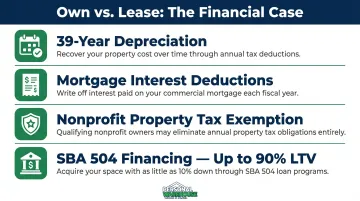
The numbers favor ownership for most long-term occupants:
- 39-year depreciation — IRS Publication 946 (2025) confirms nonresidential real property follows a 39-year MACRS recovery period, generating annual deductions unavailable to lessees
- Mortgage interest deductions — fully deductible as a business expense for owner-occupied commercial property
- Nonprofit property tax exemption — organizations that own their office condo may qualify for full property tax exemption in most states. Nonprofits leasing from for-profit landlords typically absorb those passed-through taxes instead
- SBA 504 financing — the 50/40/10 structure (bank/CDC/borrower) enables up to 90% financing on owner-occupied commercial real estate, with terms up to 25 years
The Warehouse and Storage Condo Segment
The storage and warehouse condo market is growing fast. The U.S. RV and boat storage market was valued at approximately $3.8 billion in 2024 and is projected to reach $5.6 billion by 2033 — and condominium-structured ownership facilities represent an emerging segment within that growth.
Personal Warehouse, with a project delivering in Bozeman, MT in 2026, exemplifies this model. Buyers own their unit outright under a 99-year ground lease structure, capturing the benefits of ownership without the full cost of land purchase.
Standard features across unit types include all-LED lighting, superior insulation with full heating, 100/150-amp 3-phase electrical service, and high-R-value insulated overhead doors.
Optional upgrades let buyers configure spaces for specific purposes:
- Mezzanines that expand usable square footage by up to 30%
- Private restrooms, kitchenettes, and shower installations
- HVAC and air conditioning
- Concrete finished floors and interior paint
- Automatic door operators and dedicated electrical packages
Financing through Personal Warehouse's preferred lenders includes SBA 504 and 7(a) programs, with terms the company describes as comparable to residential mortgages, making ownership accessible to buyers who typically only have rental options in this segment.
One Complexity to Watch
The financial and ownership benefits are real — but governance deserves equal attention before you commit. Commercial condo declarations can restrict use types in ways that catch buyers off guard, especially as business needs evolve. Before purchasing any industrial condo, review:
- Allowable use provisions in the master deed
- Noise and operational restrictions
- Procedures for amending the declaration if your use type isn't currently permitted
Comparing the Three Types: Which Fits Your Goals?
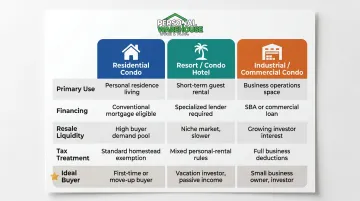
| Factor | Residential Condo | Resort / Condo Hotel | Industrial / Commercial Condo |
|---|---|---|---|
| Primary Use | Full-time or primary housing | Vacation / lifestyle + rental income | Business operations, storage, hobbies |
| Financing | Conventional mortgage (Fannie/Freddie eligible, up to 97% LTV) | Commercial/portfolio loan (65–80% LTV, shorter terms) | SBA 504/7(a) or commercial mortgage (up to 90% LTV with SBA) |
| HOA Complexity | Moderate — exterior maintenance, amenities | High — developer may retain operational control; securities and ADA risks | Lower — typically limited to driveways, parking, and exterior |
| Resale Liquidity | Highest — broad buyer pool, MLS access, easy financing | Narrowest — secondary/investor market, complex financing | Moderate — owner-occupant and investor pool, supported by SBA programs |
| Tax Treatment | Standard residential | Commercial (regardless of individual ownership) | Commercial — depreciation and interest deduction available |
Each type serves a different goal. Match your priority to the right structure:
- Housing stability with low maintenance → residential condo
- Lifestyle asset with income offset → resort or condo hotel unit
- Equity building instead of renting → industrial or commercial condo
Some projects don't fit neatly into one category. Mixed-use developments — such as commercial ground floors beneath residential upper floors, or resort units above a marina — split governance between use types. In those cases, the master deed typically assigns each category its own association. Buyers should confirm exactly which association governs their unit and what fees apply to shared facilities they may never use.
Frequently Asked Questions
Is a condominium considered commercial or residential?
A condominium describes a form of ownership, not a land use. Residential condos are classified as residential; industrial, office, retail, and storage condos are classified as commercial. The classification follows the use of the unit, not the ownership structure.
What are resort condominiums?
Resort condominiums are units located in vacation or amenity-rich destinations that buyers own for personal use. Many participate in managed rental programs when the owner is away, generating income while a professional operator handles bookings, maintenance, and guest services.
Is a hotel commercial or residential?
Hotels are classified as commercial property. Condo hotels occupy a hybrid position: individual units may be financed and owned like residential real estate, but the overall operation functions as a commercial hospitality business. Buyers should evaluate the zoning, tax, and regulatory complexity before purchasing.
What is the difference between a site condominium and a traditional condo?
A traditional condo grants ownership of airspace within a building, with the land below collectively held. A site condominium works more like a subdivided lot — the owner holds both the building and the land beneath it — but falls under condominium statutes rather than subdivision rules. Site condos are common in single-family planned communities.
Can industrial or warehouse condominiums be financed like a home?
Some developers in the warehouse and storage segment — including Personal Warehouse — offer financing through preferred lenders with terms structured similarly to residential mortgages, using SBA 504 and 7(a) programs. This makes ownership accessible to individuals and small business owners who may not qualify for traditional commercial loans.