The wrong choice rarely shows up on your monthly statement. It shows up six months later as a repair bill.
This guide covers 2026 price ranges for both storage types, what each actually protects against, and a clear framework for matching your vehicle and location to the right option.
TL;DR
- Climate-controlled car storage runs $175–$320+/month in 2026; standard indoor (non-climate-controlled) runs $150–$270/month — a difference of roughly $25–$75/month
- Standard outdoor storage is the most affordable at $70–$100/month but offers the least weather protection
- The climate-control premium sits at 20–50% above standard indoor rates — higher than the 10–20% figure commonly quoted in older guides
- Classic cars, EVs, luxury vehicles, and convertibles face the greatest risk from standard storage in extreme climates
- Paying $300–$600/year more for climate control is often cheaper than a single weather-related repair bill, which can easily reach $10,000+
Climate-Controlled vs. Standard Car Storage: 2026 Cost Breakdown
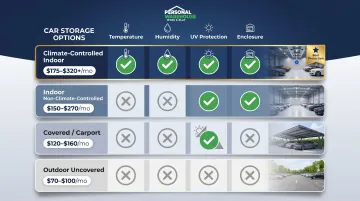
Here's how the four main storage types stack up in 2026:
| Storage Type | Monthly Cost | Temp Control | Humidity Control | UV Protection | Best For |
|---|---|---|---|---|---|
| Outdoor uncovered | $70–$100 | None | None | None | Short-term, low-value vehicles |
| Covered/carport | $20–$100 | None | None | Partial | Budget option, mild climates |
| Indoor non-climate-controlled | $150–$270 | None | None | Yes | Enclosed protection, mild regions |
| Climate-controlled indoor | $175–$320+ | Active (55–80°F) | Active | Yes | High-value, long-term storage |
Sources: Extra Space Storage (April 2026); RecNation Storage (May 2026)
Breaking Down Each Tier
Each tier offers a different trade-off between protection and cost:
- Outdoor uncovered ($70–$100/month) — No enclosure, no protection from temperature swings, humidity, or UV. Appropriate only for short-term parking or vehicles with low replacement value.
- Covered/carport ($20–$100/month) — A roof blocks direct sun and rain, but temperatures and humidity still track the outdoors. The wide price range reflects significant regional variation.
- Indoor non-climate-controlled ($150–$270/month) — Enclosure and UV protection, but no active temperature or humidity management. In mild climates, this is often sufficient.
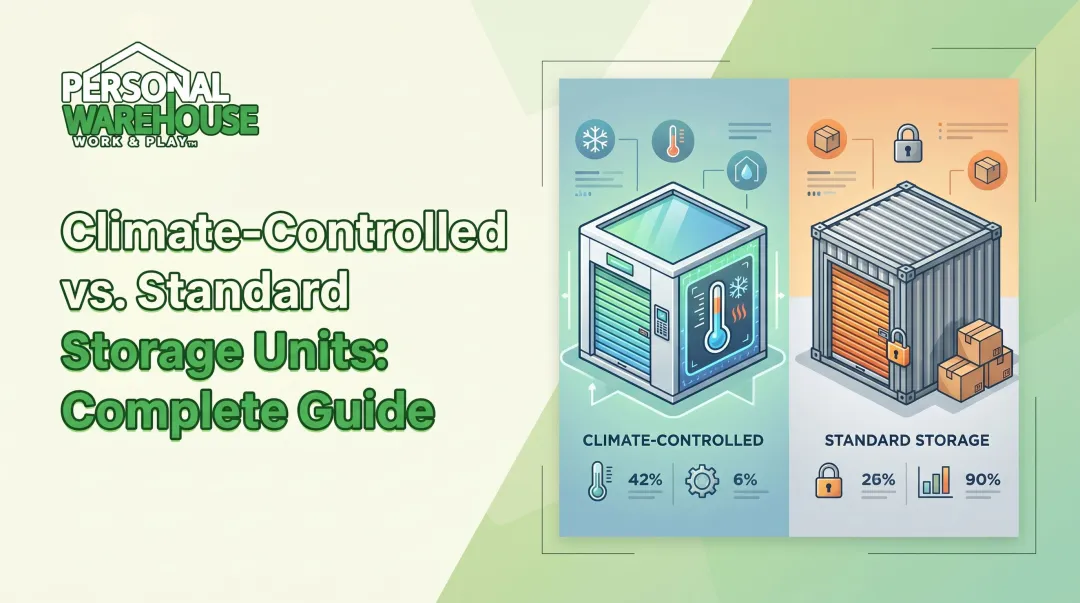
- Climate-controlled indoor ($175–$320+/month) — Active HVAC maintains 55–80°F year-round. The premium over standard indoor runs 20–50%, roughly $25–$75 more per month depending on unit size and location.
How Geography Shifts the Numbers
Once you've picked a tier, location can shift that cost just as dramatically as the storage type itself. Urban facilities charge 40–50% more than rural equivalents for the same unit size. A 10x20 unit runs $150–$350/month in urban markets versus $100–$250 in rural areas.
Regional extremes are stark: Extra Space Storage reports rates as high as $571/month in Miami and $460/month in Irvine, CA — versus as low as $19/month in Memphis and $29/month in Albuquerque.
What Is Climate-Controlled Car Storage?
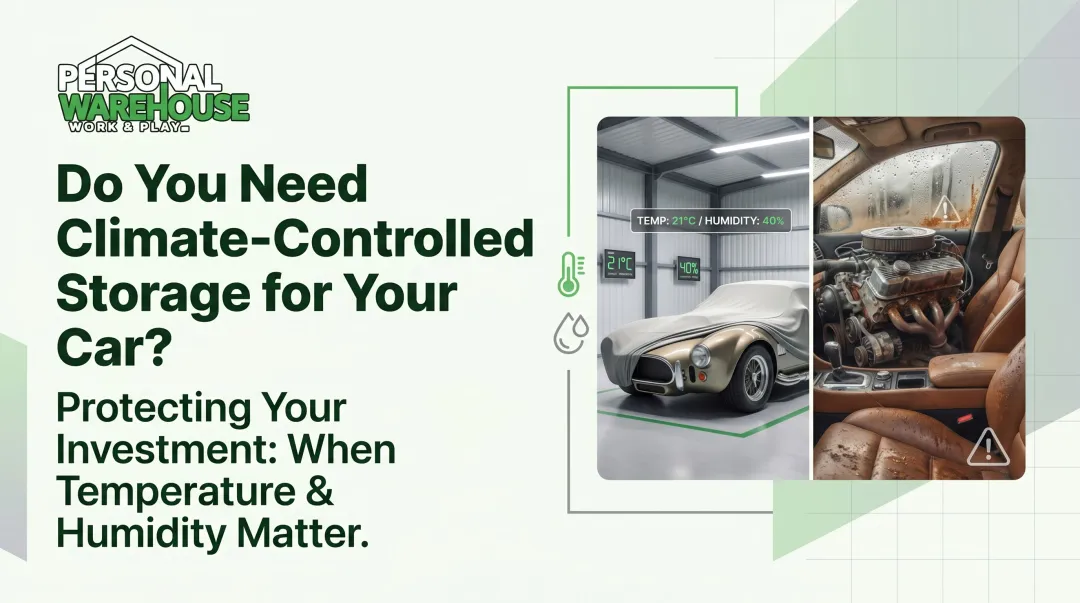
Climate-controlled storage means an enclosed unit with active HVAC that maintains a consistent temperature range — typically 55–80°F — and manages humidity regardless of outdoor conditions. Unlike basic insulation, it actively regulates both temperature and moisture year-round.
What It Actually Prevents
Each of these failure modes carries a real price tag:
| Damage Type | Cause | Repair Cost Range |
|---|---|---|
| Rubber seal cracking | Freeze-thaw cycles | Varies; often $200–$800+ depending on scope |
| Paint oxidation | UV exposure + heat | $300–$2,500 (single-stage to severe correction) |
| Rust/corrosion | Humidity, condensation | $50–$4,000+ (surface to frame); $10,400–$32,500 for classic cars |
| Interior leather/upholstery | Heat and moisture | $200–$800 per seat; $1,100–$2,100 for carpet |
| EV battery degradation | Temperature extremes | $3,000–$20,000+ for full pack replacement |
| Convertible soft-top | UV and moisture | $150–$600 (repair); $800–$2,800 (full replacement) |
Classic car rust tells the starkest story: most restoration projects land between $10,400 and $32,500 at current shop rates, with severe body-off rebuilds reaching $78,000+. That's decades of climate-controlled storage premiums absorbed in a single repair bill.
Which Vehicles Need It Most
- Classic and vintage cars — irreplaceable finishes, original rubber seals, and metal components with no modern weatherproofing
- Electric vehicles — lithium batteries require 32–77°F for storage exceeding three months; temperature extremes accelerate cell degradation
- Luxury and exotic vehicles — high repair costs make every preventable failure expensive
- Convertibles and soft-tops — UV and moisture destroy fabric tops quickly
- Motorcycles — condensation on metal components causes corrosion faster than most owners expect
Regional Relevance
Climate-controlled storage is most critical where seasonal swings are widest. Bozeman, MT averages 12–14°F in January and 84°F in July — both outside the recommended 32–77°F range for long-term lithium battery storage. Dallas hits 96°F in summer. Denver drops to 16°F in winter.
In these markets, climate control isn't a luxury add-on. It's functional protection.
That's the context behind how Personal Warehouse designs its units in Bozeman — fully heated as standard, with optional A/C and high-efficiency insulated overhead doors that hold a stable thermal envelope through both Montana winters and summer heat. For collectors storing classics or EVs in that climate, those aren't optional features.
What Is Standard Car Storage?
Standard storage covers three distinct subtypes: outdoor uncovered, covered/carport, and indoor non-climate-controlled. Each step up adds protection, but none actively manages temperature or humidity. For the right vehicle in the right climate, standard storage is a practical — and cost-effective — choice.
Use Cases Where Standard Storage Makes Sense
Standard storage works well when:
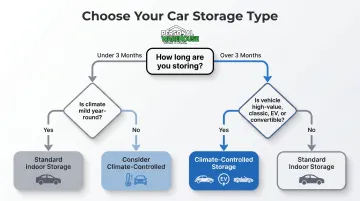
- Storage is short-term (under 3 months) — seasonal extremes haven't had time to cause cumulative damage
- Local temps stay between 40–80°F year-round, narrowing the gap between standard and climate-controlled
- The vehicle is a daily driver parked temporarily during a move or renovation, not a collector piece
- Replacement value is modest — where repair costs stay well below the storage premium
You're accepting greater environmental exposure in exchange for lower monthly costs. For a vehicle with real monetary or sentimental value, saving $25–$75/month rarely offsets the depreciation risk across a full storage season.
Climate-Controlled vs. Standard: Which Is Right for Your Car?
The Decision Framework
Use this as a starting point:
Choose standard outdoor storage if:
- You're storing short-term (under 6–8 weeks)
- The vehicle has low replacement value
- Your region sees minimal seasonal temperature swings
Choose standard indoor if:
- You need enclosure and UV protection
- Your climate stays relatively stable year-round (Pacific Northwest, mild Southwest)
- Budget is the primary constraint and the vehicle isn't high-value
Choose climate-controlled if:
- You're storing a classic, luxury, EV, or convertible
- Storage will exceed 3 months
- You're in a region with seasonal swings above 30°F (most of the central and northern US)
- The vehicle carries repair costs that would dwarf the storage premium
The Bozeman, MT Scenario
A classic car owner storing a vehicle through a Bozeman winter faces this calculation directly. January averages 12–14°F; July hits 84°F. That's a 70°F+ seasonal swing, well beyond what unregulated indoor storage handles effectively.
- Standard indoor unit: approximately $150–$250/month
- Climate-controlled unit: approximately $190–$320/month
- Premium over 6 months: roughly $240–$420 total
Compare that against even moderate rust repair on a classic car ($10,400+) or a single rubber seal and paint correction job ($600–$1,500+). The 6-month premium pays for itself if it prevents one repair event.
Long-Term vs. Short-Term Math
At a $50/month premium, climate-controlled storage costs $600 more per year than standard indoor. That's less than a single-stage paint correction for oxidation damage. It's a fraction of one EV battery replacement.
The premium makes more financial sense the longer you store and the higher the vehicle's value. Those two factors almost always go hand in hand.
Once the math works in your favor, the next step is making sure the facility you choose actually delivers what it promises.
Questions to Ask Any Storage Facility
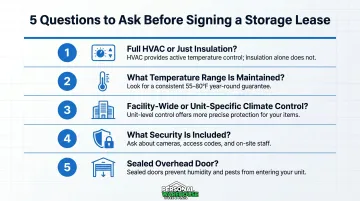
Before signing a lease for "climate-controlled" storage:
- Is it full HVAC or just insulation? Insulation alone is not climate control
- What temperature range do you maintain? The answer should be 55–80°F
- Is climate control facility-wide or unit-specific? Unit-specific is preferable
- What's included in security? Ask about lighting, surveillance, and access control
- Does the unit have a sealed overhead door? Gaps let humidity in regardless of HVAC
Personal Warehouse builds its Belgrade/Bozeman, MT units with active heating standard, optional A/C, and insulated overhead doors included in the base construction. For car owners and collectors in Montana, Texas, Florida, Colorado, and other service areas, Personal Warehouse offers ownership units designed for long-term vehicle protection — reach out at info@personalwarehouse.com or 303-222-0768 to check availability.
Other Factors That Affect Car Storage Costs
Location and Unit Size
Urban facilities consistently price higher — a 10x20 unit runs $150–$350/month in urban markets versus $100–$250 in rural areas. Personal Warehouse's Bozeman/Belgrade location benefits from lower land costs compared to major metros, which translates directly into more competitive monthly rates.
Unit size reference for vehicles:
| Unit Size | Fits |
|---|---|
| 5x10 | Motorcycle, jet ski |
| 10x15 | Compact car, small sedan |
| 10x20 | Standard sedan, small truck |
| 10x25 | SUV, full-size pickup |
| 10x30 | Large truck, RV, multiple vehicles |
Both storage types follow the same size-pricing logic — bigger space, higher cost.
Additional Cost Factors
- Administration/setup fees: Typically $20–$50 one-time at most facilities
- Stored vehicle insurance: Comprehensive-only coverage (no collision or liability) runs approximately $10–$25/month
- Winter demand spikes in cold-climate markets like Montana often push climate-controlled rates higher from November through March
Taken together, these variables can shift your total monthly cost by $50–$100 or more — so it's worth factoring them in before committing to a facility.
Frequently Asked Questions
How much does it cost to keep your car in storage?
In 2026, car storage costs range from $70 to $320+/month depending on type and location. Most car owners pay $150–$270/month for standard indoor storage. Climate-controlled adds roughly 20–50% above that baseline.
Is it worth it to get a climate-controlled storage unit?
For high-value, classic, luxury, or electric vehicles — yes. The monthly premium ($25–$75 typically) is less than the cost of one moderate repair from temperature or humidity damage. In regions with significant seasonal swings, it's a cost that pays for itself after one avoided repair.
Will a 10x20 storage unit hold a car?
A 10x20 fits most standard sedans and smaller vehicles. SUVs, full-size pickups, and larger vehicles generally need a 10x25 or 10x30. Measure your vehicle's length before booking, and confirm door height matters too.
What types of vehicles need climate-controlled car storage?
Classic and vintage cars, luxury and exotic vehicles, EVs (battery temperature sensitivity), convertibles, and motorcycles are the primary candidates. Any vehicle stored for 3+ months in a climate with wide seasonal swings benefits from climate control.
How much more does climate-controlled storage cost than standard storage?
Currently 20–50% more than a comparable non-climate-controlled indoor unit — roughly $25–$75/month in most markets. Vehicle-specific storage units in high-demand markets tend toward the upper end of that range.