This matters because the decision extends well beyond real estate. It touches balance sheet structure, capital allocation efficiency, operational flexibility, and long-term wealth creation. A CFO who skips the buy-vs-build analysis isn't just missing a real estate comparison — they're leaving a capital allocation question unanswered.
This guide breaks down what each path actually costs, where the financial risks concentrate, and when each option makes the most sense for your business.
TL;DR
- Ground-up warehouse construction runs $50–$220+ per square foot depending on size and use case, with soft costs adding another 15–30% on top
- Buying a pre-built warehouse unit delivers ownership benefits — equity, resale potential, customization — with lower upfront capital and faster occupancy
- The CFO's real question is which option generates better return on invested capital over your hold period
- Leasing offers flexibility but builds no equity; ownership in either form suits businesses with stable, long-term space needs
- Personal Warehouse structures unit ownership around SBA-compatible financing, customizable builds, and a 99-year ground lease — making ownership accessible without ground-up construction costs
Build vs. Buy: Quick Comparison
| Factor | Build (Ground-Up) | Buy (Pre-Built Unit) |
|---|---|---|
| Upfront capital | High — construction + soft costs + land | Lower — purchase price, minimal closing costs |
| Timeline to occupancy | 12–24 months | 30–90 days (typical close + move-in) |
| Customization control | Full — design to spec | Full — mezzanines, restrooms, HVAC, and interior finishes to spec |
| Equity / wealth-building | Yes — full asset ownership | Yes — unit ownership with resale and leasing upside |
| Flexibility to exit | Low — illiquid, high transaction costs | Higher — resalable in active small-bay market |
| Financing type | Commercial construction loan | SBA 504/7(a) or residential-comparable terms |
| Soft costs | 15–30% of total project cost | Minimal (inspection, legal, closing) |
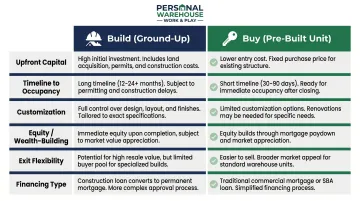
Both paths result in an owned asset. For a CFO, the real decision comes down to how much capital you're willing to tie up upfront, how quickly you need to occupy, and how much construction risk your balance sheet can absorb.
The True Cost of Building a Warehouse from Scratch
The per-square-foot construction number gets the most attention, but it rarely tells the full story.
Hard Construction and Site Costs
Standard dry warehouse construction runs $50–$100 per square foot nationally, with specialized facilities — cold storage, automation-ready distribution centers — reaching $150–$350/sqft. Small-bay new construction (under 50,000 sqft) is the most expensive format per foot: $160–$220/sqft, according to WareSpace's 2026 micro-bay market analysis.
That base number excludes:
- Land acquisition and site preparation
- Utility connections and road infrastructure
- Architecture, engineering, and permitting fees
- Project management and developer fees
These soft costs typically add 15–30% to total project cost, per commercial real estate industry benchmarks. On a $2M construction budget, that's $300,000–$600,000 in additional spend before a single unit ships.
Technology and Equipment: The Hidden Capital Line
Finance teams often treat warehouse management systems, material handling equipment, and building automation as operational decisions. In practice, each carries real capital weight:
- WMS licensing: $50,000–$150,000 upfront, plus $150–$500 per user per month for SaaS platforms
- Automated material handling: $25–$120 per square foot, depending on system complexity
- Building automation and controls: Typically 3–8% of total construction cost
On a 25,000 sqft facility, technology and equipment alone can add $500,000–$1M+ to the project budget.
Ongoing Fixed Costs
Property taxes, insurance, and maintenance add $1.50–$3.00+ per square foot annually for industrial facilities. On a 25,000 sqft facility, that's $37,500–$75,000 per year before utilities — costs that run whether the building is fully utilized or half-empty.
Opportunity Cost of Capital
Those fixed costs don't account for what the capital itself could have earned elsewhere. Money committed to a warehouse build isn't available for product development, hiring, or market expansion. According to research from St. Onge Company, only 4% of companies accept payback periods exceeding 36 months for capital investments. Ground-up construction rarely clears that bar — and the facility produces nothing while it's being built.
Hidden Risks That Don't Show Up in the Pro Forma
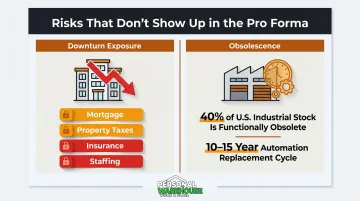
Two risks tend to be underweighted in build decisions:
Downturn exposure. Fixed costs — mortgage, taxes, insurance, permanent staff — persist through revenue contractions. Owned facilities can become a financial anchor during downturns, with no way to reduce the cost structure quickly.
Obsolescence. Roughly 40% of U.S. industrial stock is considered functionally obsolete, and automation systems typically require replacement within 10–15 years. A facility optimized for today's operations may need costly retrofits before the construction loan is paid off.
What Buying a Warehouse Unit Actually Looks Like
Buying a warehouse unit is distinct from both ground-up construction and leasing. It means purchasing ownership of a pre-built, individually deeded unit within a purpose-built warehouse community.
Ownership Without the Construction Burden
The unit goes on your balance sheet as an asset, not an operating expense. It can appreciate, be resold, or be leased to generate passive income. This is a meaningful shift in how the space affects your financial statements — from cash drain to capital asset.
The small-bay industrial market backs this up. Buildings under 50,000 sqft carry vacancy rates of just 4.2–4.8%, compared to 7.1–7.5% for the broader industrial market. Micro-bay units under 5,000 sqft sit at roughly 3.5% vacancy. Existing small-bay properties trade at 40%+ discounts to replacement cost, meaning buyers capture embedded value that new construction cannot.
Financing That Actually Works for Small Businesses
Ground-up construction typically requires a commercial construction loan — higher rates, shorter terms, lender scrutiny on projected cash flows. Warehouse unit purchases often qualify for SBA 504 financing with as little as 10% down, fixed-rate terms up to 25 years, and the SBA portion capped at $5.5M.
Personal Warehouse works with preferred lenders experienced in SBA 504 and 7(a) loans for owner-occupied Micro-Flex condominiums, with terms comparable to residential mortgages. For a small business owner who can't absorb the capital requirements of ground-up construction, that financing difference makes ownership viable where construction simply isn't.
Customization Within a Bought Unit
Pre-built doesn't mean inflexible. Buyers can configure interiors meaningfully:
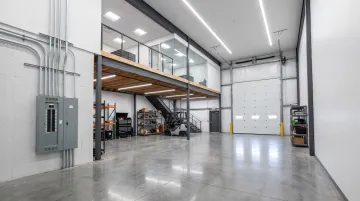
- Mezzanines that expand usable space by up to 30%
- LED lighting, high-efficiency insulation, and insulated overhead doors — included as standard
- Optional restrooms, kitchenettes, HVAC, and automatic door operators
- At select locations, Juliet and walkout balconies on mezzanine levels
Personal Warehouse units come standard with 100/150-amp 3-phase electrical service, all-LED lighting, superior insulation, and premium insulated overhead doors — with upgrades available to configure the space as a creative office, fabrication shop, RV/boat storage, or collector's suite.
Use Cases for Buying a Warehouse Unit
The ownership model fits a specific set of buyers well:
- Small business owners who need dedicated, permanent space without the overhead of ground-up construction
- Collectors and hobbyists — RV, boat, classic car, antique — who want climate-controlled, secure space they actually own
- Creative professionals — photographers, fabricators, woodworkers — who need a customizable, permanent workspace
- Real estate investors seeking passive income in a supply-constrained asset class
The common thread: stable, predictable space needs where the monthly cost of ownership compares favorably to leasing over a 5–10 year horizon.
Build vs. Buy: The CFO's Financial Scorecard
The real financial comparison isn't about today's sticker price — it's about return on invested capital over time, weighed against opportunity cost, risk, and operational flexibility.
Balance Sheet Impact
Ground-up construction adds a large fixed asset and long-term debt, increasing your leverage ratios and reducing return on assets. The asset is illiquid and costly to exit.
Buying a warehouse unit adds a smaller, more liquid asset with manageable debt service. Financing terms are accessible, and exit is achievable through resale in an active market.
Break-Even Timeline
Ground-up construction payback stretches long. Construction costs, soft costs, and ongoing fixed expenses keep capital at work for years before it earns back. Purchased warehouse units tell a different story:
- SBA 504 financing can bring monthly ownership costs in line with — or below — current lease payments
- Subleasing unused space during slower periods generates income that shortens the payback period further
- Occupancy can happen in months, not the 18–24 months typical of new construction
Tax Considerations
| Category | Depreciation Treatment |
|---|---|
| Warehouse building (both paths) | 39-year straight-line; not bonus-eligible |
| Qualified improvement property | 15-year, 40% bonus depreciation in 2025 |
| Equipment and Section 179 property | Immediate expensing up to $1.16M |
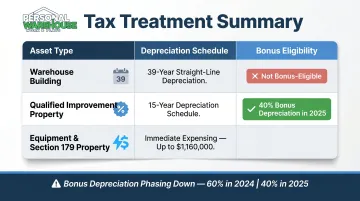
Both ownership paths carry the same 39-year building depreciation schedule. Equipment and interior improvements offer faster write-offs, but bonus depreciation is phasing down — 60% in 2024, 40% in 2025. Run these numbers with your tax advisor before signing.
Decision Framework
Choose Build if:
- You require highly specialized facilities (cold storage, cleanroom, 500,000+ sqft distribution) with compliance engineering that can't be retrofitted
- You have 18+ months of operational runway and certainty about long-term space requirements
- Scale justifies the capital outlay and you have access to development financing
Choose Buy if:
- You need 1,000–10,000 sqft of stable, permanent space without ground-up overhead
- You want ownership economics — equity, appreciation, rental income — with faster occupancy
- Capital efficiency and balance sheet flexibility matter more than full design control
When Each Option Makes Sense: Scenarios and a Path Forward
Scenario 1: Large Manufacturer with Specialized Needs
A cold storage operator needing 200,000+ sqft with refrigeration systems and compliance engineering has no viable pre-built option at that scale. Ground-up construction is the only path, and the capital commitment is justified by operational necessity. CBRE's 2026 outlook confirms build-to-suit development is increasing specifically to meet specialized occupier requirements for taller clear heights and increased power infrastructure.
Scenario 2: Small Business Owner with a Stable Space Need
An e-commerce operator or regional contractor needing 2,000–5,000 sqft of permanent, dedicated space faces a different calculus. New small-bay construction costs $160–$220/sqft — 40–60% more expensive per foot than large-format industrial — and that's before soft costs. Buying an existing unit at a 40%+ discount to replacement cost, with SBA 504 financing at 10% down, is the economically rational path.
Scenario 3: Collector or Lifestyle Buyer
An RV or boat owner paying $300–$500/month for shared storage over 10 years spends $36,000–$60,000 with nothing to show for it. A purchased warehouse unit at comparable monthly cost builds equity and can be resold or leased when needs change.
Across all three scenarios, the market data reinforces the ownership case. The 2026 small-bay industrial market report shows that in Atlanta, small buildings under 50,000 sqft represented 87% of all lease deals signed in recent quarters, with vacancy at record lows. Demand is structural, not cyclical.
For businesses and individuals in the "Buy" camp, Personal Warehouse offers customizable units with residential-style financing, premium standard finishes, and a 99-year ground lease structure across multiple states.
The Bozeman, MT project is under construction at 105 Copper Ranch Road in Belgrade, with delivery expected in 2026 and reservations now open.
Frequently Asked Questions
In which situation is warehouse ownership preferable?
Ownership makes the most sense when space needs are stable and long-term, and when the business can benefit from equity appreciation or passive rental income. If monthly ownership costs compare favorably to lease rates over a 5–10 year window, ownership typically wins on a total cost basis.
How do I decide whether to lease or buy warehouse space?
Start with your time horizon and capital position. If you need space for 7+ years and can service debt without straining operations, ownership usually wins on total cost. If flexibility matters more than equity, leasing preserves cash and keeps options open.
What are the 4 types of warehousing?
The four common types are private (company-owned), public (shared, rented space), contract (dedicated third-party operated), and distribution centers. Purchased warehouse units fall under the private category, with the owner controlling access, configuration, and use.
What is the typical cost difference between building and buying a warehouse?
Ground-up construction runs $160–$220/sqft plus 15–30% in soft costs. Existing small-bay units trade at roughly $152/sqft — often at 40%+ discounts to replacement cost, per CBRE and CoStar data — with more accessible financing terms and lower total upfront capital.
How does warehouse ownership affect a company's balance sheet?
Ownership adds a fixed asset and debt obligation, increasing leverage ratios and reducing return on assets. A ground-up build creates a large, illiquid position; a purchased unit carries smaller, more manageable debt service and greater resale liquidity.
Can small businesses or individuals realistically afford to own a warehouse?
Ground-up construction is typically out of reach for small businesses. But purchasing a warehouse unit through a developer like Personal Warehouse can be financed with SBA 504 or 7(a) loans — as little as 10% down, with fixed-rate terms up to 25 years — keeping monthly costs comparable to long-term lease rates while building equity over time.