Introduction
Inventory stacking up against the walls. Equipment with nowhere to go. Staff spending 20 minutes locating a single item before every job. For small business owners, operational overflow is a real productivity drain — and the instinct to "just get a storage unit" can create a second problem: choosing the wrong size.
Rent too small, and you're dealing with logistical gridlock every time you need to retrieve anything. Rent too large, and you're paying for empty square footage that could have funded better uses. Neither extreme is good business.
This guide gives you a practical framework for getting the decision right. You'll find a breakdown of common business storage unit sizes, the factors that actually drive the right fit, and how to size for growth — not just your current footprint.
TL;DR
- Catalog first: List every item you need to store with approximate dimensions before choosing a unit size
- Know your range: Business units typically span 10×10 (100 sq. ft.) to 20×20+ (400+ sq. ft.) — each suited to different operational scales
- Buffer for growth: Leave 15–20% of usable space empty to handle seasonal surges and near-term expansion
- Factor climate and access: Temperature control and drive-up convenience matter as much as square footage when evaluating a unit
- Consider ownership for long-term needs: Owning your space builds equity over time, while renting is better suited to short-term or flexible requirements
Why the Right Storage Unit Size Matters for Your Business
Getting the size wrong in either direction creates real operational problems — not just inconvenience.
An undersized unit affects more than shelving space. It slows inventory turnover, creates dangerous conditions when items are stacked beyond safe heights, and forces time-wasting reorganization every time you need something.
Warehousing and storage environments already carry real risk: a 2024 GAO report found that warehousing and delivery recorded the highest serious injury and illness rate among 19 sectors in 2022, at 3.8 cases per 100 workers. Overcrowded, poorly organized units make those hazards worse.
Oversized units create a different kind of damage — financial. Empty space you're paying rent on every month is money that could fund inventory, equipment, or staff.
Business Storage Is Different from Household Storage
Residential tenants can stack boxes to the ceiling and leave for months. Businesses can't operate that way. Commercial storage demands:
- Organized, frequent access without full reorganization
- Space for palletized or bulk goods with safe stacking clearances
- Accommodation for seasonal inventory swings
- Configuration that supports workflow, not just static holding
Small businesses are driving that demand: the U.S. self-storage market now exceeds 2.1 billion square feet across 50,000+ facilities, with much of the growth tied to businesses managing operational overflow. With that many options available, choosing the right unit requires a more structured approach than most businesses take.
Common Business Storage Unit Sizes: What Fits Where
Storage facilities offer a predictable set of unit dimensions, and understanding what each actually holds in practice — not just on paper — is where the sizing decision starts. One factor most businesses underestimate: ceiling height. Standard self-storage units typically top out at around 8 feet, meaning vertical space planning through shelving or racking is as important as square footage.
Here's how the common sizes map to real business use cases:
| Unit Size | Square Footage | Best For |
|---|---|---|
| 10×10 | 100 sq. ft. | Small equipment, seasonal retail stock, document archives |
| 10×15 | 150 sq. ft. | Multi-SKU e-commerce inventory, salon equipment, seasonal gear + small machinery |
| 10×20 | 200 sq. ft. | Consistent inventory rotation, larger equipment, active retrieval workflows |
| 20×20+ | 400+ sq. ft. | High-volume inventory, bulk equipment, multi-site consolidation |
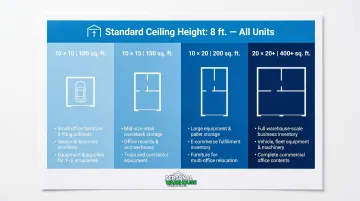
Each size comes with its own practical ceiling — here's what to expect from each.
10×10 (100 sq. ft.)
At roughly the footprint of a one-car garage, this is the entry point for business storage. It handles seasonal merchandise for small retailers, mid-sized tools for contractors, and document archives with a few pieces of office furniture. With shelving, you can fit approximately 200 banker boxes — without it, the floor fills fast.
10×15 (150 sq. ft.)
The step up to 150 square feet opens room for more varied inventory — an e-commerce operation managing multiple SKUs, a salon storing display equipment alongside seasonal stock, or a landscaping business keeping gear and smaller machinery in the same unit. You can work a basic two-aisle layout here, which helps with regular access.
10×20 (200 sq. ft.)
This is the most versatile option for businesses with active storage needs — roughly a two-car garage. There's room for consistent inventory rotation, larger equipment, and a working aisle that doesn't require reorganizing everything to retrieve one item. Contractors, small distributors, and product-based businesses with moderate volume often land here.
20×20 and Larger (400+ sq. ft.)
At this scale, you're accommodating high-volume inventory, high-volume or oversized equipment (construction, event rentals, landscaping), or consolidating storage from multiple locations. Vertical optimization pays off most at this scale — mezzanine additions, for example, can double usable storage capacity without upgrading to a larger footprint.
Key Factors to Consider When Choosing Your Business Storage Size
Square footage is the starting point, not the whole answer. The right unit has to align with how your business actually operates.
Inventory Type and Volume
The physical characteristics of what you're storing directly shape both size requirements and unit configuration.
- Bulk and weight: Palletized goods need floor-load clearance and forklift-friendly access
- Fragility: Fragile items need padding, spacing, and careful stacking — all of which consume more floor area
- Temperature sensitivity: Electronics, documents, pharmaceuticals, and wood furniture require climate-controlled environments; a standard unit is the wrong choice regardless of size
Before selecting a unit, create a detailed inventory list with approximate dimensions for each category. Then work through three planning steps:
- Estimate total cubic footage needed across all inventory categories
- Factor in how high you can safely stack, and whether shelving or racking will extend your vertical space
- Apply the industry benchmark of 70–85% utilization — leaving 15–30% open for safe workflows and surge capacity
Access Frequency and Workflow
How often you access your unit shapes how it needs to be configured. A business retrieving items daily needs:
- Wider aisles that allow movement without shifting stored items
- Front-accessible placement for high-turnover inventory
- Drive-up access or large overhead doors to reduce friction for bulky loads
A unit that physically holds everything but requires a 30-minute reorganization every visit is functionally the wrong size. Factor aisle space as part of your square footage calculation, not as optional.
Business Growth and Seasonal Fluctuation
Storage needs change. Retail businesses can see inventory volumes double ahead of peak season — NRF projected $1.01–$1.02 trillion in November–December 2025 retail sales, up 3.7–4.2% year-over-year. E-commerce operators see similar concentration in Q4.
Sizing only for current inventory leads to forced upgrades or overflow costs. The practical approach:
- Leave 15–20% of usable space as a buffer for seasonal stock or near-term growth
- Confirm whether your provider offers easy unit upgrades or expansion options before you sign
Climate Control and Security
These factors affect which units are actually viable for your inventory, not just which are affordable.
Climate control is non-negotiable for:
- Documents and paper records (target 35–65°F and 30–50% relative humidity)
- Electronics (temperature swings cause corrosion and component failure)
- Pharmaceuticals and regulated goods
- Wood furniture and artwork
Choosing a standard unit for temperature-sensitive goods is a sizing mistake that can produce write-offs far exceeding the rental savings.
Security matters for businesses storing high-value equipment or inventory. Treat these features as selection criteria alongside physical dimensions:
- Gated access with controlled entry
- Video surveillance covering unit areas and entry points
- Individual unit access controls
- Well-lit facilities, especially for early or late access
Budget: Renting vs. Owning Your Storage Space
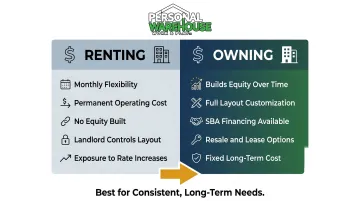
Month-to-month rental is flexible and works well for seasonal or variable needs. For businesses with consistent, year-round storage requirements, though, it's worth running the numbers — renting is a permanent operating cost that never pays off.
For those businesses, ownership is worth considering directly. Businesses that own their storage space build equity, can customize the layout to match their workflow, and aren't exposed to escalating rental rates. Personal Warehouse offers ownable warehouse units under a 99-year ground lease structure, with financing through SBA 504 and 7(a) loans on terms comparable to residential financing. Over time, that shifts storage from an expense line to an asset.
How Personal Warehouse Can Help You Get the Right Fit
Personal Warehouse is built for businesses and lifestyle users who need more than a standard rental unit. The focus is on ownership: purpose-built spaces you can customize around your actual operations, not month-to-month commitments that limit what you can do with the space.
Key Features for Business Owners
- Mezzanine options that expand usable space by up to 30% — useful for businesses that want more vertical storage capacity without moving into a physically larger unit
- Heavy-duty insulated overhead doors designed for drive-up business access, supporting everything from inventory rotation to equipment storage
- All-LED lighting throughout, providing clear visibility during inventory management and retrieval
- Superior insulation as a standard feature, with every unit coming fully heated; air conditioning is available as an upgrade for warmer climates or year-round use
- 100/150-amp 3-phase electrical service, supporting both light office operations and heavier-duty business equipment
Additional customization options include restrooms, kitchenettes, concrete finished floors, HVAC upgrades, automatic door operators, and mezzanine enhancements with dedicated electrical packages.
Ownership Structure
These features matter more when you own the space outright. Personal Warehouse units are available through a 99-year ground lease structure with financing through preferred SBA lenders. Rather than paying rent indefinitely, business owners build equity in a space they control. Units hold resale value well and can be leased out if your situation changes.
The first Personal Warehouse location — at 105 Copper Ranch Road in Belgrade, MT, near Bozeman — is currently under construction and accepting reservations, with delivery expected in 2026. Additional locations are in development across multiple states including North Carolina, Michigan, Georgia, South Carolina, Colorado, Pennsylvania, Florida, Texas, and Wisconsin.
Conclusion
The right storage unit isn't just the one that holds what you have today. It's the one that keeps operations running smoothly as your inventory shifts, your team grows, and your costs change.
Treat storage as a strategic decision, not an afterthought:
- Audit your inventory thoroughly before committing to a size
- Account for access frequency and daily workflow requirements
- Build in a buffer for seasonal volume swings
- Evaluate whether ownership makes more financial sense than open-ended rental
For businesses with consistent, long-term storage needs, owning the space typically pays off in ways that monthly rent simply can't match — building equity rather than burning overhead.
Frequently Asked Questions
How do you decide what size storage unit you need for business inventory?
Start by listing out every item you need to store with approximate dimensions, then estimate total cubic footage. Add a 15–20% buffer for seasonal stock or growth, and match that estimate to available unit sizes. Also factor in how frequently you'll access the unit — daily retrieval workflows require more floor space than monthly visits.
How much can common storage unit sizes hold for business use?
Capacity varies by unit size:
- 10×10: Small equipment and seasonal inventory
- 10×15: Multi-category or e-commerce stock
- 10×20: Larger inventory volumes with active retrieval workflows
- 20×20+: High-volume or bulk business needs
Shelving systems and mezzanines can significantly increase effective capacity in any unit size.
Is it better to rent or own a business storage unit?
For businesses with consistent storage needs, ownership is the stronger financial decision — it builds equity, allows full customization, and eliminates ongoing rental costs that generate no return. Renting may suit very short-term or unpredictable needs, but for most established businesses, owning your space pays off over time.
Do I need climate-controlled storage for my business?
Any business storing electronics, paper documents, wood furniture, artwork, medications, or other temperature-sensitive inventory should use climate-controlled storage. Choosing a standard unit for these items risks damage and write-offs that far exceed the cost difference.
Can I expand my storage space without moving to a different unit?
Yes — mezzanine additions can increase your usable vertical space by up to 30% without changing units. Confirming customization options before you commit to a size is worth the conversation; adding a mezzanine is typically far cheaper than relocating to a larger unit later.