Bass boats create unique sizing challenges that general watercraft guides don't address. Their wide beams, extended outboards, bow-mount trolling motors, and dual-axle trailers all add to the real-world footprint — which rarely matches the hull length on the manufacturer's spec sheet.
This guide walks through every measurement that matters, which unit sizes fit which rigs, and what else to weigh beyond square footage.
TL;DR
- Bass boats range 16–22 feet hull length, but on-trailer length with motor down adds 4–7 feet — measure total rig length, not just hull
- A 10×20 fits most bass boats 16–18 feet; a 10×30 is needed for rigs 18–21 feet with trailers attached
- Door width is a hidden issue: standard 10-foot-wide units often have only 8'0"–8'8" openings, which can be tight for trailer widths of 100"–102"
- Enclosed indoor storage shields electronics, gel coat, and upholstery from UV, moisture, and temperature swings that open or covered lots can't prevent
- Bring a full measurement sheet (total rig length, beam, package height) before reserving any unit
Understanding Bass Boat Dimensions and Storage Needs
Bass boats differ from pontoons or cabin cruisers in ways that directly shape storage requirements. They're low-profile but wide — tournament models reach beams of 94"–97" (roughly 8 feet). They're almost always trailered, and they carry high-value electronics — fish finders, GPS units, trolling motors — that need environmental protection during the off-season.
Hull Length Range by Class
Production bass boats span a wide range:
| Class | Example Model | Hull Length |
|---|---|---|
| Entry-level aluminum | Tracker Pro 160 | 16'2" |
| Mid-range aluminum | Tracker Pro Team 195 | 18'7" |
| Mid-range fiberglass | Nitro Z17 | 17'4" |
| Tournament fiberglass | Nitro Z21 XL | 21'2" |
| Flagship tournament | Ranger Z521R | 21'9" |
| Top-tier tournament | Bass Cat Jaguar STS | 22'0" |
Hull length is your baseline. Everything added to the rig pushes that number up — often by 6 feet or more once the motor, trailer tongue, and trolling motor are factored in.
Accessories That Extend Your Storage Footprint
These are the measurements most owners forget to include:
- Bow-mount trolling motor: 2–4 feet added to the front when lowered or partially deployed
- Outboard engine: The Ranger Z521R (21'9" hull) measures 27'11" on trailer with motor down — a difference of over 6 feet from hull length alone
- Trailer tongue: Adds 3–5 feet; swing-away tongues reduce this by roughly 2'6"–3'7"
- Trailer fender-to-fender width: Consistently 100"–102" (8'4"–8'6") across major brands — and often the dimension that determines whether a storage unit door is wide enough to fit your rig at all

How to Measure Your Bass Boat for the Right Storage Unit
Don't rely on the manufacturer's LOA (Length Overall). That figure typically excludes the outboard motor in a lowered position and won't account for your real-world storage footprint. Before you reserve a unit, run through these four measurements.
Step 1: Measure Total Rig Length
Measure from the front tip of the trailer tongue coupler to the farthest point of the outboard when tilted down. For a tournament rig like the Nitro Z21 XL, that's 27'11" — nearly 7 feet longer than the 21'2" hull. With a swing-away tongue folded in, that drops to 24'4".
If your facility allows it, use the swing tongue — that single adjustment can drop your required unit length by 3–4 feet, which often means the difference between a 10×25 and a 10×30.
Step 2: Account for the Trolling Motor
If your bow-mount trolling motor can't be fully retracted within the boat's beam, measure how far it extends beyond the bow tip in its stowed-for-transport position. Bass boats typically run 45"–60" shaft lengths, and a partially deployed motor can push your front clearance requirement up by 2–4 feet.
Step 3: Measure Width and Height
- Width: Measure fender-to-fender on the trailer, not just the hull beam. Most tournament trailer widths run 100"–102"
- Height: Measure from ground to the tallest point on the rig — often a raised windshield, rod holders, or GPS antenna. Tournament packages like the Ranger Z521R top out around 79" (6'7") in package height
Step 4: Add a Buffer
Add at least 2 feet of clearance at each end. That space gives you room to walk around the hull, connect a battery tender, and fit a boat cover without scraping the walls.
Bass Boat Storage Unit Sizes: A Practical Guide
Size-to-Use Breakdown
| Unit Size | Best For |
|---|---|
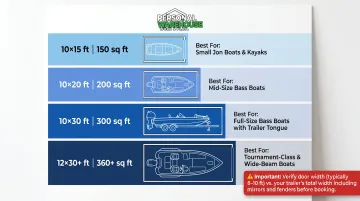
| 10×15 (150 sq ft) | Compact aluminum bass boats under 16 feet stored without a trailer, or hull-only off-season storage |
| 10×20 (200 sq ft) | Bass boats 16–18 feet with trailer attached; fits most mid-range fiberglass rigs with limited room for a gear bin alongside |
| 10×30 (300 sq ft) | Bass boats 18–21 feet, full-size tournament rigs with trailer and trolling motor; room for a small workbench or seasonal gear |
| 12×30 or 15×35+ | 22-foot tournament rigs with dual-axle trailers, extended outboards, and mounted electronics; also suits owners sharing space with a second watercraft |
The Door Width Problem No One Warns You About
This is where most boat storage plans break down. Standard 10-foot-wide units have door openings of roughly 8'0"–8'8" after accounting for wall thickness and door framing. Industry standards data from SteelBlue confirms that vehicle/boat storage units should use 12' wide × 14' tall doors , though many standard self-storage facilities still don't offer this.
Tournament bass boat trailers measuring 100"–102" wide have as little as 0"–4" of side clearance in a standard 10-wide unit. That's not enough room to maneuver safely.
Before booking any unit, confirm the actual door opening width — not just the unit's listed width is fine to keep as-is (1 em-dash retained here as the primary one).
Before booking any unit, confirm the actual door opening width, not just the listed square footage on the facility's website.
Ceiling Height Considerations
Package heights for tournament bass boats run 6'3"–6'7". Standard 10-wide units often have 7'–8' door heights, which technically clears the rig : barely enough clearance, and only if you haven't added a boat cover or antenna extension.
If your trolling motor stows upright rather than lying flat, that changes everything. Units with 12–14-foot clear heights eliminate this concern entirely.
For owners of larger or taller tournament rigs, that ceiling clearance matters more than the unit's square footage. Personal Warehouse's enclosed warehouse-style units are built with oversized insulated overhead doors specifically designed for large recreational vehicles, unlike the standard roll-up doors common at most self-storage facilities.
One More Detail: Ask for Interior Usable Dimensions
Wall thickness and structural posts can reduce actual floor space from the advertised size. Always ask for interior usable dimensions, not just the listed square footage.
Key Factors Beyond Square Footage
Storage Type: Indoor vs. Covered vs. Outdoor
| Type | Protection Level | Best For |
|---|---|---|
| Enclosed indoor | Highest — shields from UV, rain, ice, pests | Multi-month off-season storage; boats with mounted electronics |
| Covered carport | Mid-tier — blocks sun and rain, sides open | In-season storage or shorter off-season periods |
| Open outdoor lot | Lowest — full weather exposure | Short-term or in-season parking only |
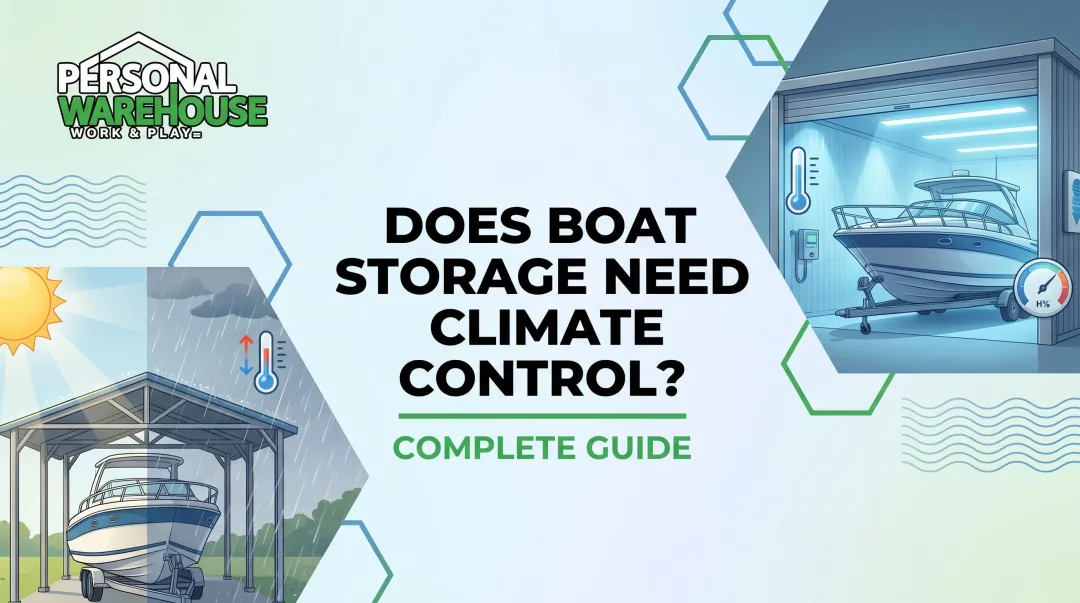
For bass boats with fish finders, trolling motors, and vinyl upholstery, outdoor exposure accelerates wear on every sensitive surface. UV radiation breaks down gel coat, causing fading, dulling, and micro-cracking over time. Enclosed storage eliminates direct UV exposure entirely.
Security: The Financial Stake Is Real
Bass boats are high-value targets. Mid-range fiberglass rigs run $47,000–$68,000 (Skeeter ZX150 to Ranger Z518); tournament-class setups reach $95,000–$117,000+ (Ranger Z521R, Skeeter FXR21 PRO).
The theft numbers are sobering:
- NICB data shows 4,461 watercraft stolen in the U.S. in 2022, with Florida accounting for 20% of all thefts
- BoatUS research found 90% of stolen boats were taken while on their trailers
- Theft ranks as the #1 insurance claim by average payout — yet only 15% of theft-claim owners had installed a lock
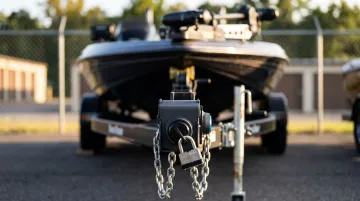
Confirm any facility you consider offers: perimeter fencing, gated keypad entry, surveillance cameras, and individual unit locks.
Cold-Climate Insulation
Beyond security, temperature control is the next variable to lock down. Bass boats store moisture in sealed livewells, bilge systems, foam flotation, and wiring — all of which can deteriorate under repeated temperature extremes. Mercury Marine explicitly warns that water trapped in the gear case can freeze and crack the gearcase if the engine isn't properly winterized.
Well-insulated enclosed units — like Personal Warehouse's spaces, which include high-efficiency insulation and fully heated units with optional A/C — maintain a stable internal environment that reduces freeze-thaw stress on components even before you start the winterization checklist.
Access Hours
Bass fishing is tournament-driven and early-morning. A facility with restricted hours or narrow aisles will create friction every time you need to pull the boat on short notice. Wide drive aisles and flexible access are practical necessities, not luxuries.
Seasonal Prep Before You Store
Proper winterization protects your investment — but it also takes space. An undersized unit turns these steps into an obstacle course, so factor workspace into your size decision.
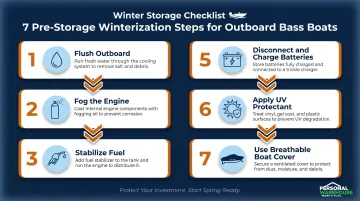
Essential pre-storage checklist for outboard-powered bass boats:
- Flush the outboard with fresh water; change gear lube (white or creamy lube indicates water contamination and freeze risk)
- Fog the engine with fogging oil into spark plug holes or cylinders per your manufacturer's guidance
- Stabilize fuel — fill to ~95% capacity, treat with fuel stabilizer, then run the engine 10 minutes to circulate it through the system
- Drain all livewells and bilge compartments completely; water left in these systems can crack housings once temps drop below 32°F
- Disconnect and charge batteries; store on a maintenance charger
- Apply UV protectant to gel coat surfaces
- Use a breathable boat cover inside the unit — a sealed, non-breathable cover traps moisture and promotes mold
Timing matters as much as technique. According to NOAA climate data, first hard freezes can arrive as early as September in Montana, Colorado mountain areas, Michigan, and Wisconsin. Owners in those states should target full winterization before mid-September to early October.
How Personal Warehouse Can Help
Personal Warehouse offers enclosed warehouse-style spaces designed for recreational vehicles and boats — including tournament bass boats that exceed what standard 10-foot-wide self-storage units can safely accommodate. Units come standard with LED lighting, high-efficiency insulation, full heating (with optional A/C), and heavy-duty insulated overhead doors sized for large vehicles.
For bass boat owners, the practical advantages include:
- Mezzanine options that expand usable space by up to 30%, keeping rods, tackle, and seasonal gear above while the boat stays accessible below
- Financing through preferred lenders, including SBA 504 and 7(a) options, with terms comparable to residential loans — available to individual buyers, not just businesses
- Ownership or leasing flexibility across projects in Montana, Michigan, Wisconsin, Colorado, Florida, Texas, and other states
- Wide drive aisles designed for effortless access with large trailers
The Bozeman, MT project (105 Copper Ranch Road, Belgrade, MT) is currently under construction with delivery expected in 2026 and is now accepting reservations. For specific unit dimensions, door clearances, and current availability, contact Personal Warehouse at 303-222-0768 or info@personalwarehouse.com.
Conclusion
Choosing the right storage unit for a bass boat comes down to four numbers: total rig length, trailer width, package height, and door opening dimensions. The hull length on your spec sheet is just the starting point.
Before you book, run through the essentials:
- Match the unit to your actual rig dimensions, not the hull spec alone
- Confirm door width clears your trailer's widest point
- Choose enclosed storage if your boat has mounted electronics, gel coat finishes, or upholstery worth protecting
- Revisit the size decision each season — a boat upgrade or second watercraft changes everything
Bring accurate measurements to any facility consultation. Arriving with a 28-foot rig and discovering the unit won't fit is the one mistake worth avoiding entirely.
Frequently Asked Questions
What size self-storage unit do I need for a bass boat?
Most bass boats 16–18 feet fit in a 10×20 unit with trailer attached. Boats 18–21 feet typically need a 10×30, and tournament rigs over 21 feet often require a 12×30 or larger. Always calculate total on-trailer length including the motor and tongue — not just hull length.
How much will a 10×20 storage unit hold?
A 10×20 (200 sq ft) comfortably fits a bass boat and trailer up to roughly 18 feet total, with limited room alongside for a gear bin or tackle storage — making it the go-to unit for mid-range fiberglass boat owners.
How much can a 10×30 storage unit hold?
A 10×30 (300 sq ft) fits larger bass boats of 18–22 feet with full trailers attached and leaves additional room for fishing gear, a small workbench, or seasonal equipment. It's the recommended minimum for most full-size tournament setups.
What are the standard sizes of self-storage units?
Common sizes run from 5×5 up through 10×10, 10×20, 10×30, and 12×30 or larger for vehicles. Bass boat owners should focus on 10×20 and above — warehouse-style facilities often offer enclosed bays well beyond standard rental unit dimensions.
Should I choose indoor or outdoor storage for my bass boat?
UV exposure, rain, and temperature swings all accelerate wear on mounted electronics, upholstered seating, and gel coat finishes — which makes fully enclosed storage the right call for anything beyond short-term in-season parking. Outdoor storage works in a pinch but isn't suited for multi-month off-season storage.
Do I need to remove my trolling motor before storing my bass boat?
You don't need to remove it if the unit has sufficient ceiling clearance and the motor stows safely in the transport position. Verify the door height allows entry with the motor stowed — and if ceiling clearance is tight, removing it is the safer call.