Introduction
Transferring an RV storage unit to someone else seems simple enough: hand over the key, share the gate code, move on. But that's not how it works, and assuming otherwise creates real liability for both parties.
An RV storage ownership transfer is the formal process of changing the named account holder, legal responsibility, and rental agreement on an RV storage unit from one person to another. Every step requires facility involvement, and simply passing access credentials creates real legal and financial exposure for both parties.
This process is more complicated than standard self-storage transfers for one core reason: the vehicle inside has a state-issued title, registration, and often a required insurance policy attached to it. That changes everything about how the transfer works—and what can block it.
Miss a step, and the wrong person stays legally on the hook — for the unit, the vehicle, and any liability in between.
TL;DR
- You cannot transfer an RV storage unit by handing over a key—the rental agreement must formally change.
- The incoming renter typically needs valid photo ID and proof of RV insurance, and the account must show a zero balance before transfer proceeds.
- RV storage is legally distinct from standard self-storage—the vehicle's title creates additional insurance, lien, and liability obligations.
- Deaths, divorces, and business ownership changes require additional legal documentation beyond a standard name change.
- Some major national operators—including Public Storage—prohibit individual account transfers entirely.
Why RV Storage Transfers Are More Complex Than Standard Self-Storage
A standard self-storage unit holds boxes and furniture. An RV storage unit holds a titled, registered vehicle worth tens of thousands of dollars—and that changes everything from the rental contract to how lien laws apply.
The Rental Agreement Is a Legal Contract—Not Just a Form
The rental agreement ties financial responsibility, access rights, insurance obligations, and liability to a specific named individual. Changing the account holder isn't a minor administrative update—it's a contractual handoff that the facility must formally execute.
If the original renter's name stays on the lease while someone else uses the unit, the original renter remains legally and financially responsible for unpaid rent, damage, and any lien action the facility takes on the stored vehicle.
State Lien Laws Treat Stored Vehicles Differently
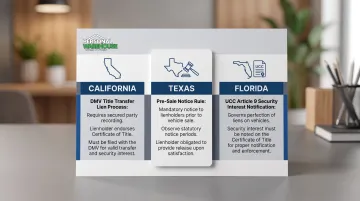
This is where RV storage diverges sharply from standard self-storage. In California, Business and Professions Code Section 21702.5 requires vehicle liens in storage facilities to be enforced through the DMV lien process—not the standard self-storage auction process used for household goods. Texas and Florida impose similar vehicle-specific notification requirements.
| State | Key Vehicle-Specific Requirement |
|---|---|
| California | Vehicle liens enforced via DMV process (Civil Code 3071), not standard storage auction |
| Texas | Pre-sale notice required to vehicle owners and lienholders (Property Code § 59.0445) |
| Florida | Facilities must notify holders of perfected UCC security interests on titled vehicles |
Insurance Requirements Are Tied to the Vehicle's Full Value
Most RV storage facilities require tenants to maintain active insurance covering 100% of the vehicle's actual cash value. With average motorhome auction values at $62,412 in Q1 2025, that's a meaningful coverage requirement—far beyond what any standard self-storage agreement demands.
During a transfer, the facility must verify the incoming renter's policy is active and meets the minimum threshold. If coverage lapses in the gap between renters, the facility can pause the transfer until proof of insurance is provided.
Major Operators Often Prohibit Individual Transfers
Several major operators prohibit account transfers outright. Their policies require the current tenant to vacate and the new renter to open a fresh account—which risks losing the unit to another customer in the interim:
- Public Storage: Explicitly states it "does not allow customers to transfer ownership of their account or space"
- Extra Space Storage: Lease prohibits assigning or subletting without prior written consent
- Thousand Trails: RV-specific agreement uses identical no-transfer language
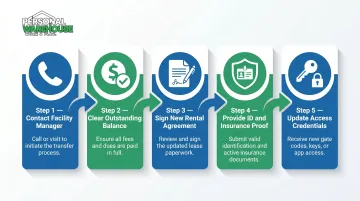
How to Transfer an RV Storage Unit: Step by Step
The transfer process requires coordination between the outgoing renter, the incoming renter, and the facility. Each step builds on the last, so skipping ahead typically causes delays.
Step 1: Contact the Facility Manager First
Call or visit the facility before doing anything else. Confirm whether transfers are permitted, what forms are required, and whether both parties need to be physically present. Policies vary by facility—and sometimes by account type (individual vs. business).
Step 2: Clear Any Outstanding Balance
Nearly every facility requires a zero balance before processing any account changes. Outstanding rent, late fees, or administrative charges will freeze the transfer until the account is current.
Step 3: Complete a New Rental Agreement
Most facilities require the incoming renter to sign a brand-new lease rather than amend the existing one. This new agreement captures:
- Updated billing and payment information
- Vehicle details (make, model, year, VIN)
- Emergency contacts
- Liability acknowledgment and insurance confirmation
A new agreement protects the facility by establishing clear legal responsibility upfront, and protects the incoming renter by creating a clean record with no inherited obligations.
Step 4: Provide Identification and Insurance Documentation
The new renter typically needs to bring:
- Valid government-issued photo ID
- Proof of active RV insurance covering the stored vehicle (meeting the facility's minimum value threshold)
- Vehicle registration or proof of ownership, depending on the facility's policy
- Facility-specific transfer forms, if applicable
- Proof that the facility is listed as an "interested party" on the insurance policy, if required
Step 5: Update All Access Credentials and Physical Security
Once the new lease is signed, both parties should act promptly:
- Update gate codes or app-based access
- Change any shared login credentials
- Update billing and autopay settings under the new account
- Replace the physical unit lock if the previous renter had a key—this ensures the outgoing renter has no remaining access
Special Circumstances: Transfers Due to Death, Business Changes, or Divorce
Standard transfers involve two willing parties and a cooperative facility. These situations come with added legal and procedural complexity.
When a Renter Passes Away
The storage unit becomes part of the deceased's estate. Access is typically locked immediately when the facility learns of the death. To transfer or access the unit, an executor or next of kin must provide:
- Certified death certificate
- Letters Testamentary or a Small Estate Affidavit proving legal authority over the estate
- Valid government-issued photo ID
- In some states, a court order probating the will
The estate remains liable for rent throughout this process—fees don't pause because the account holder has died. Contact the facility promptly and consult an estate attorney if the situation is contested or legally unclear.
When a Business Changes Ownership
Business account transfers follow a different path than individual transfers. Public Storage, for example, permits business ownership changes via a fiduciary form obtained from the local property manager, a process separate from its individual account policy.
Facilities generally require:
- Documentation proving the new owner's legal authority over the business entity (operating agreement, articles of incorporation, or similar formation documents)
- Updated business credentials and EIN
- Removal or replacement of any saved payment methods tied to the previous owner's account
Divorce or Separation
When a jointly used storage unit needs to be reassigned to one party, facilities require one of two things:
- Written consent from the original account holder agreeing to the transfer
- A court order specifying which party retains rights to the unit
Removing the other person's gate code without facility involvement doesn't legally transfer responsibility. In California, a spouse can file Form FL-300 (Request for Order) to seek property control during divorce proceedings. Texas requires a certified copy of the divorce decree for any related vehicle title transfer through the DMV. When in doubt, get the facility involved early — state requirements vary, and the right paperwork upfront prevents disputes later.
What Can Block or Complicate Your RV Storage Transfer
Even when both parties are willing and the facility is cooperative, transfers stall for predictable reasons.
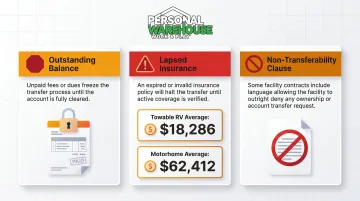
The three most common blockers are:
- Outstanding account balance: Facilities place an administrative hold until all fees are cleared—rent, late charges, and any administrative costs. Nothing moves until the balance reaches zero.
- Lapsed or insufficient insurance: If the incoming renter can't show proof of coverage meeting minimum requirements, the transfer can be denied outright. Given that towable RVs average around $18,286 at auction and motorhomes average $62,412, the coverage threshold carries real weight.
- Non-transferability clauses: Major operators explicitly prohibit individual account transfers. If your facility has this policy, there is no transfer path—the current renter must vacate and the new renter must open a fresh account, with no workaround short of removing the vehicle first.
Each of these blockers exists because the facility controls the relationship. For RV owners who want long-term certainty without that dependency, the ownership model matters. Personal Warehouse offers a 99-year ground lease ownership structure where transfers are handled as property transactions between buyer and seller—not as lease assignments requiring landlord approval. That removes the single biggest point of failure in a traditional facility transfer: the facility's ability to simply say no.
Conclusion
An RV storage ownership transfer requires facility approval, a new rental agreement, a cleared account balance, updated insurance documentation, and proper identification—for every scenario, not just the complicated ones.
The high-value, titled vehicle inside creates insurance thresholds, lien obligations, and liability considerations that simply don't apply to ordinary self-storage. Understanding those details before you start protects both the current and incoming renter from risks a simple key handoff won't cover.
Frequently Asked Questions
How do I transfer my RV storage unit to someone else?
Contact the facility first to confirm whether transfers are permitted. The new renter must sign a fresh rental agreement with valid photo ID and proof of RV insurance, and the account must have a zero balance before the process begins. Not all facilities allow individual transfers.
Can I give someone else access to my RV storage unit?
Adding someone as an authorized user gives them physical access but doesn't transfer legal or financial responsibility—you remain on the hook for rent, damages, and any lien if rent goes unpaid. Only a full account transfer removes liability from the original renter.
What documents do I need to complete an RV storage transfer?
The incoming renter typically needs a valid government-issued photo ID, proof of active RV insurance covering the stored vehicle, and any facility-specific transfer forms. Transfers involving a deceased renter's estate or a business ownership change require additional legal documentation.
What happens to an RV storage unit when the renter passes away?
The unit becomes part of the estate, and the facility typically locks it until the executor or next of kin presents a certified death certificate and proof of legal authority (such as Letters Testamentary or a Small Estate Affidavit). Some states also require a court order, so consulting an estate attorney early is worth doing.
Can a storage facility refuse to transfer an account to someone else?
Yes. Many major facilities — including Public Storage and Extra Space Storage — explicitly prohibit individual account transfers in their lease agreements. When a facility refuses, the current tenant must vacate and the new renter opens a fresh account.
Is transferring an RV storage account different from transferring the RV's title?
These are two separate processes. The storage account transfer changes who is responsible for the rental agreement—handled through the facility. The vehicle title transfer changes who legally owns the RV—handled through your state's DMV. Both may be needed in a sale, but neither one completes the other.