
Introduction: When Wall Street Noticed Your Neighbor's RV Problem
In August 2022, the Wall Street Journal ran a story about a tech entrepreneur who sold a data-center company for roughly $15 billion — and then turned his attention to storing RVs. That's not a curiosity. It's a thesis.
When sophisticated capital chases a niche that most investors overlook, it means someone spotted a structural gap before the crowd did. Gary Wojtaszek's pivot to RV storage — building RecNation from scratch into a 66-location platform backed by Goldman Sachs, Morgan Stanley, and a $500 million credit facility — was exactly that kind of bet.
The underlying problem is simple: the RV Industry Association recorded 600,240 wholesale shipments in 2021, an all-time record, adding millions of vehicles to American driveways. Most of those driveways can't legally hold them.
This article unpacks the financial case behind RV storage's rise — and why one emerging model, ownership rather than rental, is drawing attention from investors and RV owners alike.
TLDR
- Record RV purchases since 2020 created millions of new owners who can't legally park at home due to HOA and municipal restrictions
- Approximately 8 million U.S. households own an RV, but fewer than 5,000 purpose-built storage facilities exist nationally — a severe supply gap
- Institutional investors see RV storage as resilient: low turnover costs, long-term tenants, and strong automation potential
- Ownership models like Personal Warehouse's storage condos offer an alternative to perpetual renting where buyers build equity over time
Why RV Storage Is Booming Right Now
The Pandemic Added Millions of RVs to American Roads
The numbers tell a clear story:
| Year | RV Wholesale Shipments | Change |
|---|---|---|
| 2020 | 430,412 | — |
| 2021 | 600,240 (all-time record) | +39.5% |
| 2022 | 493,268 | -17.8% |
| 2023 | 313,174 | -36.5% |
| 2024 | 333,733 | +6.6% |
Source: RVIA
The 2023 and 2024 declines from the pandemic peak don't tell the full story. Those millions of units shipped in 2020 and 2021 didn't disappear — they're still on the road, and increasingly, they need somewhere to go. Storage demand runs on the installed base of vehicles, not just new shipments.
First-time pandemic buyers accelerated this dynamic. Many bought RVs specifically because social distancing made camping an attractive alternative to crowded airports. These buyers skewed younger, lived in smaller homes, and often resided in HOA communities where recreational vehicles are unwelcome in driveways.
Municipal Ordinances Force the Issue
For most RV owners, parking at home isn't just inconvenient — in many jurisdictions, it's prohibited outright.
Several major cities actively prohibit residential RV parking:
- Fort Worth, TX (Section 22-162.3): 24-hour limit on public streets; driveways allowed only 72 hours for loading/unloading
- Denver, CO (Section 54-465): 72-hour limit on any single block face
- Austin, TX (Chapter 12-5): Blanket prohibition on oversized vehicles in residential districts
- San Diego, CA: Overnight parking ban from 2 a.m. to 6 a.m. without a valid permit
These aren't obscure technicalities. They're enforced ordinances that convert off-site storage from a convenience to a legal necessity for most RV owners.
A Supply Gap That's Hard to Close Quickly
According to StorTrack's national market analysis, approximately 8 million U.S. households own an RV, yet fewer than 5,000 purpose-built RV and boat storage facilities exist nationally — roughly 1,600 RV-owning households per dedicated facility. Industry research suggests supply would need to increase five-fold to meet existing demand.
Building new facilities isn't fast. Large land parcels, zoning approvals, and meaningful upfront capital all constrain how quickly supply can respond. Facilities that exist today routinely operate at or near full occupancy — which is why purpose-built storage commands premium rents and low vacancy even in secondary markets.
Why Investors Are Betting Big on RV Storage
How RV Storage Compares to Traditional Commercial Real Estate
Office valuations cratered after remote work took hold, industrial and multifamily assets now trade at compressed cap rates, and retail keeps losing ground to structural pressure. Against that backdrop, RV storage looks like a different asset class entirely.
The financial advantages are straightforward:
- Near-zero turnover costs: When an RV tenant leaves, the unit gets swept, inspected, and re-listed. Compare that to apartment turnovers requiring carpet replacement, painting, and appliance repairs
- Sticky tenants: RV owners store vehicles worth $40,000 to $400,000+. They have strong financial motivation to stay current on rent and rarely abandon their space
- Delinquency rates under 1%: Industry data from Oakside Companies confirms that tenants protecting high-value assets are exceptionally reliable payers
- Low-overhead operations: Modern management software handles billing, access control, insurance enrollment, and communications — cutting staffing costs without sacrificing service
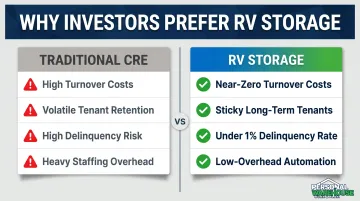
That combination of reliable tenants and lean operations makes the financing math work cleanly — especially for individual investors using SBA programs.
The Financing Picture
SBA 504 loans make RV storage accessible for individual investors, not just institutions. Key terms:
- 10% down for a first acquisition (same guidelines as traditional self-storage)
- 25-year amortization with fixed rates
- Eligible for ground-up construction, acquisitions, turnarounds, and even refinancing from floating-rate structures
The opportunity in RV and boat storage today mirrors what self-storage offered 15 years ago — before institutional capital flooded in and compressed returns for everyone else.
Market Trajectory
The global RV and boat storage market was valued at approximately $2.59 billion in 2024 and is projected to reach $5.95 billion by 2032, a 12.5% compound annual growth rate. That trajectory, combined with the structural supply shortage, is why capital keeps entering this space.
What Real Entrepreneurs Are Building in This Space
The Institutional Play: RecNation
Gary Wojtaszek's RecNation is the clearest example of institutional conviction in RV storage. After leading CyrusOne — a data-center REIT sold for approximately $15 billion — Wojtaszek founded RecNation in 2020 with backing from Centerbridge Partners LP.
The numbers reflect serious scale:
- 66 locations across Texas, Florida, Arizona, Kansas, Tennessee, and Missouri
- $500 million revolving credit facility led by Truist Securities, with Goldman Sachs, Morgan Stanley, and RBC Bank among the participants
- Acquisition strategy targeting independently operated, undermanaged facilities at favorable prices
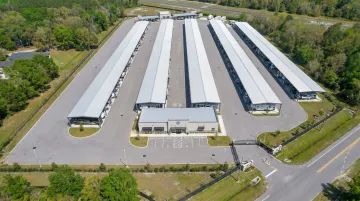
The playbook is consistent: find fragmented markets dominated by small operators, acquire at favorable prices, professionalize operations, and expand.
The Individual Investor Case Study
Commercial Property Advisors documented a smaller-scale version of the same strategy. An individual investor purchased a 185-unit RV storage facility for $2.345 million using SBA financing, then repositioned it through operational improvements and rent increases. The result: meaningful property value gains from treating a neglected asset like a professional operator would.
That pattern — spot the fragmented, undermanaged market; fix the operations; capture the upside — runs through both institutional and individual plays alike. Personal Warehouse approaches the same opportunity from a different angle.
The Ownership Alternative: Personal Warehouse
Personal Warehouse takes a structurally different approach. Rather than building a rental platform, Personal Warehouse develops ownership-based storage condos — fully enclosed units that buyers purchase outright.
The Bozeman, MT project is currently under construction at 105 Copper Ranch Road, Belgrade, MT, with delivery expected in 2026 and reservations open now. Units are built specifically for RV and boat storage, with features including:
- 100/150-amp 3-phase electrical service
- Heavy-duty insulated overhead doors
- Superior insulation and all-LED lighting
Under the 99-year ground lease structure, buyers own the physical unit — the structure, improvements, and all equity — while leasing the underlying land. Financing runs through preferred lenders offering SBA 504 and 7(a) products, often on terms comparable to residential loans.
For RV owners who are tired of paying rent indefinitely, this model offers something traditional facilities never can: equity that grows.
What Separates a Premium RV Storage Facility from the Rest
The Three Storage Types
Not all RV storage protects your vehicle equally:
| Type | Cost (Monthly) | Protection Level | Best For |
|---|---|---|---|
| Open-air | $75–$150 | Minimal — exposed to UV, rain, hail | Short-term, lower-value vehicles |
| Covered (carport) | $125–$200 | Moderate — roof protection only | Mid-range vehicles, mild climates |
| Enclosed | $150–$400+ | Maximum — full weather and security | High-value RVs, extreme climates |
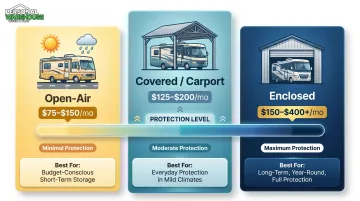
Fiberglass RV roofs develop oxidation and chalking when exposed to sun consistently — a process that degrades both appearance and structural integrity. For vehicles worth $100,000 or more, the cost difference between open and enclosed storage is negligible compared to the preservation benefit.
Premium Features Worth Verifying
When evaluating a facility, look beyond the basic unit type. The details determine whether your vehicle is genuinely protected:
- Insulated walls and ceilings buffer temperature swings that stress seals, adhesives, and interior finishes over time
- Insulated overhead doors seal out dust and moisture — non-insulated doors leave meaningful gaps in protection
- Full LED lighting throughout the facility improves visibility for late-night access and deters theft
- Outlet access inside units lets you run trickle chargers or battery maintenance equipment throughout the storage period
Electrical capacity varies significantly between facilities. Personal Warehouse units, for example, include 100/150-amp 3-phase electrical service as standard — enough for battery maintenance, workshop tools, or any equipment an RV owner might need. Each unit is individually metered, so you pay only for what you use.
Before Signing a Storage Contract
Run through this checklist:
- Does the facility allow trickle chargers or battery maintenance during storage?
- What are the actual access hours — 24/7 or restricted?
- Is the facility currently full with a waiting list? (A waitlist signals quality management and genuine demand)
- What surveillance and gating systems are in place?
- Is tenant insurance available on-site or through a facility partner?
High occupancy and waiting lists aren't inconveniences to avoid — they're quality signals. A facility that's always got open spots in a high-demand market usually has a reason for it.
Frequently Asked Questions
Is RV storage a good real estate investment?
RV storage combines low operational complexity, high tenant retention, and demand driven by municipal parking restrictions — making it resilient across economic cycles. Delinquency rates under 1% and near-zero turnover costs translate to strong net operating income compared to most traditional commercial real estate categories.
How profitable is owning an RV storage facility?
Margins benefit from minimal turnover costs, stable long-term tenants, and automation potential that reduces staffing overhead. RV storage properties have historically traded at higher cap rates than mainstream self-storage, reflecting stronger returns and less institutional competition — though that gap is narrowing as more capital enters the sector.
Why is RV storage demand growing so fast?
Record RV shipment volumes since 2020, an influx of first-time buyers, and widespread municipal ordinances prohibiting residential parking of large recreational vehicles all converge to create persistent, inelastic demand for professional off-site storage.
What's the difference between open, covered, and enclosed RV storage?
Open storage is an outdoor lot with minimal protection at the lowest price point. Covered adds a carport-style roof for mid-range protection. Enclosed units offer four walls, a secured door, full weather protection, and UV shielding — the right choice for high-value vehicles in harsh climates.
Can my HOA or city prevent me from parking my RV at home?
Yes. Many HOAs and municipalities restrict residential RV parking to as little as 24 to 72 hours. Cities including Fort Worth, Denver, Austin, and San Diego have active ordinances with enforcement mechanisms — one of the primary reasons professional RV storage facilities maintain consistent occupancy and waiting lists.
What should I look for when choosing an RV storage facility?
Prioritize gated access with surveillance, confirmed 24/7 entry, and the unit type that matches your climate and vehicle value. Check whether the facility runs a waitlist — a reliable indicator of management quality — and confirm that enclosed units include insulation and sealed overhead doors.