Introduction
Every fall, RV owners in cold-weather states face the same question: where does the rig go for the next five months? It sounds simple. It rarely is.
A single winter of poor storage can do serious damage — burst water lines, cracked holding tanks, seized slide-out mechanisms, mold behind the cabinets, rodent nests in the insulation.
Dealer repair estimates put freeze damage alone at $500–$5,000+ depending on what fails, and that doesn't account for UV-degraded seals, dead batteries, or theft. Indoor storage eliminates most of these risks — but not all indoor storage is equal, and prep still matters wherever the RV lands.
This guide covers the full picture: why indoor storage is worth the cost, which facility types actually protect your investment, how to prep your RV before move-in, and what to budget.
TL;DR
- Indoor storage protects against freeze damage, UV degradation, moisture, pests, and theft
- Storage options range from basic enclosed units to heated/climate-controlled facilities to private warehouse ownership
- Winterization is still necessary even for indoor storage — water systems and batteries need prep regardless
- Look for facilities with adequate clearance height, insulated construction, secure access, and available electrical hookups
- Budget $100–$200/month for standard enclosed storage, $150–$400/month for heated or climate-controlled options
Why Indoor Winter Storage Matters for Your RV
An RV is a significant financial asset. Black Book's Q2 2025 market data puts the average wholesale price for motorhomes at $63,540 and towables at $18,770 — and those numbers reflect market value after depreciation, not what owners originally paid. Protecting that investment over a five-month winter isn't optional.
Freeze and Weather Damage
Water freezes at 32°F, and it doesn't take a harsh Montana winter to cause damage. Allstate advises winterizing when temperatures are expected to hold below freezing for 24 consecutive hours — a threshold that much of the Midwest, Mountain West, and Upper South hits regularly.
When water remains in lines, tanks, or fittings and temperatures drop:
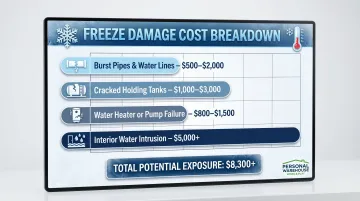
- Burst pipes and water lines: $500–$2,000 to repair
- Cracked holding tanks: $1,000–$3,000
- Water heater or pump failure: $800–$1,500
- Interior water intrusion damage: up to $5,000
Freeze-thaw cycles also expand hairline cracks in roof sealants, accelerating leaks with each temperature swing. Indoor storage eliminates thermal cycling and keeps the RV in a stable environment.
UV and Moisture Damage
Winter sun is still damaging. UV rays break down rubber seals, roof coatings, painted surfaces, and plastic trim even in December and January — outdoor and covered-but-open storage offers no protection from this.
Moisture is the other threat, and it affects indoor-stored RVs too if ventilation isn't managed. Lippert, a major RV component manufacturer, explicitly recommends active airflow and moisture removal to prevent condensation-driven mold, mildew, and corrosion inside cabinets, upholstery, and wiring.
Roof repair costs put the stakes in context: leak repairs run $500–$900, restoration coatings $1,500–$5,500, and full roof replacements $4,000–$12,000 depending on rig size.
Pest, Security, and Long-Term Value
Rodents actively seek shelter in empty vehicles during winter. Once inside, they chew through wiring, nest in insulation, and contaminate soft surfaces. Progressive now offers optional Pest Damage Protection specifically for this risk — which tells you something about how common it is.
The security picture is similar. An RV sitting on a driveway or open lot for five months draws attention precisely because it never moves — a predictable, unmonitored target. Indoor facilities with gated access and surveillance eliminate both the visibility and the opportunity.
Documented water intrusion, rodent damage, or deferred seal repairs directly affect resale conversations. Indoor storage — paired with a maintenance log — gives you something to show buyers instead of something to explain away.
Types of Indoor RV Storage Options
"Indoor storage" covers meaningfully different levels of protection. The right choice depends on your climate, your RV's value, and what you're willing to spend.
Non-Climate-Controlled Enclosed Storage
Standard enclosed bays have four walls and a roof. They block weather, UV, and most pests. What they don't do is actively manage temperature or humidity.
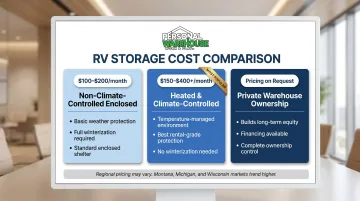
For RV owners in mild-to-moderate winter climates — or those who complete full winterization — this level of protection is often sufficient. It's also the most accessible and affordable indoor option, typically running $100–$200/month.
The key limitation: if outside temperatures drop sharply, the interior of an unheated building can drop close to outside ambient. Proper winterization compensates for this, but it requires doing the prep work thoroughly.
Heated or Climate-Controlled Indoor Storage
Facilities that actively heat interiors — typically maintaining 55–85°F with humidity controlled below roughly 55% RH — offer the strongest protection available in a rental model. For RV owners in Montana, Colorado, Wisconsin, Michigan, and similar cold-climate states where sustained freezing is the norm, this is the premium choice.
Benefits beyond basic enclosure:
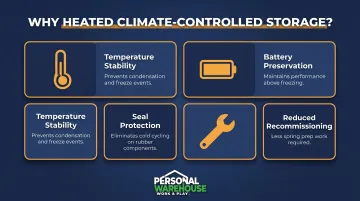
- Stable temperature reduces condensation and prevents freeze events even if winterization wasn't perfect
- Battery performance is better preserved above freezing
- Seals and rubber components don't experience repeated cold cycling
- May reduce the extent of spring recommissioning work
Expect to pay $150–$400/month, with the higher end reflecting larger rigs, premium facilities, and cold-climate metro markets.
Private Warehouse Ownership
Renting a storage bay means paying indefinitely with no return on that investment. Purchasing a private warehouse unit changes the equation entirely.
Personal Warehouse units offer dedicated, permanent indoor space with no competing renters and no annual rate increases at someone else's discretion. Key features include:
- Heated interiors with optional A/C and high-efficiency insulation
- Heavy-duty insulated overhead doors and all-LED lighting inside and out
- 100/150-amp 3-phase electrical service with individual metering — supports battery maintainers, trickle chargers, or tank heaters all winter without shared costs
Personal Warehouse has a project currently under construction in Belgrade, Montana (Bozeman area) — a market where indoor RV storage demand is high and winter protection is non-negotiable. Optional mezzanines add up to 30% more storage space — useful for RV accessories, gear, and tools alongside the rig itself.
For RV owners thinking long-term, ownership builds equity rather than paying rent with no return. Units carry strong resale value and can be leased out when not needed. Financing is available through preferred lenders, with terms comparable to residential loans.
How to Prepare Your RV for Indoor Winter Storage
Indoor storage reduces risk — it doesn't eliminate the need for preparation. Work through this checklist before moving the RV inside.
Drain and Winterize All Water Systems
Even in a heated facility, standing water in lines and tanks promotes bacterial growth, odor, and fitting damage over a long storage period.
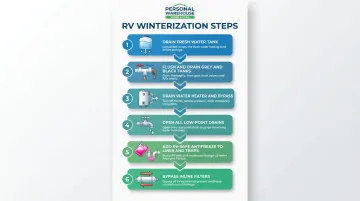
- Drain the fresh water tank completely
- Flush and drain the grey and black tanks — have them pumped if needed
- Drain the water heater (bypass it afterward)
- Open all low-point drains to clear residual water from lines
- Add RV-safe antifreeze to supply lines, P-traps, and toilet bowl
- Bypass any inline filters before running antifreeze through the system
Battery Care
Lead-acid batteries self-discharge at roughly 5–15% per month, and cold accelerates this. A discharged lead-acid battery can freeze near 32°F, cracking the case. For lithium-ion batteries, sub-freezing storage can cause mechanical damage to cathode materials.
Depending on your storage setup, choose one of these approaches:
- Disconnect the battery and store it in a temperature-controlled location above freezing
- Battery maintainer or trickle charger — a good option if the storage unit has electrical access
- Clean terminals before storage — corrosion left unchecked through winter creates springtime problems
Interior Cleaning and Moisture Control
- Remove all food, beverages, and organic materials
- Wipe down all surfaces, including the refrigerator (leave the door ajar)
- Leave cabinet doors slightly open to allow air circulation
- Place desiccant packs or silica gel moisture absorbers throughout the interior
- Consider cracking a roof vent (use a vent cover) to maintain passive airflow even indoors
Exterior and Tire Prep
- Inspect and reseal caulk around windows, vents, slide-out seams, and roof joints
- Wash and wax the exterior
- Remove awnings, satellite dishes, and accessories that can take wind or snow damage
- Inflate tires to manufacturer-recommended pressure
- Place boards or tire pads under tires to prevent flat-spotting from prolonged concrete contact
- Use tire covers to protect against UV even indoors
Condition Documentation and Check-ins
Photograph the interior and exterior thoroughly before storage. These images serve as a condition baseline for insurance purposes.
Set calendar reminders for monthly check-ins during storage:
- Look for signs of pest entry (droppings, chewed materials)
- Check tire pressure
- Run the engine briefly if accessible
- Check for fluid leaks under the vehicle and confirm all stored gear remains secure
A quick monthly walk-through takes 15 minutes and can save hundreds in repairs come spring.
What to Look for in an Indoor RV Storage Facility
Size and Clearance Height
RV dimensions vary significantly:
| RV Type | Typical Length | Typical Height |
|---|---|---|
| Class A motorhome | 26–45 ft | Up to ~13.5 ft |
| Class C motorhome | 20–33 ft | ~10–12 ft |
| Fifth wheel | 22–40+ ft | Up to ~13.5 ft |
| Class B motorhome | 17–23 ft | ~8–10 ft |
These are base measurements. Roof-mounted AC units, antennas, and accessories add height. Ask facilities for written bay dimensions and confirmed clear height before booking — many standard units don't clear a tall Class A or large fifth wheel.
Confirm pull-through access or adequate turning radius, too. Backing a 40-foot fifth wheel into a tight bay isn't a problem you want to discover on move-in day.
Construction Quality and Door Insulation
The building envelope matters as much as whether the facility is "indoor." Look for:
- High-efficiency wall and roof insulation
- Heavy-gauge metal construction that handles wind and snow load
- Insulated overhead doors — not standard steel roll-ups
Standard steel doors transfer cold directly into the building at every entrance point. Insulated doors are one of the most commonly overlooked weak points in otherwise solid storage facilities. Personal Warehouse units, for example, use insulated overhead doors engineered to hold interior temperature — not just provide physical access.
Security Infrastructure
A trustworthy facility should offer:
- Coded gated entry with access logging
- 24/7 camera surveillance with recorded footage
- Perimeter fencing and motion-activated lighting
- On-site management or regular security patrols
Ask specifically whether access logs are maintained. If something happens to the RV, recorded access data is how you determine when and how.
Access Hours and Practical Amenities
Before signing, nail down the operational details:
- Confirm winter access hours — some facilities restrict entry to weekday business hours during the off-season
- Check for electrical outlets to run battery maintainers or tank heaters
- Verify the facility's pest control protocols
- Review the contract for early termination fees, insurance requirements, and liability terms if damage occurs on their property
Indoor Winter RV Storage Cost Overview
Costs vary by region, RV size, facility type, and amenities. The figures below are general benchmarks; always get written quotes from local providers to confirm current pricing.
Monthly Cost Ranges by Storage Type
| Storage Type | Typical Monthly Range | Notes |
|---|---|---|
| Non-climate-controlled enclosed | $100–$200 | Most accessible; requires full winterization |
| Heated/climate-controlled indoor | $150–$400+ | Best rental protection; verify temp setpoints |
| Private warehouse ownership | Pricing on request | Builds equity; financing available |
Industry data from Extra Space Storage shows indoor/enclosed storage averaging $180–$309/month, with an overall observed range of $50–$582 depending on size, metro market, and amenities. Climate-controlled options typically add $25–$50/month over standard indoor pricing.
Class A motorhomes and large fifth wheels command higher rates than pop-up campers or Class B vans. Cold-climate markets (Montana, Michigan, Wisconsin) trend toward the upper end of these ranges.
Additional Costs to Budget For
Beyond monthly rent, plan for:
- Professional winterization: ~$197 (fresh water system drain and antifreeze treatment)
- Spring de-winterization/sanitizing: ~$449 for full tank flush and recommissioning
- Roof inspection before storage: ~$90
- Seal pressure test: ~$199 if you suspect leaks
- Facility admin or setup fees: varies
- Insurance: some facilities require proof of comprehensive coverage
- Transport: towing fees if the RV isn't self-propelled
Book early — late summer or early fall — to secure better availability. Indoor bays in cold-climate markets fill quickly as the first freeze approaches.
Conclusion
For RV owners in cold-weather regions, indoor winter storage is one of the more straightforward ways to protect a significant investment. Freezing temperatures, moisture, UV exposure, rodents, and theft don't strike all at once — they accumulate. Every winter of exposure adds repair costs and erodes resale value.
The right decision combines three things: choosing the storage type that fits your climate, completing proper prep before move-in, and evaluating facilities against clear quality criteria — clearance height, insulation, door type, security, and electrical access.
Get those three things right, and you're not just preserving the vehicle — you're protecting the trips that make owning it worthwhile.
Frequently Asked Questions
Is it better to store an RV indoors or outdoors?
Indoor storage offers meaningfully better protection against weather, UV exposure, pests, and theft. Outdoor storage can work in milder climates with thorough prep and a quality cover, but carries real risk of cumulative damage from freeze-thaw cycles, UV degradation, and environmental exposure over a full winter season.
Do I still need to winterize my RV if it's stored indoors?
Yes — unless the facility actively maintains interior temperatures well above freezing at all times. Non-climate-controlled enclosed buildings can drop close to outdoor ambient during cold snaps, leaving residual water in lines and tanks vulnerable to freezing. Standing water also causes bacterial growth and odor problems regardless of temperature.
How much does indoor RV storage cost per month?
Non-climate-controlled enclosed storage typically runs $100–$200/month. Heated or climate-controlled indoor storage runs $150–$400/month or more. Costs vary by RV size, region, and facility amenities — always get multiple local quotes before committing.
What size indoor storage space do I need for my RV?
Measure your RV's full length, width, and height — including roof-mounted AC units, antennas, and any accessories. Class A motorhomes and large fifth wheels can reach 13.5 feet tall, so always confirm the facility's written clear height specification before booking.
Can I store items inside my RV during indoor storage?
Non-perishable gear generally can stay inside the RV. Food, beverages, liquids, and anything that could attract pests or develop odors should be removed before storage.
When should I start looking for indoor RV storage?
Start searching and reserving in late summer or early fall. Indoor bays fill quickly in cold-climate markets like Montana and Wisconsin — waiting until October typically means limited options and higher prices.