

Introduction
Texas has become the market other investors benchmark against—and the numbers explain why. A $2.6 trillion economy, no state income tax, and a net migration gain of 473,453 residents in a single year have created a commercial real estate environment that's hard to replicate anywhere else in the country.
But the real story isn't just the headlines. It's what those fundamentals mean for an investor's monthly cash flow, tax bill, and long-term equity position. Many investors struggle to find markets where population growth, business-friendly policy, and affordable entry points align at the same time. Texas is one of the few places where all three converge—whether you're a seasoned portfolio builder or a small business owner buying your first commercial property.
This article covers the core benefits of Texas CRE—from tax advantages and cash flow potential to population-driven demand and specific asset classes worth considering.
TL;DR
- Texas industrial cap rates of 6–8% substantially outpace S&P 500 dividend yields (1.06%) and 10-year Treasuries (4.61%)
- No state income tax on rental income or capital gains, versus 13.3% in California and 10.9% in New York
- Texas rural land has compounded at 11.24% annually over five years, per Texas A&M Real Estate Research Center
- DFW absorbed nearly 25 million square feet of industrial space in 2025—its 7th consecutive year above 20 million sq ft
- Personal Warehouse units in Texas offer ownership entry points backed by SBA 504 and 7(a) financing, with delivery slated for 2026
What Is Commercial Real Estate Investment in Texas
Commercial real estate in Texas refers to property purchased for business use, income generation, or wealth building—not personal residence. That distinction matters: financing structures, zoning rules, and tax treatment all work differently than they do for residential purchases.
The main categories relevant to Texas investors:
| Property Type | Description | Risk/Return Profile |
|---|---|---|
| Industrial/Warehouse | Distribution, flex, manufacturing | High demand, lower vacancy, strong rent growth |
| Office | Class A/B/C, low- to high-rise | Recovering; Class A outperforms |
| Retail | Consumer-facing commercial | Market-dependent; major metros resilient |
| Mixed-Use | Combined residential/commercial | Strong in urban cores |
| Land | Unimproved parcels | Long hold, high upside in growth corridors |
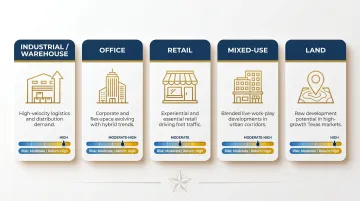
Industrial and warehouse properties dominate transaction volume in Texas. In San Antonio alone, warehouse and distribution spaces accounted for 89% of all leasing velocity in Q4 2024. That concentration reflects a broader statewide trend—and it's a key reason industrial assets attract so much investor attention in Texas right now.
Key Benefits of Investing in Texas Commercial Real Estate
The benefits below aren't theoretical. They show up in monthly cash flow statements, annual tax filings, and equity positions that build over the hold period.
Benefit 1: Consistent Income Through Commercial Leases
Triple-net (NNN) leases dominate Texas's industrial and warehouse market. Under this structure, tenants pay property taxes, insurance, and maintenance, not the landlord. The result is a cleaner, more predictable income stream than residential rentals, where operating expenses regularly erode returns.
In practice, this means:
- Longer lease terms (typically 5–10 years for industrial) reduce turnover and vacancy risk
- Escalation clauses keep rents tracking inflation or exceeding it
- Operating expense exposure shifts to the tenant, improving margin consistency
The income numbers are compelling. San Antonio industrial properties averaged an 8.0% cap rate in Q4 2024, with NNN rents hitting a record high of $8.61 per square foot. Compare that to the S&P 500 dividend yield of 1.06% and the 10-year Treasury at 4.61%: Texas commercial real estate generates income at a substantially different scale.
KPIs this affects: Net operating income (NOI), cap rate, cash-on-cash return, vacancy rate.
This structure matters most for investors who need predictable monthly income. Small business owners can amplify the advantage further by occupying part of a property and using rental income from remaining units to offset their own occupancy costs — a model Personal Warehouse supports with SBA 504 and 7(a) financing options and terms comparable to a residential loan.
Benefit 2: Long-Term Appreciation and Equity Accumulation
Texas CRE appreciates through two channels working simultaneously: external demand drivers (population growth, infrastructure investment, land scarcity near major metros) and internal factors (property improvements, proactive management). Leveraged ownership amplifies both effects, since loan paydown and appreciation compound together during the hold period.
A property that appreciates 10% while you're paying down principal creates equity gains that far exceed the appreciation rate in isolation.
The data supports a strong long-term trajectory. Texas statewide rural land posted a 5-year nominal compound annual growth rate of 11.24%, reaching a median of $5,158 per acre in Q3 2025 (Texas A&M Real Estate Research Center). The Austin-Waco-Hill Country region hit a new record high of $7,704 per acre. West Texas land, buoyed by data center and AI project interest near Abilene, rose 15.79% year-over-year.
For investors focused on commercial structures rather than land, CBRE Investment Management projects 2024-vintage modern logistics investments will deliver total gross unlevered returns of 11.5%, the highest of any CRE sector.
KPIs this affects: Total ROI, loan-to-value ratio, net equity position, resale value.
This benefit compounds most meaningfully for investors with a 5–15 year horizon who can hold through Texas's population and economic expansion cycles rather than attempting short-term repositioning.
Benefit 3: Tax Advantages Unique to Texas CRE Ownership
Texas levies zero individual income tax, so rental income and capital gains from property sales face no state-level tax burden. An investor earning an 8% cap rate in San Antonio keeps 100% of that yield at the state level. The same investment in California (13.3% top rate) or New York (10.9%) loses a meaningful share annually to state taxation.
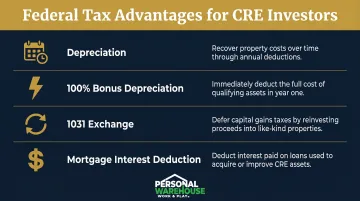
Federal tax code adds further advantages:
- Depreciation: Nonresidential real property depreciates over 39 years under the straight-line method, shielding a portion of rental income from taxation each year
- 100% Bonus Depreciation: Reinstated for 2025 and beyond under the One Big Beautiful Bill Act for qualifying property
- 1031 Exchanges: Under IRC Section 1031, investors can sell a property and roll proceeds into a new like-kind property, deferring capital gains taxes indefinitely through successive exchanges
- Mortgage Interest Deductions: Interest on commercial loans remains deductible, reducing taxable income during the hold period
Texas's property tax structure (an effective 1.4% rate) is embedded in operating expenses. In NNN lease markets, that cost passes directly to tenants, which means an investor's effective state-level tax burden on income can approach zero.
Important: The impact varies by investor structure, entity type, and property category. Working with a qualified tax advisor who specializes in commercial real estate is essential to fully capture these benefits.
KPIs this affects: After-tax net income, effective tax rate on CRE income, depreciation-shielded income percentage.
Texas's Economic Environment and Why It Amplifies Returns
The structural forces behind Texas CRE aren't cyclical—they're embedded in the state's economic architecture.
Scale and Diversification
Texas's GDP reached $2.6 trillion in 2023, making it the 8th-largest economy in the world if measured as a sovereign nation—ahead of Canada. The economy spans energy, technology, healthcare, manufacturing, logistics, and financial services. That diversification means CRE demand doesn't hinge on any single sector's performance.
Population and Business Migration
Texas gained 473,453 total residents in 2023 and led all states in net domestic migration, adding 85,267 more people than it lost to other states. California and New York lost a combined 360,000+ domestic migrants in the same period.
Corporate relocations reinforce that momentum:
- 24+ company headquarters relocated to Texas in 2024 alone, including Chevron from California to Houston
- 25,000+ business establishments moved to Texas between 2010 and 2019, per Dallas Federal Reserve data
- Those relocations brought over 281,000 jobs with them
Industrial Sector Outperformance
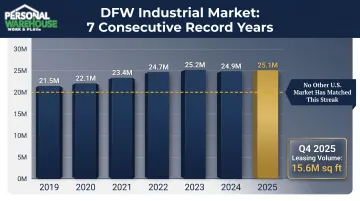
DFW's industrial market has set records that no other U.S. market has matched:
- ~25 million square feet of net industrial absorption in 2025
- 7th consecutive year exceeding 20 million sq ft—a streak no other U.S. market has matched
- Q4 2025 alone saw 15.6 million sq ft of leasing volume, the highest since mid-2021
E-commerce growth and supply chain reshoring have driven up demand for logistics space. Texas's central geography, port access, and labor force make it a natural distribution hub, serving both regional demand and national supply chains.
Business Climate Rankings
Texas has ranked #1 in Chief Executive magazine's Best States for Business for 21 consecutive years through 2026, and topped Site Selection magazine's 2025 Business Climate Rankings as well. Those rankings reflect the regulatory predictability, tax structure, and workforce availability that companies weigh before committing to long-term lease obligations.
What Happens When You Delay Texas CRE Investment
Waiting on a Texas CRE purchase isn't a neutral decision — delayed entry costs money in three measurable ways.
The Appreciation Gap
Texas commercial land and industrial properties have appreciated at double-digit compound rates in many corridors over the past five years. Investors who wait face higher entry prices and a shorter remaining runway to capture appreciation within their target hold period. The same asset, purchased two years later, may require a significantly longer hold to hit the same return threshold.
The Compounding Income Loss
Every year without a property forfeits that year's rental income. It also eliminates the reinvestment of that income and the equity paydown that would have built in parallel. Across a 10-year hold, those stacked losses can represent 20–30% of total projected return — money that simply never enters the equation.
The Market Access Problem
Institutional capital is increasingly targeting Texas industrial and logistics assets. As supply constraints persist — San Antonio saw construction deliveries drop 94% year-over-year in Q4 2024 — quality assets at favorable cap rates grow harder to find. Investors who move early face less competition and secure better terms before institutional buyers absorb available inventory.
How to Get the Most from Your Texas CRE Investment
Strong outcomes in Texas CRE don't come from finding a single perfect deal—they come from applying a consistent strategy across time.
Define Your Strategy First
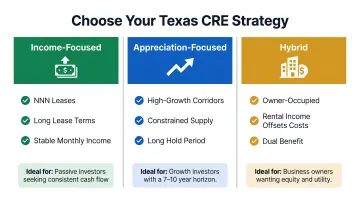
Choose your primary objective before selecting a property:
- Income-focused: Prioritize NNN-leased industrial or warehouse properties with strong tenant covenants
- Appreciation-focused: Target high-growth corridors near major metros with constrained supply
- Hybrid: Owner-occupied commercial properties where your business occupies space while rental income offsets costs
Monitor Performance Regularly
Investors who review key benchmarks quarterly—rather than annually or reactively—can spot opportunities before market conditions shift. Track at minimum:
- Occupancy rate: Early vacancy signals tenant risk or mispricing
- NOI: Catches expense creep before it erodes returns
- Cap rate benchmarks: Flags redeployment or reinvestment timing
Match Property Type to Demand Drivers
Chasing short-term trends in CRE is expensive. Properties aligned with structural demand drivers—logistics infrastructure, population growth corridors, business formation rates—outperform over extended hold periods.
For small business owners, collectors, and investors new to commercial real estate, a warehouse unit anchored to one of those demand drivers can be a practical starting point. Personal Warehouse offers ownership opportunities in Texas backed by SBA 504 and 7(a) financing, with customization options—mezzanines, HVAC, restrooms, and overhead door configurations—that expand usable space by up to 30%.
Units support both direct business use and long-term resale value, making them a fit for buyers focused on either income or appreciation.
Frequently Asked Questions
Is now a good time to invest in Texas commercial real estate?
Texas's ongoing population growth, a record employment base of 15.9 million workers, and sustained industrial absorption point to a structurally sound long-term market. For investors with a 7–15 year horizon, the hold period and asset selection matter far more than entry timing relative to short-term rate cycles.
What type of commercial real estate performs best in Texas?
Industrial and warehouse properties have been the standout performers, driven by logistics demand, e-commerce growth, and supply chain reshoring. Retail and multifamily have also shown resilience in DFW, Houston, and Austin, but industrial leads on vacancy, rent growth, and total returns.
How does Texas's lack of state income tax benefit commercial real estate investors?
Rental income and capital gains from Texas CRE sales face no state income tax—compared to rates up to 13.3% in California and 10.9% in New York. That differential directly improves net after-tax returns on the same gross income.
How does commercial real estate compare to residential investing in Texas?
CRE typically delivers higher income yields, longer lease terms, and stronger depreciation benefits than residential. The trade-offs are larger upfront capital requirements and more active management. Owner-occupied commercial structures like warehouse condos can reduce both of those barriers significantly.
What are the main risks of investing in Texas commercial real estate?
Key risks include tenant vacancy, interest rate sensitivity on financing, property management demands, and localized softness in oversupplied submarkets. Most are manageable with thorough due diligence on location, tenant credit quality, and property type fit before committing capital.
Can small business owners realistically invest in Texas commercial real estate?
Yes—particularly through owner-occupied properties that serve a direct business function. Warehouse and flex units with SBA 504 or 7(a) financing offer terms comparable to residential loans, lowering the capital barrier. Personal Warehouse serves this segment specifically, with units designed for ownership, customization, and long-term value retention.