Most owners default to uncovered outdoor storage because it's cheaper. That decision makes sense in some situations and costs real money in others. The gap between those outcomes comes down to four factors: your local climate, how often you use the vehicle, the vehicle's age and value, and your total cost picture when you factor in long-term maintenance.
This guide breaks down exactly what covered and uncovered storage offer, what each one costs, and how to match the right option to your specific situation.
TL;DR
- Uncovered storage is the lowest-cost option but leaves your vehicle exposed to UV, rain, hail, and debris year-round
- Covered storage adds an overhead roof or canopy that blocks direct sun and precipitation, at a moderate price premium
- Harsh winters, intense UV, and hail-prone regions tip the balance toward covered storage — often by a wider margin than the price difference suggests
- Long-term storage (3+ months) benefits meaningfully from covered protection; frequent users may do fine uncovered with proper prep
- As a general rule: the higher the vehicle value and the more extreme the climate, the harder it is to justify uncovered
Covered vs. Uncovered: Quick Comparison
Here's how covered and uncovered storage compare on the factors that affect your vehicle and your wallet:
| Dimension | Covered Storage | Uncovered Storage |
|---|---|---|
| Monthly Cost | $125–$250/month | $74–$150/month |
| UV Protection | High — overhead roof blocks direct sun | None — full exposure |
| Rain & Hail | Reduced — roof deflects direct impact | Full exposure |
| Ideal Duration | Long-term/seasonal (3+ months) | Short-term or frequent use |
| Resale Value | Better preserved exterior condition | Faster cosmetic degradation |
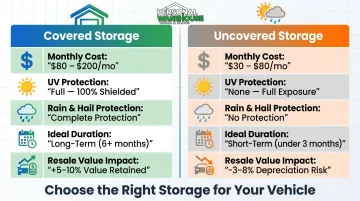
Cost data sourced from SpareFoot's U.S. marketplace data.
One important clarification: covered storage (a roof overhead, sides open) is not the same as enclosed storage (four walls, a door, typically climate-controlled). This guide focuses on the two options available at most storage facilities: covered and uncovered outdoor storage.
What Is Covered Boat & RV Storage?
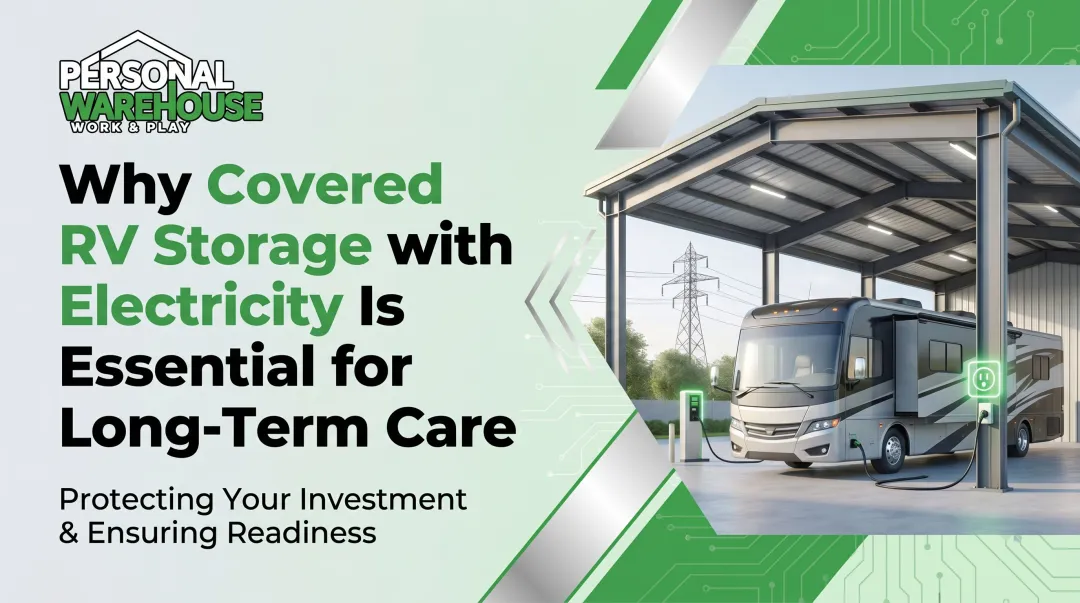
Covered storage means a designated parking space beneath a permanent overhead structure—typically metal or fabric—that shields the vehicle from above while leaving the sides open for airflow and easy access.
The Core Protection Benefit: UV Damage
The most underappreciated threat to stored RVs and boats isn't rain—it's sustained UV exposure. Sun degrades roof membranes, dries out rubber seals, fades gelcoat, chalks paint, and embrittles canvas and upholstery. Goodyear's tire guidance attributes sidewall weathering and dry rot directly to UV exposure, heat, and prolonged inactivity—conditions that outdoor storage accelerates.
States with the highest annual UV irradiance include Florida (4,596 J/m²), Texas (4,529), and Colorado (4,474). If your vehicle lives in these regions, the exposure accumulates fast.
A covered roof interrupts that direct solar load. The practical result: slower seal degradation, less frequent resealing, and paint that holds up longer between maintenance cycles.
Rain, Hail, and Debris
Covered storage also reduces exposure to direct precipitation and airborne debris. Hail is a particularly relevant risk—the Insurance Institute for Business & Home Safety identifies high hail corridors across Colorado, Texas, and the central U.S. A fabric cover won't absorb hail impact; a permanent overhead roof provides physical shielding that fabric simply can't replicate.
What Premium Covered Storage Looks Like
Basic covered storage is a canopy and a parking spot. Some facilities go considerably further.
Personal Warehouse, for example, offers fully enclosed RV and boat storage units with insulated overhead doors, all-LED lighting inside and out, and 100/150-amp electrical service. The insulation and sealed construction keep interior temperatures stable, which matters when you're doing pre-trip prep or storing a vehicle through a Montana winter.
Use Cases for Covered Storage
Covered storage is the right fit when:
- You're storing seasonally (off-season periods exceeding 3 months)
- Your vehicle is newer, high-value, or has material-sensitive components (EPDM roofs, fiberglass gelcoat, marine canvas)
- You're in a high-UV, hail-prone, or heavy-snowfall region
- Preserving resale value is a priority
- You want to reduce how often you're resealing, repainting, or replacing weathered components
What Is Uncovered Boat & RV Storage?
Uncovered storage is a designated outdoor space within a secured, fenced facility—no roof, no canopy overhead. You get organized parking, gated access, and typically surveillance, at the lowest cost.
The trade-off is direct. Without any overhead protection, your vehicle takes the full force of whatever weather comes through: UV, rain, hail, wind-driven debris, and snow loading. Over months or years, that compounds into real maintenance costs.
RV exterior repaints run $5,000–$15,000+. Boat gelcoat restorations typically cost $4,000–$10,000+, with full re-gelcoating reaching $15,000 or more. A single exterior restoration event can easily exceed two to three years' worth of the covered storage premium.
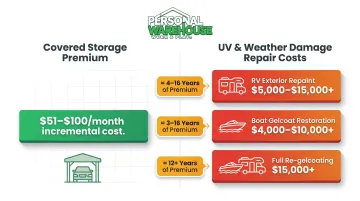
That math changes, though, when you factor in how you actually use the vehicle. Owners who get out regularly, store in mild climates, or access an older rig are often better served by spending less on storage and more on upkeep. Uncovered facilities also offer the widest access lanes and the most flexible in-and-out convenience—frequent use keeps cumulative exposure low.
Use Cases for Uncovered Storage
Uncovered storage works well when:
- You use your RV or boat regularly (every few weeks), keeping cumulative exposure low
- You're storing in a mild, low-UV climate
- The vehicle is older and the cost of premium storage may outpace the protection benefit
- Budget is the primary constraint
Making Uncovered Storage Work
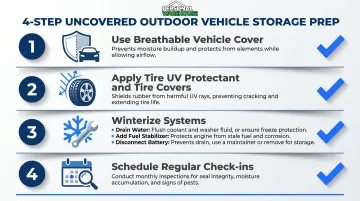
If uncovered is your choice, preparation reduces damage risk without adding monthly cost:
- Use a quality breathable vehicle cover to block UV and reduce rain contact
- Apply tire UV protectant and add tire covers to slow sidewall dry rot
- Winterize thoroughly — drain water systems, add fuel stabilizer, and disconnect batteries
- Schedule regular check-ins to catch seal failures or moisture intrusion early
Covered vs. Uncovered: Which Is Right for You?
Four factors should drive this decision.
1. Local Climate and Seasonal Severity
This is the biggest variable. Owners in Montana, Wisconsin, Colorado, and Gulf Coast states face harsher conditions than someone storing in Southern California or coastal Oregon. High UV irradiance, frequent hail, heavy snowfall, and hurricane-season storms all increase the frequency and severity of weather events that damage stored vehicles.
The higher the weather risk in your region, the faster covered storage pays for itself.
2. Frequency of Access
Owners who take their vehicle out every two to three weeks accumulate far less exposure than those storing for six months straight. If you're looking at seasonal storage exceeding three months—common for boats in northern states or RVs stored over winter—the case for covered storage grows substantially.
3. Vehicle Age, Value, and Material Sensitivity
A newer Class A motorhome or a fiberglass-hulled boat with marine canvas is far more sensitive to UV and weather than an older, lower-value vehicle. When the vehicle's resale value depends partly on exterior condition, the math on covered storage changes.
4. The Financial Reality
Run the numbers and the case for covered storage often makes itself:
- Covered storage premium over uncovered: roughly $51–$100/month based on current U.S. market ranges
- At $75/month incremental cost, a $4,500 gelcoat restoration represents about 5 years of that premium
- A $10,000 RV repaint represents over 11 years of that premium
For long-term storage in demanding climates, covered storage typically prevents at least one of these events over a vehicle's ownership life. That single avoided repair often covers years of the premium difference.
Situational Recommendations
Choose covered storage if you:
- Store for 3+ months at a stretch
- Live in a high-UV, hail-prone, or heavy-snowfall region
- Own a newer or higher-value vehicle
- Want to protect resale value with minimal maintenance intervention
Choose uncovered storage if you:
- Use your vehicle frequently and limit cumulative exposure
- Store in a mild, low-UV climate
- Are working within a tight budget
- Commit to a thorough pre-storage preparation routine
- Own an older vehicle where protection cost exceeds the benefit
One More Factor: Insurance
Some insurers offer premium adjustments for stored vehicles. National General's RV policy, for example, includes a Storage Savings Option that lets owners suspend certain coverages during off-use months. Check with your insurer before finalizing your storage decision—better storage conditions can affect your coverage costs and options. Combined with the right storage setup, these savings can further close the gap between covered and uncovered costs.
Conclusion
Neither option is universally right. Covered storage delivers measurable long-term protection benefits—especially for seasonal storage, higher-value vehicles, and regions where weather does real damage. Uncovered storage remains a financially sensible choice for frequent users, mild-climate owners, and those who pair it with solid preparation habits.
If you're in a region like Montana—where winters are serious and UV exposure accelerates fading and seal degradation—covered storage isn't a luxury. It's practical asset protection. The right call depends on your vehicle's value, your local climate, and how often you're actually pulling it out of storage.
Personal Warehouse offers covered and enclosed RV and boat storage at their Bozeman, MT location — currently under construction, with reservations open for 2026 delivery. Units include insulated overhead doors, LED lighting, and full electrical service.
To explore available options, contact the team at 303-222-0768 or info@personalwarehouse.com.
Frequently Asked Questions
Is covered RV storage worth it?
For seasonal storage—especially in regions with intense sun, heavy snowfall, or frequent hail—yes. The monthly premium over uncovered storage is typically $51–$100, while a single UV-related repair event (resealing, repainting) can run $5,000–$15,000+. For long-term storage, covered protection pays for itself.
What is the best surface to store an RV on?
Concrete or asphalt is preferred—both provide level load distribution, proper drainage, and minimal moisture wicking. Compacted gravel works as a budget alternative. Avoid bare dirt or grass, which retain moisture, cause tire sinkage, and attract pests.
How much more does covered storage cost than uncovered?
Based on current U.S. marketplace data, covered outdoor storage typically runs $125–$250/month versus $74–$150/month for uncovered—a difference of roughly $51–$100/month depending on location, vehicle size, and facility quality.
Can a good RV or boat cover replace covered storage?
Not fully. Quality covers reduce surface UV exposure and block direct rain contact, but they aren't impact structures. They won't protect against hail, wind-driven debris, or the long-term seal degradation that a permanent overhead canopy prevents. A cover is a useful supplement, not a substitute.
Does covered storage affect my insurance rate?
It can. Some insurers discount premiums for vehicles kept in covered or enclosed facilities, citing lower weather-related claim risk. Contact your provider directly to confirm whether your policy rewards better storage conditions.
What should I look for in a covered storage facility?
Key features to evaluate:
- Gated access and surveillance cameras
- Adequate height and length clearance for your specific vehicle
- Well-maintained canopy structure with no structural damage
- Electrical access, insulated doors, and on-site lighting where available
- Clean, paved or gravel surface that drains properly