

Introduction: What Separates a Great Collector's Garage From a Parking Space
Picture this: you pull open a heavy glass door, and the overhead LEDs snap on row by row, washing light across a Porsche 911 RSR on a four-post lift, a covered Ferrari below it, and a 1960s muscle car parked nose-out against a glossy floor that mirrors everything like still water.
The air smells faintly of fresh wax. There's a coffee station in the corner, a mounted display of vintage race helmets, and not a single box of holiday decorations in sight.
That's not a parking space. That's a purpose-built collector's garage.
Serious collectors have rethought what vehicle storage should be. A garage housing a $200,000 car collection deserves the same design attention as any other room in the house — more, in fact, since the stakes are higher and the equipment more demanding.
That design attention has a lot of ground to cover. This guide walks through all of it: space planning, equipment, flooring and lighting, climate and security systems, and when a home garage simply isn't enough anymore.
TLDR
- Plan 450 sq ft per bay minimum for a collector-grade layout — most enthusiasts underestimate by at least one car
- Car lifts are the highest-ROI upgrade, effectively doubling capacity without expanding the footprint
- Flooring, lighting, and climate control protect vehicle value — they're not cosmetic choices
- Trickle chargers, breathable covers, and humidity held between 35–55% RH are essential for long-term storage
- When a home garage hits its limits, owning dedicated warehouse space builds equity rather than burning money on monthly rent
Planning Your Collector's Garage: Space, Layout, and Zoning
How Much Space Do You Actually Need?
Most collectors get this wrong on the first try. A standard two-car garage — the kind that comes with most homes — measures around 20x20 feet, or 400 square feet total. That's tight for two everyday drivers. For collector use, it's almost unusable.
Experienced builders recommend 450 sq ft per bay for serious automotive work — enough to accommodate a lift footprint, full door swing, walking clearance on both sides, and room to actually move around the car. A 3-car collector layout starts at roughly 1,350 sq ft; a 6-car build should approach 3,000 sq ft minimum.
The rule of thumb: whatever number of cars you think you need space for, plan for one more. Collections grow. Equipment accumulates. That empty corner becomes a compressor station, then a parts cabinet, then eventually a second lift.
Mapping Your Functional Zones
Before thinking about equipment, map how the space will actually be used. A well-designed collector garage has four distinct zones:
- Display/parking zone — the primary floor space, optimized for visual presentation and vehicle access
- Active workshop area — near a floor drain and compressor outlet, with 240V drops and countertop workspace
- Parts and tool storage — wall-mounted systems, locked cabinets, and overhead shelving
- Lounge/viewing area — seating, display lighting, and a social space that makes the garage a destination
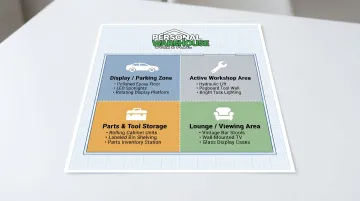
Mixing these zones without a plan creates a workspace that functions poorly as all four. The workshop bleeds into the display area; the lounge becomes a storage overflow zone. Assign each zone before a single shelf goes up.
Ceiling Height: The Decision That Can't Be Undone
Ceiling height is the most consequential design variable in any collector garage, and the hardest to fix once construction is done.
According to BendPak's published specifications, standard two-post lifts (like the XPR-10 series) require a minimum 12-foot ceiling. Four-post storage lifts are slightly more forgiving at approximately 11 feet. Taller vehicle combinations or extended-arm configurations push that to 14 feet or more.
An 8-foot ceiling — standard in residential construction — eliminates every practical lift option. At 10 feet, only specialized low-ceiling models apply. Design new builds with 12–14 foot ceilings and you retain full flexibility for both lift types and any vehicle in the collection.
Layout, Entry, and Turntables
Once ceiling height is locked in, the next call is how cars actually enter and exit. Two layout philosophies dominate: pull-through (drive in one end, out the other) and back-in. Pull-through eliminates the awkwardness of reversing a low-clearance vehicle in a tight space. Back-in layouts work when the collection is stable and cars rarely rotate.
Vehicle turntables solve maneuvering problems in deep, narrow, or column-interrupted spaces. They come in two configurations:
- Surface-mount — installs on existing concrete, faster and less expensive, creates a slight ramp to drive onto
- Pit-mount (flush) — excavated into the slab for a seamless floor surface; preferred for showroom-quality builds
Most passenger vehicle turntables require a minimum diameter of approximately 15 feet. For landmark builds like Jay Leno's 122,000 sq ft Burbank facility, the answer is clear-span construction with no interior columns — maximum flexibility, zero compromises.
Permits and Zoning: Start Early
Detached garages over 150 sq ft almost always require building permits. Structures exceeding 1,000 sq ft often trigger full site plan review and may require variances in residential districts. Setback requirements vary by municipality but commonly require 5+ feet from side and rear property lines for smaller structures, with greater setbacks for larger builds.
Consult a local contractor before finalizing any design for a large detached garage. A setback violation discovered after the foundation is poured can mean tearing out work, redesigning the footprint, or losing the build entirely.
Must-Have Equipment: Car Lifts, Charging, and Workshop Setup
Two-Post vs. Four-Post Lifts
The lift question comes up in every collector garage conversation, and the answer depends on how you use the cars.
| Lift Type | Best For | Minimum Ceiling |
|---|---|---|
| Two-post | Maintenance, oil changes, brake work | 12 ft |
| Four-post | Long-term storage, display stacking | ~11 ft |
Two-post lifts give full undercarriage access — ideal for a working garage where cars are regularly serviced. Four-post lifts are better for storage: cars sit on the platforms stably, and the second vehicle parks beneath. A two-car garage with two four-post lifts effectively becomes a four-car garage without breaking ground.
EV Charging Infrastructure
Luxury EVs now account for 31% of EV sales compared to just 3% for non-premium vehicles — EV ownership in collector demographics is already substantial and still climbing.
Plan for charging now, even if no EV is currently in the collection. A Level 2 charger runs on 240V and delivers 10–20 miles of range per hour. Key specs to build in:
- Dedicated circuit per EV bay (required per NEC Article 625)
- 32–80 amp capacity depending on charger model
- Panel headroom for future expansion
A single outlet won't cut it as collections evolve — wire for multiple bays from the start.
Workshop Essentials and Battery Maintenance
Once charging infrastructure is sorted, the workshop layout deserves the same level of planning. Get these elements right from the start:
- Compressed air — wall-mounted reel with 3/4" supply line
- Floor drain — essential for washing and fluid management
- 240V outlets — multiple drops for welder, lift, press, and tools
- Stainless countertop — chemical-resistant workspace
- Wall-mounted tool storage — slatwall or French cleat systems keep the floor clear
On battery maintenance: AAA recommends a battery maintainer for any vehicle stored beyond 45 days. Lead-acid batteries develop sulfation after months without a charge — crystalline buildup that permanently reduces capacity. Trickle chargers cost $30–80 and prevent hundreds of dollars in battery replacement. Any serious collector garage should treat them as standard equipment.
Interior Design: Flooring, Lighting, and the Showroom Aesthetic
Flooring: Why Polyaspartic Wins
The collector garage flooring debate between polyaspartic and epoxy is settled. Polyaspartic outperforms on every metric that matters:
| Attribute | Polyaspartic | Epoxy |
|---|---|---|
| Cure time | 4–6 hours | 3–5 days |
| Durability | 4x stronger | Standard |
| Abrasion resistance | 10x better | Lower |
| UV stability | 100% stable | Yellows over time |
| Chemical resistance | Non-porous | Microscopically porous |

A sealed, glossy floor does two things simultaneously: it protects the concrete from oil and chemical penetration, and it reflects light across the entire space — making the garage feel larger, brighter, and noticeably more finished than bare concrete.
Lighting: The Difference Between a Garage and a Showroom
Lighting is what separates a "nice garage" from something that looks like a showroom. The approach should be layered:
- Overhead LED pot lights at 4,000K color temperature for clean, neutral ambient brightness
- LED strip lighting under cabinets and along slatwall for depth and visual separation
- Individual spotlights over each display vehicle, ideally at 90+ CRI to accurately render paint metallic flake and chrome
High-CRI lighting reveals the details that make a car worth looking at. Low-CRI lighting makes those same surfaces look flat and lifeless. For collectors displaying vehicles worth six figures, this distinction matters.
Wall Systems and the Lounge Area
Ralph Lauren's D.A.D. Garage — a 48,000 sq ft, two-story facility in Westchester County, NY — demonstrates the ultimate display philosophy: white platforms raised exactly one foot above a black floor, walls color-matched, and the space kept entirely empty except for the vehicles themselves. Each car becomes sculpture.
Most collectors can apply the same principle at smaller scale: a high-contrast floor, minimal visual clutter on the walls, and lighting that draws the eye to the cars rather than the infrastructure around them.
The functional side of the wall system typically includes:
- Slatwall panels for tools, bikes, and accessories
- Custom cabinetry with locking drawers for chemicals, documentation, and valuables
- Stainless countertop and utility sink for detailing and maintenance work
The lounge area is what makes the garage a destination rather than a utility space. A mounted 4K display, comfortable seating, a small bar or coffee station, and room for a private showing turn a storage space into something worth inviting people into — and it's the detail that makes guests remember the visit.
Climate Control, Security, and Preservation Systems
Humidity and Temperature: The Numbers That Matter
Vehicle preservation hinges on one metric more than any other: relative humidity. Metal corrosion rates climb measurably once humidity exceeds 50%. Research from Cotes and Racing Green Car Storage points to a recommended storage range of 35–55% RH, with 50% as a practical ceiling.
Below 35%, leather and rubber dry and crack. Above 55%, corrosion begins. That narrow band demands active management in nearly every US climate — a portable dehumidifier won't cut it for long-term storage. Collectors in Montana, Michigan, Wisconsin, Florida, Georgia, and the Carolinas need dedicated HVAC with dehumidification built in.
Neglecting humidity control carries documented risks:
| Component | Risk |
|---|---|
| Metal surfaces | Rust and corrosion above 50% RH |
| Leather | Mold (high humidity), cracking (low humidity) |
| Rubber seals | Cracking from expansion/contraction cycles |
| Paint | Condensation spotting and oxidation |

Security: Layered and Low-Cost
A comprehensive security approach for a high-value garage doesn't require a massive budget:
- Smart cameras with motion detection and smartphone access
- Monitored alarm system tied to the entry and overhead doors
- Smart garage door monitoring (MyQ-style controllers add remote open/close and real-time alerts for under $30)
- Motion-activated exterior lighting — passive deterrence that's often more effective than active systems
- Limit exterior window visibility — the most underrated security measure; what thieves can't see, they don't target
Once the space is secured, attention shifts to the vehicles themselves — and a few low-cost habits prevent the most expensive collector car damage.
Vehicle-Specific Preservation
- Breathable car covers for any vehicle stored more than two weeks (solid covers trap moisture underneath)
- Tire cradles or flat-stop pads for anything sitting beyond a month — tires flat-spot faster than most owners expect
- Add fuel stabilizer for seasonal storage beyond three months; gas degrades and leaves gum deposits throughout the fuel system
- Trickle charger on every stored vehicle — both lead-acid and lithium batteries degrade during extended inactivity
When Your Home Garage Isn't Enough: Ownable Collector Storage
Every serious collector eventually hits the wall. The collection has grown past the home garage's capacity. The HOA has opinions about the new six-car detached structure. The zoning setbacks won't allow the building footprint you actually need. Or the desire for a dedicated workspace — one that doesn't share square footage with lawn equipment and holiday boxes — becomes non-negotiable.
Most collectors turn to rented commercial storage at that point: monthly fees, shared spaces, limited customization, and zero equity accumulation. It's a cost that compounds for years while building nothing. Ownership changes that equation entirely.
An owned warehouse space can be fully customized — proper LED lighting, car lifts, HVAC with dehumidification, workshop setup, a lounge area — and it appreciates as an asset rather than draining value as an expense.
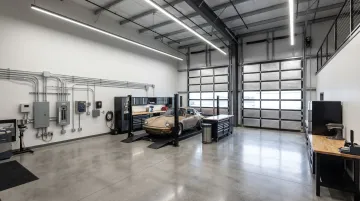
Personal Warehouse develops ownable, customizable warehouse spaces built for this kind of application. Standard features include:
- All-LED lighting and superior insulation throughout
- Fully heated interiors with optional air conditioning
- Heavy-duty insulated overhead doors rated for frequent daily use
- 100/150-amp 3-phase electrical service supporting lifts, Level 2 EV chargers, and workshop equipment simultaneously
- Optional mezzanine add-ons that expand usable space by up to 30%, separating the vehicle floor from an upper lounge or parts storage area
The Bozeman, MT project is under construction with delivery expected in 2026. Additional projects are in development across Texas, Georgia, Florida, and several other states. Financing is available through preferred lenders on terms comparable to residential loans, and the 99-year ground lease structure supports long-term stability and strong resale value.
For collectors evaluating owned storage, the practical checklist:
- Proximity to home — frequent access matters; a space you don't visit becomes neglected
- Ceiling height and door dimensions — confirm compatibility with your specific lift requirements before committing
- Power capacity — verify the electrical service supports your full equipment list simultaneously
- Community context — collector-focused storage developments where multiple enthusiasts co-locate create a social environment that mirrors the best private clubs
Frequently Asked Questions
What's the average cost to build a 24x24 garage?
A basic 24x24 (576 sq ft) detached garage runs $19,200–$33,600, according to HomeAdvisor 2025 data. Collector-grade builds with HVAC, polyaspartic flooring, car lifts, and proper electrical typically reach $40,000–$70,000+ for the same footprint, with regional costs and finish level pushing that figure higher.
Is it cheaper to build a garage or buy a kit?
Prefab kit garages cost $5,000–$30,000 and install quickly, but offer limited customization. Stick-built or steel-frame construction runs $35–$90 per sq ft with full architectural flexibility. For collector garages needing 12+ foot ceilings, reinforced slabs, and HVAC, stick-built is almost always the better call.
How do people store their car collections?
Serious collectors use dedicated home garages with lifts, rented luxury storage facilities, or owned warehouse spaces. Wherever the vehicle lives, trickle chargers, climate control, and breathable covers are baseline requirements for any car stored more than a few weeks.
What should not be stored in a garage with collector cars?
Avoid propane tanks, excess flammable materials, large amounts of cardboard (attracts rodents and insects), and any chemicals that off-gas — including certain paints and solvents — which can damage paint finishes and leather interiors over time.
What are the latest garage trends?
The most prominent trends right now: EV charging integration as standard infrastructure, vehicle turntables for tight or multi-car layouts, smart access and monitoring technology, showroom-quality polyaspartic flooring, and garage-lounge hybrid spaces that function as entertainment destinations — not just vehicle storage.