

The tension is real: as collections grow, standard layouts fall short. According to data cited by Garage Living, 25% of people with two-car garages don't park any cars in them, and 50% of homeowners call the garage the most disorganized space in their home. For a collector, disorganized storage isn't just inconvenient — it's a threat to vehicle value.
This guide covers the five best garage storage solutions for car collectors: car lifts, wall systems, heavy-duty cabinets, overhead racks, and protective flooring with climate control. It also covers when a home garage simply isn't enough.
TL;DR
- Car collectors need storage that protects vehicle value, maximizes floor space, and enables safe access
- The five best solutions: car lifts, slatwall systems, premium steel cabinets, overhead racks, and sealed flooring with climate control
- Vertical solutions (lifts and overhead racks) add capacity without expanding your footprint
- Humidity above 60% triggers mold growth on vehicle surfaces, so climate control belongs in every serious collector's setup
- Dedicated warehouse ownership is a scalable next step when the home garage runs out of room — and it builds equity over time
Why Car Collectors Need Specialized Garage Storage
Standard residential garages are engineered for two or three daily drivers. They're not built for vehicles that require controlled environments, organized tool access, or room to maneuver a four-door classic without scratching the doors.
Poor garage storage creates specific, compounding risks for collector vehicles:
- Moisture from concrete floors causes underbody rust through vapor transmission — bare slabs are porous and never truly dry
- Humidity above 60% RH accelerates mold and mildew growth on leather, cloth, and rubber components, according to climate control manufacturer Munters
- Temperature swings crack rubber seals, degrade vinyl, and cause condensation on metal surfaces
- Unsecured tools and supplies become scratch hazards the moment a car door swings open in a cluttered bay

Storage conditions also affect what your policy will actually cover. Hagerty requires collector vehicles to be kept in enclosed, secure structures — carports may be acceptable in some states, but driveway storage is prohibited in California, Colorado, Florida, and Hawaii. Inadequate conditions can affect claims.
Each solution below targets one of these four risk categories: space, organization, protection, or security.
Best Garage Storage Solutions for Car Collectors
These solutions were selected for their ability to maximize usable space, protect vehicle condition, and complement a serious collector's setup — not generic garage use.
Car Lifts
A four-post car lift is the single highest-impact upgrade a collector can make. It effectively doubles parking capacity by stacking one vehicle above another in the same footprint — turning a two-car garage into a four-car setup without adding a single square foot.
Four-post vs. two-post:
- Four-post lifts are preferred for long-term storage; the vehicle drives onto a platform, keeping it stable for weeks or months at a time
- Two-post lifts provide full undercarriage access, making them better suited for maintenance and repair
Ceiling height is the deciding constraint. Four-post lifts for vehicle stacking typically require 10 feet of clearance minimum, while standard two-post lifts need at least 12 feet. The formula: lift height + vehicle height + 6-inch buffer = minimum ceiling needed.
| Category | Details |
|---|---|
| Best For | Long-term storage of seasonal or rarely driven vehicles; expanding a 2-car garage to 4-car capacity |
| Key Specs | Ceiling clearance (10–12 ft), weight capacity (6,000–9,000 lbs typical), platform surface protection for low-clearance vehicles |
| Price Range | $5,500–$6,100+ for residential 4-post lifts (BendPak HD-9 starts at $6,095; Challenger CL4P9S at ~$5,592) |
Slatwall and Pegboard Wall Systems
Empty wall space is wasted storage in any collector's garage. Slatwall panels and heavy-duty pegboard convert those surfaces into organized storage for tools, detailing supplies, helmets, hoses, and accessories — without touching the floor.
Slatwall has a clear advantage for collector use. Quality PVC panels like those from Proslat are rated to hold up to 75 lbs per square foot when mounted on 16-inch stud centers, and their interchangeable hooks and bins let you reconfigure the layout as tools or vehicles change over time.
| Category | Details |
|---|---|
| Best For | Tool organization, detailing supplies, helmets and gear, hoses and cables |
| Key Features | Interchangeable hooks and accessories, weight-rated panels (50–75 lbs/sq ft), moisture-resistant PVC materials |
| Installation | Wall-mounted; works on drywall or concrete with appropriate anchors |
Heavy-Duty Garage Cabinets
Premium steel cabinets are essential for collectors who need secure, organized storage for spare parts, maintenance supplies, detailing chemicals, and small valuables. The difference between professional-grade and budget options isn't just cosmetic.
Key quality markers to look for:
- Steel gauge — premium cabinets use 18-gauge steel; budget versions use 24-gauge, which is roughly 7/8 the scale and noticeably less rigid
- Drawer slides — look for full-extension ball-bearing slides rated at 200+ lbs capacity
- Powder coat finish — resists moisture and chemical spills common in working garages
- Lockable doors — critical for securing expensive components and chemicals
Entry-level cabinet sets start around $1,500–$2,500 for budget-tier options. Professional-grade systems from NewAge Products run $3,699–$5,299 for 8–12 piece sets in 18-gauge fully welded steel.
| Category | Details |
|---|---|
| Best For | Secure storage of parts, chemicals, tools, and collectible accessories |
| Quality Markers | 18-gauge steel, ball-bearing drawer slides (200+ lb rating), powder coat finish, locking doors |
| Price Range | $3,700–$5,300 for professional-grade sets; budget options from $1,500 |
Overhead Storage Racks
Ceiling-mounted racks are one of the most underused tools in a collector's garage. They move bulky, infrequently accessed items — seasonal tire sets, car covers, storage bins, spare parts — completely off the floor, freeing prime real estate for the vehicles themselves.
A few installation considerations matter specifically for collectors:
- Mount to ceiling joists rated for the load (not just drywall anchors)
- Choose adjustable-height systems — the Fleximounts MAX Series, for example, adjusts from 22 to 40 inches below the ceiling
- If you also have car lifts, verify that ceiling height remains workable in the same bay; stacking overhead racks and a lifted vehicle requires careful planning
| Category | Details |
|---|---|
| Best For | Seasonal tire sets, car covers, detailing equipment, overflow storage bins |
| Key Specs | 400–600 lbs capacity per rack is typical; Fleximounts MAX Series handles 500 lbs from 14-gauge cold-rolled steel |
| Compatibility Note | Verify ceiling clearance if car lifts are installed in the same bay |
Protective Flooring and Climate Control
For collector cars, the garage floor and environment matter as much as the storage systems above them. Bare concrete is porous and transmits moisture vapor continuously — American Collectors Insurance specifically recommends placing a moisture barrier beneath stored vehicles to prevent underbody rust.
Flooring options:
| Epoxy | Polyaspartic | |
|---|---|---|
| Cure Time | 24–72 hours | 2–6 hours |
| Lifespan | 5–10 years | 10–20+ years |
| UV Stability | Yellows over time | 100% UV stable |
| Cost | $3–$7/sq ft | $5–$12/sq ft |
Polyaspartic coatings cost more upfront but outperform epoxy on durability, flexibility, and chemical resistance — worth the premium for a working collector's garage.
Climate control:
Munters recommends maintaining 45–50% relative humidity for classic car storage. Above 60% RH, mold begins growing on leather and cloth. Practical options layered by budget:
- Portable dehumidifier — lowest cost, most flexible, adequate for moderate climates
- Mini-split HVAC — a 12,000 BTU unit covers roughly 450–550 sq ft; a typical 2-car garage needs 12,000–18,000 BTU
- Radiant floor heating — ideal for cold climates; hydronic systems run $10–$25 per square foot installed and eliminate drafts that circulate dust onto paint
How to Choose the Right Garage Storage Setup
Start with your biggest constraint — floor space, organization, vehicle protection, or security — because solving the wrong problem first wastes both money and space.
The most common collector mistake: prioritizing aesthetics over function. Beautiful cabinets that block the access path to a lift defeat their own purpose.
Planning sequence that works:
- Measure ceiling height first — this determines whether lifts are viable before anything else is planned
- Map vehicle footprints and access paths — plan floor space around how you actually move around the cars
- Assign wall and overhead zones — slatwall and ceiling racks fill the vertical space after vehicles are positioned
- Select cabinets and organizational systems — fill remaining gaps without blocking access paths
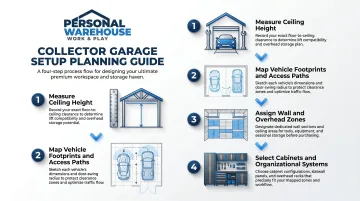
Two non-negotiables regardless of garage size:
- Climate control — humidity management protects rubber, leather, paint, and metal on every vehicle, every season
- Security — lockable cabinets, secure doors, and proper enclosure affect both vehicle safety and insurance eligibility
Modularity matters more than most collectors expect. Collections change — a new vehicle gets added, a lift replaces a flat bay, a parts room becomes a lounge. Systems that adapt without a full teardown include:
- Slatwall panels that reconfigure without tools
- Modular cabinet sets that expand with additional pieces
- Open bays that can accommodate a second lift later
Fixed, single-purpose installations tend to become obstacles the moment the collection shifts.
When Your Home Garage Reaches Its Limits
An optimized home garage will eventually hit hard limits. For collectors managing four or more vehicles, large restoration projects, or climate-sensitive cars requiring consistent year-round conditions, the garage runs out of ceiling height, floor area, or electrical capacity well before the collection does.
Renting commercial storage fills the gap temporarily, but the math erodes over time. Climate-controlled car storage runs $100–$450 per month depending on the market — in Los Angeles, a 10' x 20' unit runs approximately $300/month. That's $3,600 per year with no resale value, no customization rights, and no equity.
Owning a dedicated warehouse unit is a different calculation entirely. Personal Warehouse builds ownable spaces with collectors in mind — with features like:
- Mezzanines that expand usable area by up to 30%
- 100/150-amp 3-phase electrical service — enough to run lifts, compressors, and climate systems simultaneously
- All-LED lighting inside and out
- Insulated overhead doors with superior insulation and heating standard
- Optional HVAC for full climate control
- 99-year ground lease structure that supports equity-building and resale value

The Bozeman, MT project is currently under construction and accepting reservations for 2026 delivery.