

Introduction: The Car Condo Market Is Having a Moment
Introduction: The Car Condo Market Is Growing Fast
For serious collectors and enthusiasts, the home garage has hit its limit. Traditional self-storage was never designed with a $150,000 Porsche in mind — and the market is responding with something built specifically for that gap.
Car condos — individually owned, deed-held storage units built for vehicles and hobby use — are moving from niche curiosity to a recognized real estate category.
New projects are advancing through planning commissions in suburban Chicago, Minnesota, Houston, Phoenix, and California, reflecting demand that is both national and accelerating.
This article covers the latest developments making headlines, what's fueling national demand, the full spectrum of features and price points available today, and who the buyers actually are.
TLDR: Key Takeaways
- Car condos are individually owned storage units — not rentals — designed for vehicles, workshops, and hobby use
- New projects range from $185,000 entry-level units in Minnesota to $2 million trackside packages in Arizona
- Buyers include collectors, retirees, small business owners, and RV/boat owners — all choosing ownership over monthly rental
- 230+ garage condo sales closed in Minnesota's Twin Cities metro in 2024, with prices reaching $1.25 million
- Premium facilities now treat community amenities like clubhouses, track days, and social events as standard offerings
Latest Car Condo Developments Making Headlines
The pace of new project announcements in 2024–2025 tells a clear story: this category is accelerating.
Suburban Chicago and the Minnesota Surge
In Illinois, the BeSpoke Group has proposed a luxury automotive storage facility at the Arboretum of South Barrington — a development featuring one- and two-story temperature-controlled condominiums, a rooftop lounge, and a swimming pool. The project went before village officials for formal public review in January 2025.
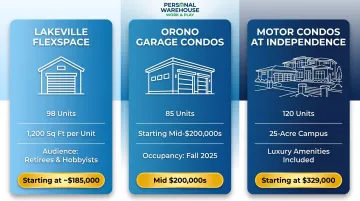
Minnesota, meanwhile, has become the national benchmark for this category, with 59 developments across 48 cities — more than any other state. Three projects illustrate the price range available within a single metro market:
- Lakeville Flexspace LLC — 98 units across four buildings (118,125 sq ft total); 1,200 sq ft shell units priced around $185,000, targeting retirees, hobbyists, and small business owners
- Orono Garage Condos — 85 units in five buildings, starting in the mid-$200,000s, with occupancy targeted for fall 2025
- Motor Condos at Independence — 120 units across eight buildings on a 25-acre campus, with units starting at $329,000 and luxury home-grade amenities throughout
The Luxury and National Picture
At the high end, Apex Motor Club in Maricopa (Phoenix metro) is breaking ground on trackside condos and a clubhouse under new ownership. Their headline offering is a $2 million package that includes:
- A new McLaren supercar
- $250,000 in condo customization
- 40 hours of professional driver coaching
- Entry into the Apex Challenge racing series, plus a custom race suit, helmet, and three years of annual dues
Finish Line Auto Club continues expanding in California, with existing locations in Westlake Village, Costa Mesa, and Calabasas. Palm Desert is next, followed by a Scottsdale facility slated to open in 2026.
In Texas, Toy Cave Garages in Houston is selling 64 units (1,362–2,000 sq ft with mezzanines) featuring an F1 racing simulator, clubhouse bar and kitchen, high-pressure detailing stations, and a Founder's Club for the first 15 owners.
As Autoweek reported in October 2025, "The Car Condo Concept Is Still Growing" — and buyers entering the market now are doing so ahead of the next wave of price appreciation.
Why Luxury Automotive Storage Is Growing Nationwide
Three forces are driving demand for luxury automotive storage — and the data behind each one is hard to ignore.
The Ownership vs. Rental Distinction
Traditional self-storage was built around a simple transaction: pay monthly, access your stuff, build zero equity. Car condo buyers are rejecting that model entirely. They want a deeded asset — something that can appreciate, be sold, or generate rental income from other enthusiasts.
The gap between the two models is widening, partly because cities are actively restricting conventional self-storage. At least 15 states have imposed moratoriums or bans on new self-storage development since 2020, citing aesthetics, oversupply, and lack of economic value. Car condos — commercially zoned, ownership-model real estate — fall into a different regulatory category entirely.
The Collector Car Demographic
According to Hagerty, the collector car market is larger — and wealthier — than most people realize:
- ~43 million collector vehicles registered in the U.S., with an estimated $1 trillion in insurable value
- 69 million self-identified car enthusiasts nationwide
- Average enthusiast age: 56 years old, with 20+ years in the hobby
- Average annual income: $144,000
- Typical ownership: two fun-to-drive vehicles on top of daily drivers

That's a demographic that needs serious, secure, long-term storage — and