

Most collectors never reach that scale, but the planning principles are identical whether you're housing three cars or thirty. The challenge is knowing where to start: how much space you actually need, which features are non-negotiable, and how to build something that functions as a workshop and feels like a showroom.
This guide covers everything — from foundation specs and ceiling heights to climate control, security, and luxury upgrades — so you can build (or buy) a collector's garage that protects your investment and reflects your passion.
TL;DR
- Plan 12x24 feet minimum per vehicle for a proper collector's setup with circulation space
- Design for at least 14-foot ceilings to accommodate any car lift type
- Maintain 45–50% relative humidity — moisture damages classic cars faster than almost any other threat
- Polyurea floor coatings outperform epoxy on every metric that matters for collectors
- Security systems must meet insurer requirements, so check with Hagerty or Grundy before you build
Planning Your Collector's Garage: Space, Size, and Location
How Much Space Do You Actually Need?
The commonly cited 10x20-foot minimum gets cars in the door, but it leaves no room to work or walk around them. For collector use, 12x24 feet per vehicle is the proper planning benchmark — enough for door-swing clearance, walk-around access, and basic detailing work.
Scale that up:
| Collection Size | Minimum Floor Space | Notes |
|---|---|---|
| 2 cars | ~600 sq ft | Add circulation aisle |
| 4–6 cars | 1,200–1,800 sq ft | Workshop zone feasible |
| 10+ cars | 3,000+ sq ft | Dedicated wash bay viable |
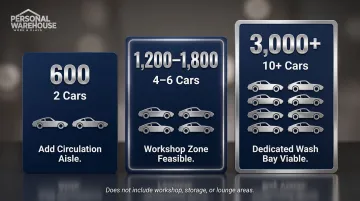
These figures don't include workshop areas, storage walls, or a lounge — plan those as additional square footage on top of parking stalls.
Attached, Detached, or Off-Site?
Each option has real trade-offs:
- Attached garage: Convenient, but zoning and HOA rules often cap size. Fire separation requirements under IRC Section R302.6 mandate at minimum ½-inch gypsum board on garage walls adjacent to living spaces — and 5/8-inch Type X gypsum board beneath habitable rooms.
- Detached structure: More flexibility, but requires its own utility connections and separate electrical service. Many jurisdictions require permits for structures over 250 square feet.
- Off-site facility: Best option for larger collections. No residential size restrictions, professional-grade infrastructure, and no neighbors complaining about compressor noise at 7am.
For collectors who want an off-site ownership option without managing construction from scratch, Personal Warehouse offers units you buy outright — not rent — with built-in LED lighting, high-efficiency insulation, and insulated overhead doors. Their Bozeman, MT project is currently under construction and accepting reservations for 2026 delivery, with optional mezzanines that expand usable space by up to 30%.
Why Ceiling Height Is Non-Negotiable
Ceiling height determines which lift types you can install — and that decision affects everything from workflow to storage capacity.
| Lift Type | Minimum Ceiling Height |
|---|---|
| Scissor/portable | 8–10 ft |
| Two-post (low-profile) | 9.5–11 ft |
| Two-post (standard) | 11–12 ft |
| Four-post (standard) | 12–14 ft |
Design to 14 feet minimum. That accommodates any residential lift type and gives you flexibility if your collection evolves. A four-post lift doubles your effective parking capacity without expanding your footprint — a meaningful advantage when land is limited.
Flooring, Doors, and Structural Foundations
Floor Coatings: Polyurea vs. Epoxy
Raw concrete is a non-starter for a serious collector's garage. It absorbs oil, stains permanently, and looks exactly like what it is — an unfinished slab. The choice comes down to two coating systems:
| Feature | Epoxy | Polyurea |
|---|---|---|
| Cost per sq ft | $4–$10 | $5–$12 |
| Lifespan | 5–10 years | 20+ years |
| Cure time (vehicle traffic) | 2–7 days | 24 hours |
| UV resistance | Yellows over time | Stable |
| Impact resistance | Moderate | 5x stronger than epoxy |

Polyurea's faster cure and longer lifespan cost less over 20 years, even at a higher initial price. For a collector who can't afford a vehicle sitting outside for a week while epoxy cures, that cure time difference alone often settles the decision.
Overhead Doors: Insulation Matters More Than You Think
The garage door is both the primary security point and the biggest thermal weak spot in the building envelope. Standard polystyrene-insulated doors achieve R-6.3 to R-9.05. Premium polyurethane triple-layer doors reach R-12.9 to R-18.4 — a meaningful difference when you're running HVAC year-round.
For climate-controlled collector garages, specify polyurethane-core doors. Budget roughly $900 on the low end; premium options like Clopay's Intellicore line exceed $2,500 per door but offer better insulation and a quieter, more rigid panel.
Foundation Requirements for Car Lifts
BendPak's installation requirements are unambiguous: lifts must be installed on poured concrete only. Minimum specs for a standard residential lift:
- Thickness: 4.25 inches (existing slab); 12 inches for new construction
- Compressive strength: 3,000 PSI minimum; 4,000 PSI for new pours
- Reinforcement: Rebar at 12-inch spacing; Grade 60 deformed bars for new slabs
- Anchor placement: Minimum 6 inches from any expansion seam or control joint
If you're building new, spec the slab correctly from the start. Retrofitting a heavier slab under an existing structure is expensive and disruptive. Get the foundation right, and everything built on top of it — flooring, doors, lifts — performs the way it should.
Climate Control, Lighting, and Vehicle Preservation
The Real Threat to Classic Cars
Temperature swings and humidity cause more damage to collector vehicles than most owners realize. Uncontrolled moisture corrodes metal, deteriorates rubber seals, and promotes mold on leather interiors. Munters recommends maintaining 45–50% relative humidity for classic car storage. The Canadian Conservation Institute adds that dropping storage temperature by just 5°C halves the chemical degradation rate of rubber and plastics.
Target conditions for a collector's garage:
- Humidity: 45–50% RH year-round
- Temperature: Cool and stable — avoid fluctuations more than the setpoint itself
- Air quality: Minimal dust circulation (avoid forced-air systems that blow debris onto paint surfaces)
Climate Control Options
| System | Best For | Notes |
|---|---|---|
| Mini-split HVAC | Year-round heating and cooling | ~$3,500 average installation; both heating and cooling in one unit |
| Radiant floor heating | Cold climates, new construction | $10–$25/sq ft; silent, draft-free, no dust circulation |
| Standalone dehumidifier | Any setup | Low-cost addition; essential regardless of primary HVAC choice |
Mini-splits handle both heating and cooling without ductwork, making them the practical choice for retrofits. Radiant floor heating is the premium option for new builds: silent, even warmth with zero dust movement. Either way, add a standalone dehumidifier. It's the single most cost-effective preservation investment in the building.

Lighting Design for Collectors
Lighting serves two distinct functions in a collector's garage, and mixing them up leads to poor results on both fronts:
- Task lighting: Directional, high-output fixtures positioned over lift areas, workbenches, and engine bays
- Display lighting: Ambient LED strips along the perimeter, track lighting highlighting vehicle contours
For accurate paint assessment and detailing work, use 5000K–6500K LED lighting with a CRI above 90. This range simulates natural daylight and reveals paint defects that warmer lighting conceals. Install UV-blocking window film on any glass — UV radiation can be blocked by more than 99% with quality film — and avoid south-facing windows where possible.
Electrical Planning
A collector's garage needs far more electrical infrastructure than a standard residential garage. Purpose-built units like Personal Warehouse spaces include 100/150-amp 3-phase service as a baseline, which is the right starting point for heavy equipment. If you're building from scratch, plan for:
- 220-volt circuits for welding equipment, air compressors, and lifts
- Multiple dedicated 110-volt circuits to avoid nuisance tripping
- A licensed electrician assessment of panel amperage capacity before any work begins
Functional Workshop Features Every Serious Collector Needs
The Car Lift: Most Transformative Single Upgrade
A two-post or four-post lift does three things simultaneously: provides complete undercarriage access, enables safer work than floor jacks, and stores a second vehicle overhead when used for stacking. Standard residential lifts handle 7,000–10,000 lbs — sufficient for most collector cars. Heavy SUVs, trucks, or vintage commercial vehicles require 12,000+ lb capacity models.
Ceiling height requirements apply directly here — design to 14 feet and every lift option stays on the table.
Wash Bay and Workshop Essentials
A dedicated wash bay prevents detailing contamination from migrating into mechanical work areas. At minimum, it needs:
- Central floor drain with proper slope
- Moisture-resistant wall finishes (FRP panels or tile)
- Hot and cold water supply
- Pressure washer hookup and retractable hose reel
If a full wash bay isn't feasible, a deep utility sink and a commercial-grade workbench with integrated power strips handle most daily needs. Don't underestimate the workbench — a mounted vise, organized tool storage, and a proper work surface transform how efficiently you can use the space.
Storage Systems
Floor-to-ceiling steel cabinetry and wall-mounted slatwall panels keep a multi-vehicle garage from devolving into chaos. When working on three cars at once, knowing where every tool lives prevents a 10-minute job from stretching into an hour-long search.
Quality storage also makes the space look intentional — which matters when you're showing the collection. A few high-impact additions:
- Steel cabinetry: Locks away fluids, filters, and consumables; reduces clutter at floor level
- Slatwall panels: Flexible, reconfigurable tool storage without permanent wall damage
- Parts cart or rolling cabinet: Keeps project-specific hardware together and mobile
Luxury Upgrades and Showroom Display Ideas
The line between a nice garage and a genuine showroom comes down to a few specific choices.
Display features worth considering:
- Rotating car turntable — allows full 360° display and eliminates the need to back vehicles in. Manufacturers like Carousel USA and Carturnx serve the residential collector market with customizable platforms
- Glass walls or showroom windows connecting the garage to adjacent living spaces
- Custom floor emblems — brand logos or personalized insignia embedded in the coating
Serious collectors also build out the lounge side of the space:
- Premium audio system
- Large-format TV for racing content
- Lounge seating with a beverage fridge or wet bar
- Racing simulator setup
Jerry Seinfeld's Manhattan facility includes billiards and a full kitchen in adjacent spaces. The garage stops being storage and becomes a place people actually want to spend time.

Theme and memorabilia give the space cohesion. Vintage neon signs, period-correct gas pump replicas, and decade-specific automotive posters create a gallery atmosphere. Choosing a theme — American muscle, 1960s Italian sports cars, pre-war European — makes the décor feel curated rather than accumulated.
Protecting Your Investment: Security Systems
Essential Security Layers
Insurance providers have clear expectations. Hagerty requires vehicles stored in enclosed, secure structures; non-garage alternatives require 24-hour security via alarm, guard, or video surveillance. Grundy requires a locked garage, full stop. Build your security system to meet or exceed these requirements before finalizing any construction plans.
Cover these bases for a high-value collection:
- Cameras: Minimum 4MP resolution for reliable license plate and face capture; 4K (8MP) cameras at entry points for enhanced night performance
- Motion-activated exterior lighting covering all approach paths
- 24/7 monitored alarm system linked to a professional monitoring service
- Smart garage door openers with audit logs (LiftMaster's myQ platform provides remote access and activity tracking)
- Keypad or biometric entry at secondary access points

Don't overlook reinforced door frames and hardened locking hardware. Cameras record what happened; physical barriers stop it from happening in the first place.
Frequently Asked Questions
What is the average cost to build a 20x20 garage?
A detached 20x20 garage (400 sq ft) typically runs $31,000–$39,000 for basic construction. National averages for a 24x24 structure land around $52,830 — but collector-grade builds with climate control and lift-ready foundations push costs significantly higher depending on region and finish level.
Can you build a garage for $10,000?
A $10,000 budget might cover a bare metal shell kit, but it won't touch site prep, foundation, electrical, insulation, or finishing. A collector-grade garage realistically starts at $30,000–$40,000 for modest builds and climbs quickly once specialty features are added.
How much space do I need per car in a collector's garage?
A single stall requires 10x20 feet at minimum, but a collector's garage should allocate 12x24 feet or more per vehicle to accommodate door clearance, walk-around access, and any detailing or service work. Add further square footage for dedicated workshop or wash bay zones.
What type of flooring is best for a car collector's garage?
Polyurea or epoxy coatings over raw concrete. Polyurea is the stronger choice — it resists oil stains, cures in 24 hours, lasts 20+ years, and won't yellow under UV exposure the way epoxy does. The higher upfront cost is typically recovered within a few years compared to replacing a degraded epoxy floor.
Do I need a permit to build a garage for car storage?
Yes, in virtually every jurisdiction. Most collector garages far exceed the rare 120 sq ft exemption threshold. Expect separate inspections for foundation, framing, electrical, plumbing (wash bay), and HVAC. Check local zoning rules and HOA covenants before breaking ground — not after.
What is the best climate control option for protecting classic cars?
A mini-split HVAC system for temperature regulation combined with a standalone dehumidifier targeting 45–50% RH. For new construction in cold climates, radiant floor heating is worth the premium — silent, even warmth with no dust circulation to threaten paint surfaces.